


Elixir Grounded Worldwide After Fatal Test Flight Crash Claims Two Pilots
By Garth Calitz

EASA suspends all Elixir operations following fatal Rochefort crash as investigators search for answers

Elixir Aircraft, one of Europe's newer general aviation manufacturers, has been dealt a devastating blow following the death of two of its production test pilots in a crash in France on 1 October. The accident, involving an Elixir aircraft during a test flight near Rochefort-Saint-Agnant Airport in western France, has prompted an immediate grounding of the entire Elixir fleet, with the European Union Aviation Safety Agency (EASA) issuing an Emergency Airworthiness Directive suspending all flight operations of the type from 3 October. The directive applies across the fleet while investigators work to establish what caused the accident and whether any aspect of the aircraft or its operation could represent a wider safety concern. At this stage, there is no confirmed cause, and it is important not to turn an ongoing investigation into a verdict before the evidence is available.

The accident occurred during a flight involving an aircraft operated by Elixir Aircraft itself, with the two occupants identified as production test pilots employed by the manufacturer. The aircraft crashed near Rochefort in the Charente-Maritime region, with the wreckage ending up inside the perimeter of the adjoining French Air and Space Force Base 721. Both pilots were killed, while there were no reported additional casualties or significant damage to the military installation. The precise circumstances remain under investigation, and authorities have not yet identified a definitive technical or operational cause. That is particularly important in this case because the aircraft was being operated as part of a professional flight-test programme, meaning investigators will examine not only the aircraft itself but also the purpose of the flight, its test profile, recent maintenance, configuration and the procedures being followed.
The regulatory response was swift. Elixir Aircraft issued an Alert Service Bulletin on 2 October instructing operators to immobilise the fleet as a precaution while information was gathered by the relevant authorities. EASA followed with Emergency Airworthiness Directive 2026-0191-E, issued on 2 October and effective from 3 October, formally suspending all Elixir flight operations. The decision applies to the complete fleet rather than a particular aircraft, production batch or serial-number range. In practical terms, EASA has decided that until investigators have more information, the safest place for every Elixir is on the ground.

Reports indicate that approximately 60 Elixir aircraft are affected, with examples operating in several countries including France, Portugal, Spain, Greece and the United States. For owners, the grounding is understandably frustrating, particularly for those who have aircraft that have accumulated hours without experiencing any apparent problems. However, fleet-wide precautionary measures are a familiar part of aviation safety. When regulators cannot yet exclude a potential common factor following a serious accident, temporarily stopping operations provides investigators with time to determine whether the accident represents an isolated event or something that could affect other aircraft.

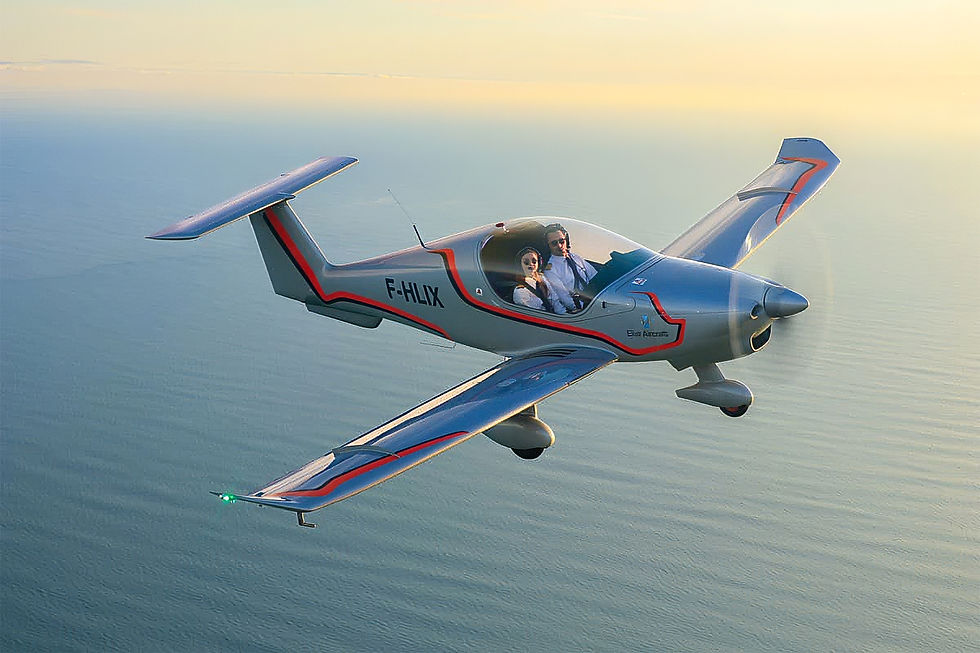
The Elixir is not an established legacy design with thousands of aircraft and decades of operational experience behind it. It is a relatively young French design developed around modern manufacturing techniques and intended to offer a lightweight and efficient approach to general aviation. Elixir Aircraft has positioned the aircraft as part of a new generation of European light aircraft, combining modern construction methods with an effort to reduce weight, simplify manufacturing and improve operating economics.
That makes the current accident particularly significant for the company. Every new aircraft programme depends heavily on confidence from regulators, operators and pilots, and a fatal accident involving two of the manufacturer's own production test pilots inevitably raises difficult questions. It does not, however, automatically mean there is a fundamental problem with the design. Aviation history is full of accidents involving aircraft that were subsequently found to have been brought down by circumstances unrelated to any inherent design defect.
The fact that the aircraft was involved in a production flight-test programme will also be a major focus for investigators. Test pilots operate in an environment that differs significantly from normal general aviation flying. Their work involves assessing aircraft performance, systems and handling characteristics, sometimes deliberately exploring areas of the flight envelope that ordinary pilots would never approach.
That does not mean test flying is reckless. Quite the opposite. It is highly structured, with detailed planning, engineering analysis, defined test objectives, operating limitations and emergency procedures. Test pilots are specifically trained to recognise and manage abnormal aircraft behaviour.

Investigators will therefore examine the flight-test programme in considerable detail. They will want to understand what the aircraft was being asked to do, its configuration at the time, the systems being evaluated, the weather conditions, the pilots' actions and the aircraft's behaviour in the moments before the crash. Any available flight data, maintenance records and wreckage evidence will become important pieces of the investigation.
France's Bureau of Enquiry and Analysis for Civil Aviation Safety, the BEA, has opened a safety investigation. Initial investigators have been sent to the scene, where the wreckage and other evidence will be examined as authorities reconstruct the aircraft's final moments.
That process will take time, and there is good reason for it to do so. Accident investigations are not simply exercises in identifying the last thing that happened before impact. Investigators are looking for the chain of events that led to the accident, including technical, operational, environmental and human factors. The eventual objective is not to find somebody to blame. It is to determine what can be learned and whether anything needs to change. That distinction is fundamental to aviation safety.
The Elixir grounding also demonstrates the difficult balance regulators must maintain following an accident involving a relatively new aircraft type. If a regulator acts too slowly when a genuine fleet-wide problem exists, the consequences could be serious. If it acts too aggressively before the evidence is understood, operators and manufacturers can face significant disruption based on a risk that may ultimately prove not to be common to the fleet.
In this case, EASA clearly decided that the circumstances justified immediate action. Its Emergency Airworthiness Directive was issued without the normal consultation process because the agency considered immediate publication necessary to address the potential safety risk.
The distinction between a grounding and a finding of a design defect is therefore important. EASA has not declared the Elixir design unsafe. It has temporarily suspended operations while more information becomes available.
Interestingly, this is not the first time Elixir aircraft have been subject to regulatory action. EASA issued an Emergency Airworthiness Directive in 2024 concerning engine mounts after cracks were identified in an affected component. The directive required inspections and replacement of affected parts, with the issue subsequently addressed through further regulatory action.

There is currently no evidence linking that earlier issue to the fatal October 2026 accident, and doing so before investigators have established the cause would be speculation. However, the earlier directive illustrates an important reality of aviation certification: certification is not the end of an aircraft's development. Aircraft continue to generate operational experience once they enter service, and regulators and manufacturers must respond when new information identifies a potential safety concern. That process can sometimes be inconvenient for operators, but it is one of the mechanisms that has made modern aviation as safe as it is.
For Elixir owners, the immediate situation is straightforward: the aircraft remain grounded until the authorities determine what action is necessary. EASA has indicated that further airworthiness action may follow as the investigation develops. Depending on the findings, that could range from inspections or modifications to more extensive corrective measures, or potentially the return of aircraft to service without significant changes if the accident is ultimately found to have resulted from circumstances specific to the aircraft or flight. The important point is that nobody knows the answer yet.
That is sometimes difficult for aircraft owners, manufacturers and aviation enthusiasts to accept, particularly in an age where information is expected almost instantly. But accident investigation does not work well when conclusions are drawn before the evidence has been assembled.
The wreckage will tell part of the story. Flight data, maintenance records and operational information will tell more. The pilots' actions, the aircraft's configuration and the test programme will fill in further pieces. Eventually, investigators should be able to reconstruct what happened.





Comments