


Airlink Heads West as Lanseria Gets its First Domestic Route
By Garth Calitz

Airlink will launch twice-daily flights between Lanseria and Cape Town in December, giving Gauteng travellers another way south and, for some, the considerably more attractive prospect of avoiding the cross-city expedition to O.R. Tambo.

Airlink is spreading its wings at Lanseria International Airport, announcing that it will launch twice-daily services between Lanseria and Cape Town from 4 December 2026. The new route will be Airlink’s first scheduled domestic service from Lanseria and represents a significant expansion of the airline’s presence at Johannesburg’s alternative airport. More importantly for passengers living in western and northern Gauteng, it provides another choice on one of South Africa’s busiest domestic city pairs without first having to negotiate the traffic, toll roads and occasional character-building experience involved in getting to O.R. Tambo International Airport.

The new service will initially operate twice daily in each direction, seven days a week, using Airlink’s 98-seat Embraer E190. From Lanseria, flights will depart at 09h10 and 13h00, arriving in Cape Town at 11h35 and 15h25 respectively. Cape Town departures are scheduled for 09h20 and 13h30, reaching Lanseria at 11h35 and 15h45. That gives the airline four sectors a day on the route from the outset, but Airlink clearly believes there is considerably more traffic available: from 22 March 2027, it plans to double the frequency to four daily return services.

That planned increase is perhaps the most interesting part of the announcement. Airlines do not generally announce a doubling of frequency before the first passenger has even climbed aboard unless they have a fairly strong idea of where the market is heading. Four daily rotations would turn Lanseria-Cape Town into a serious part of Airlink’s domestic network rather than an experimental side project and would provide the sort of frequency needed to attract business travellers as well as leisure passengers.


“Travel options on this route have been limited, and we intend to give passengers a comfortable and enjoyable alternative for travelling between the two regions, while also complementing our existing services to O.R. Tambo,” Airlink CEO de Villiers Engelbrecht said in announcing the route.
For anyone living in Randburg, Fourways, Sandton, Roodepoort, parts of Pretoria or further west towards Hartbeespoort and the North West Province, Lanseria can be a considerably more convenient proposition than O.R. Tambo. Of course, Gauteng traffic retains the ability to turn even the most carefully planned airport journey into an impromptu endurance event, but Lanseria’s location gives a large section of the province another practical option. Airlink specifically identifies western Gauteng and North West as important parts of the airport’s catchment area.

There is another important aspect to the announcement: Airlink is not abandoning O.R. Tambo in favour of Lanseria. Far from it. O.R. Tambo remains the backbone of the airline’s Johannesburg operation and one of the most important connecting hubs in its extensive Southern African network. Lanseria is instead being developed as a complementary point-to-point operation, allowing Airlink to reach passengers who may value convenience more than the connecting opportunities available through O.R. Tambo.

It also places Airlink directly into a market where FlySafair has established a significant presence. That should make things considerably more interesting. South African domestic aviation has spent enough time watching airlines disappear that seeing another carrier enter an established route is something worth welcoming. Competition generally has a remarkable ability to focus airline management minds and occasionally even does pleasant things to airfares.
Airlink will also be bringing a somewhat different product to the route. Its E190s are arranged in the familiar two-by-two configuration, which means every passenger gets either a window or aisle seat. There are no middle seats, removing at least one of commercial aviation’s minor social experiments: three strangers silently negotiating ownership of two armrests for two hours. The aircraft also allows Airlink to enter the market with 98 seats rather than immediately throwing larger narrow-body capacity at the route.
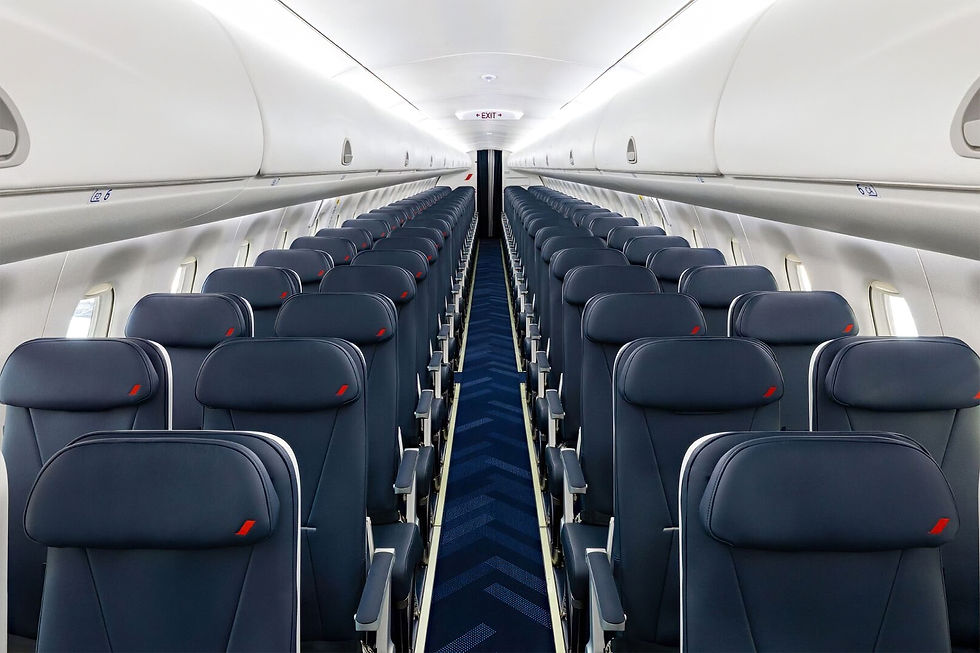
The E190 is particularly well suited to this sort of operation. Airlink has built much of its success around matching aircraft size and frequency to individual markets rather than simply chasing maximum seats per departure. A 98-seat jet operating several frequencies a day gives the airline flexibility to build the route while providing passengers with useful departure choices. If demand develops as Airlink expects, increasing to four daily returns from March will provide substantial capacity without necessarily requiring a larger aircraft.

For years, the privately operated airport has occupied an interesting position in South African commercial aviation. It is close enough to Johannesburg to offer a genuine alternative to O.R. Tambo, yet far enough from the eastern side of Gauteng that its usefulness depends heavily on where passengers actually live or work. The airport has nevertheless developed into an important domestic gateway, particularly for travellers in Johannesburg’s northern and western suburbs as well as Pretoria.
Airlink’s arrival adds another dimension. The airline had already announced that Lanseria would join its scheduled network with a three-times-weekly service to Harare beginning on 15 November 2026. Cape Town follows less than three weeks later, meaning Airlink will have both international and domestic operations at Lanseria before the end of the year.

Airlink has been steadily broadening its network and fleet capabilities. Its Embraer E195-E2s are now operating alongside the airline’s established E-Jet and regional jet fleet, giving it greater capacity on busier routes while retaining smaller aircraft for thinner markets. The E195-E2 entered Airlink service in December 2025 and has subsequently been deployed on higher-demand domestic and international sectors.

The airline has also been increasingly willing to develop routes that do not depend entirely on Johannesburg. Just days before the Lanseria announcement, Airlink inaugurated its non-stop Cape Town-Mauritius service using the E195-E2, further strengthening Cape Town’s role within its network.
The Lanseria move therefore fits into a broader strategy. Airlink is still very much a Johannesburg-based airline, but its network is becoming increasingly multidimensional. Cape Town is growing as an international gateway, larger E195-E2s are giving the carrier additional capacity where required, and Lanseria now provides another foothold in the enormous Gauteng aviation market. Whether Cape Town-Lanseria ultimately justifies four daily return flights will depend on fares, passenger behaviour and how competitors respond. But Airlink appears confident enough to set a date for that expansion before the first scheduled domestic flight departs Lanseria.

There is, however, another reason why Airlink's arrival at Lanseria deserves closer attention. It provides a rather convenient real-world test of the assurances surrounding Harith's proposed acquisition of FlySafair — particularly those concerning the treatment of competing airlines at an airport in which Harith already has a significant interest.
Harith announced in February that it had entered into an agreement to acquire FlySafair. At the same time, Harith has an approximately 37% interest in Lanseria International Airport. That combination immediately created an obvious competition question: what happens when the owner of, or a significant investor in, an airport also owns one of the airlines competing for passengers and capacity at that airport?

For South African passengers, this move can only be characterised as good news. More competition between Gauteng and Cape Town means more choice, different products and potentially more pressure on fares. For Lanseria, securing Airlink represents another step towards becoming more than simply Johannesburg’s smaller alternative airport.
And for the long-suffering traveller living west of Johannesburg, the sales pitch may be even simpler. Two hours to Cape Town sounds rather attractive when the alternative can sometimes feel like two hours just to get to O.R. Tambo.





Comments