


Elders Take to the Skies as Wonderboom Hosts 2026 Elders Flight
By Garth Calitz
Photos by Trevor Cohen, Guy Martin and Garth Calitz

There are airshows, there are fly-ins, and then there are days when aviation becomes something considerably more important than aircraft flying overhead. Saturday, 3 October 2026, at Wonderboom National Airport was firmly in the third category.

The Elders’ Flight 2026 was an opportunity to give senior citizens a taste of flight, but that description rather undersells what happened. For more than 500 elderly South Africans, the majority of whom had never flown before, Wonderboom became the starting point for a day of aircraft, memories, laughter, nervous anticipation and ultimately, a rather large number of new aviation lovers. As is often the case when the South African general aviation community decides to do something, it does it properly; there was considerably more going on than simply putting elderly people into aeroplanes.
Long before the first aircraft taxied towards the flight line to load their passengers, Wonderboom was already buzzing. The event began early, with organisers, volunteers, pilots, ground crews, emergency services and the various participating organisations getting everything into position. More than 500 elders had been brought in from retirement villages, care facilities and social organisations around Gauteng. For many, simply arriving at an airport was already an event.
For the pilots and volunteers, however, the morning was about preparation. Aircraft had to be positioned, passengers organised, safety procedures checked and the enormous logistical exercise of getting hundreds of people airborne had to be turned into something resembling an orderly operation. Somehow, as it always does, it worked.
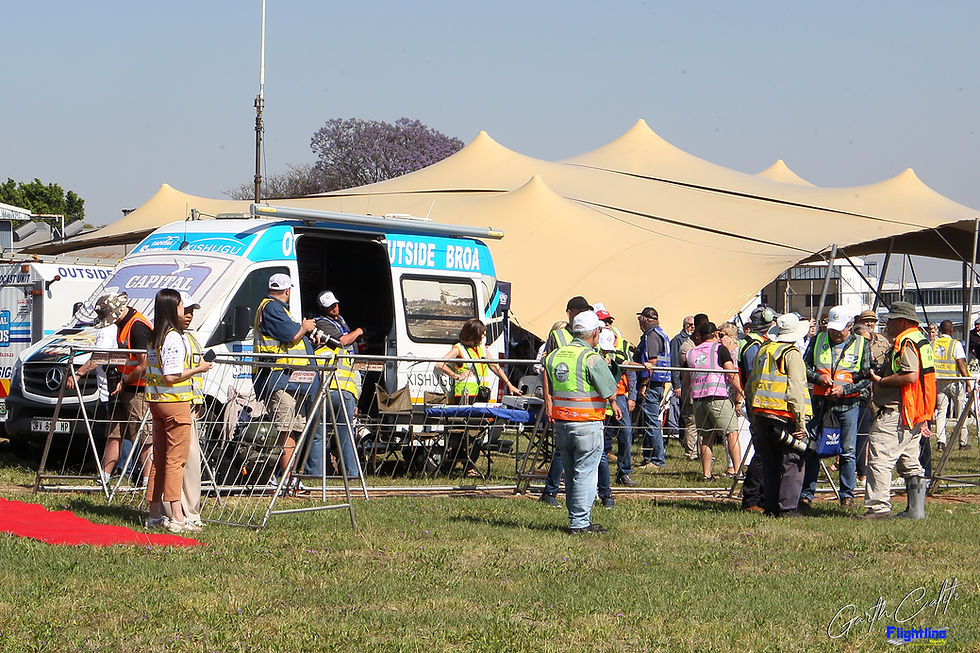
Well-respected airshow commentator Brian Emmenis, assisted by his very capable team from Capital Sounds, took control of proceedings, setting the tone for what would become a very busy day.

Following the Lord’s Prayer, led by Daryl Hardy of City Gates Connect-IT, attention turned skyward, leading to one of the day's most spectacular moments. Graham Field, along with two other skydivers, took off from Wonderboom in an Antonov An-2, affectionately known as the Anushka. After exiting the historic biplane, Graham deployed a giant South African flag. As the enormous flag floated above the airport, the national anthem rang out. It was an appropriately South African start to an event that was about much more than simply flying.

The aircraft were not the only machines attracting attention. Wonderboom's emergency-response capability was demonstrated through a cavalcade involving airport fire trucks, ER24 rapid-response vehicles, Fidelity ADT Secufire vehicles and Tshwane Metro Police Department vehicles.
While the cavalcade was certainly part of the day's spectacle, it also underlined something that can easily be overlooked when watching an event such as this from the outside. Flying hundreds of elderly passengers requires a considerable amount of planning and support on the ground. The pilots may get the glory when the wheels leave the runway, but there is an army of people who make sure that everything before and after that moment happens safely and efficiently. That Army was once again led by a familiar "General", Felix Gosher, the driving force behind the Elders Flight and the ever-popular Children's Flight
A selection of elders and dignitaries, including the chief of the SAAF, Lieutenant General Carl Moatshe and SACAA Senior Manager: General Aviation, Mr Neil de Lange, were escorted along the red carpet towards the taxiway. Waiting for them were a Cessna Citation business jet, a Van’s RV-10 and a Bell UH-1 helicopter and two Bell 407s. For some of the passengers, the aircraft represented a lifetime ambition. For others, it was something completely outside their experience. The opening group was taken on a circuit around Wonderboom, officially getting the Elders’ Flight airborne.

Before the mass passenger flying reached full tempo, Wonderboom was treated to an airshow programme that would have been enough to attract aviation enthusiasts even without the Elders’ Flight. The Flying Lions, flown by Arnie Meneghelli and Nigel Hopkins, opened the display with their distinctive two-ship Harvard formation. The sound of those radial engines rolling across the airport provided the sort of soundtrack that makes even people who have absolutely no interest in aviation stop what they are doing and look up.
The Harvards were followed by Andre van Zyl in his Magni gyrocopter and then Eugene du Preez in a solo Harvard display sponsored by the Harvard Club of South Africa. It was a carefully selected combination, providing everything from historic warbirds to modern light aviation in a relatively short period. For the elders waiting for their own flights, it also provided plenty of entertainment while they waited their turn.

If the Harvards provided a connection with South Africa's aviation history, Jan Botma's Bell Huey brought an entirely different dimension to the morning. The unmistakable helicopter was used in a rescue demonstration, producing the characteristic rotor sound that has become almost inseparable from the image of military helicopter operations courtesy of the many Vietnam War movies.
The morning then moved into rather more energetic territory as the Extra 330SCs arrived. Tristan Eeles and Nigel Hopkins alternated their solo displays, displaying the skill that has elevated these pilots to the top of their respective competition classes. For the spectators, however, it was pure entertainment. For the elders waiting for their flights, it was also a useful distraction. Watching an Extra 330SC tumble through the sky is probably not the greatest way of taking one's mind off the fact that, in a few minutes, one will be climbing into an aircraft and discovering what happens when the ground disappears beneath it.

The airshow was entertaining, but it was not the reason Wonderboom was busy. The real mission of the day was now getting into full swing as groups of elders were moved towards the flight line. Marimba choirs lined the route, adding music to an already colourful scene as passengers were divided between fixed-wing and rotary-wing aircraft. The variety was remarkable. There were Slings, RVs, Cessnas, Caravans, twins, homebuilt aircraft, light sport aircraft, a Piaggio P.166 Albatross and even a weight-shift microlight, while the helicopter contingent included Bell Jet Rangers, Long Rangers and Hueys.

By eleven o'clock, Wonderboom was operating at full tempo. Aircraft departed, completed their circuits and returned, passengers climbed out, new passengers climbed in, and the process began again. From the ground, it looked remarkably like an aviation conveyor belt, except that the products coming off the end were smiling pensioners rather than parcels. From an operational perspective, however, the process was a considerable achievement. Hundreds of passengers had to be moved through the system while maintaining safe aircraft movements and keeping the operation running smoothly. There is something particularly satisfying about watching someone who has spent decades looking at aircraft finally being invited to climb aboard one.
For the passengers themselves, the procedure was beautifully simple: climb aboard, strap in, take a breath and watch Wonderboom fall away beneath you. For those experiencing their first flight, that moment must have been extraordinary. Commercial aviation has made flying so routine that many of us regard boarding an airliner as little more than catching a bus with wings. For somebody who has spent an entire lifetime on the ground, however, seeing the city shrink beneath the aircraft and the horizon open up is still capable of producing genuine wonder.

By midday, hundreds of passengers had already experienced their flights and the operation showed little sign of slowing. The diversity of the aircraft involved remained one of the highlights, with passengers finding themselves in everything from Slings and RVs to helicopters and larger aircraft. Importantly, this was not simply a quick ride around the block. The event was about giving elderly people a genuine aviation experience and allowing them to participate in something that many had never previously had the opportunity to experience.
Once back on the ground, the passengers received their wings. Aviation people tend to become accustomed to wings. They are badges, insignia and symbols that appear on uniforms and souvenirs. For somebody who has just completed their first flight, however, a set of wings represents something far more personal. It is proof that they did it. They got airborne.

As the afternoon approached, the character of the event began to change. The general Elders’ Flight programme was moving towards its conclusion, but another particularly important group was waiting for their turn. Military veterans were to be honoured during the final hour of the programme, and the atmosphere became noticeably more ceremonial. This time the red carpet was lined by the Jeppe Boys pipe band, whose bagpipes provided a soundtrack that seemed entirely appropriate for the occasion. These were not simply passengers being given a joyride. They were men and women who had spent significant parts of their lives around the military and, in many cases, aviation. For some, the aircraft waiting on the apron would have been familiar from earlier chapters of their lives. There was inevitably a sense that the final flying session was about memory as much as it was about aviation.

Among those honoured were Major General (Ret) Lucky Ngema and former SAAF Chief Lieutenant General (Ret) Fabian Msimang, together with other military veterans who were given the opportunity to take to the air. The aircraft selected for them could hardly have been more appropriate, including an Alouette III, a Tiger Moth, a Navion and the Antonov An-2. For former members of the Air Force and the broader military community, climbing aboard aircraft with such strong historical associations was about considerably more than simply getting airborne. It provided an opportunity to reconnect with an aviation world that had defined much of their lives. Aircraft that had once represented duty, work, responsibility and, for some, danger were now providing something very different: a pleasant afternoon in the sky and a chance to revisit memories without any of the operational pressures that had once accompanied them.

By half-past two, the pace was beginning to slow. The constant cycle of departures and arrivals was easing; passengers were returning from their flights and the aircraft were gradually beginning to settle back onto the apron. The wings had been handed out, photographs had been taken and the nervous anticipation of the morning had been replaced by animated conversation about what had just happened. More than 500 senior citizens had been given the opportunity to see Pretoria from above, and for some it had been their first flight.
Eventually, the engines began falling silent. The helicopters wound down, the Harvards disappeared from the sky, the aerobatic aircraft were back on the ground and the An-2 was once again sitting quietly on the apron, dropping a bit of oil to mark its territory. The red carpet was no longer busy, the music had faded and the steady stream of passengers had stopped. Wonderboom gradually returned to being an airport rather than the centre of one of South Africa's most unusual and heart-warming aviation operations.
Yet the significance of the day extended well beyond the number of flights completed. The Elders’ Flight, the brainchild of Felix Gosher, began at Rand Airport in 2018 and has grown into a major annual event. Its continued success demonstrates what can happen when the general aviation community puts its aircraft, pilots and resources behind an idea that has nothing to do with selling aeroplanes or generating profit and everything to do with giving something back.

It would be easy to describe Saturday simply in terms of aircraft. There were plenty of them. Harvards, Hueys, Extras, RVs, Slings, Caravans, helicopters, the Citation, the An-2 and an assortment of other aircraft demonstrated just how diverse South African general aviation remains. But the aircraft were ultimately the supporting cast. The stars were the passengers, and the most important statistic of the day was not the number of aircraft involved or the number of circuits flown. It was the number of people who went home with a story to tell.
Aviation sometimes gets itself trapped in numbers. Passenger figures, aircraft orders, operating costs, fuel prices, regulations, certification requirements and increasingly impressive technology dominate the industry. Then an event such as the Elders’ Flight comes along and strips all of that away. There was no billion-rand aircraft launch at Wonderboom on Saturday, no glossy corporate presentation and no executive standing beside a new aircraft explaining how the future of aviation had arrived. There were simply pilots, aircraft, volunteers, emergency crews and, very importantly, sponsors who decided that more than 500 elderly people deserved to be spoiled and get a chance to fly.

An aircraft is, ultimately, a machine. It is metal, composite, engines, avionics, fuel, tyres and paperwork. The magic only happens when somebody climbs inside it and leaves the ground. For more than 500 senior citizens at Wonderboom on Saturday, that magic was very real. Some fulfilled a lifelong dream. Some discovered something completely new. Some undoubtedly arrived with reservations and left wondering when they could do it again.
The Elders’ Flight proved that aviation does not always need to be spectacular to be meaningful. Sometimes it simply needs an aircraft, a willing pilot and somebody who has spent a lifetime looking at the sky, wondering what it would be like to see the world from up there. On Saturday, Wonderboom provided the answer. And judging by the smiles on the flight line, nobody seemed particularly keen to come back down.





Comments