


Air Canada A350-1000s Set to Anchor Next Phase of Long-Haul Growth

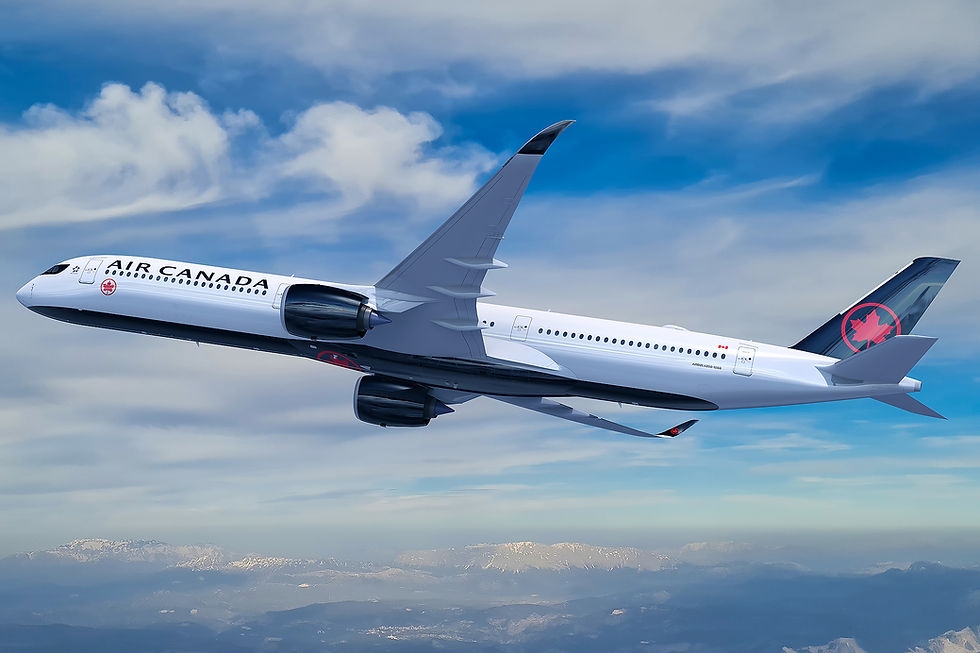
Air Canada has quietly turned last year’s “undisclosed” widebody order into a very visible statement of intent, confirming a firm purchase for eight Airbus A350-1000 aircraft. While eight aeroplanes may sound modest in an industry accustomed to headline-grabbing mega-orders, the choice of variant speaks volumes about where Canada’s flag carrier sees its long-haul future heading.

The A350-1000 represents the largest and longest-legged member of Airbus’ A350 family, designed to sit at the top end of the airline’s long-range fleet. With a range approaching 9,000 nautical miles, the aircraft opens the door to non-stop services from Canadian hubs to some of the world’s most distant growth markets, including the Indian subcontinent, Southeast Asia and Australia. For Air Canada, whose network strategy increasingly revolves around using Canada’s geography as a natural transatlantic and transpacific bridge, the -1000 is less about replacing aircraft one-for-one and more about expanding the envelope of what is commercially possible.

From an operational standpoint, the aircraft brings clear economics to the table. Compared with older generation widebodies, the A350-1000 offers around a 25% reduction in fuel burn and emissions, driven by advanced aerodynamics, extensive use of lightweight composite materials and the latest generation Rolls-Royce Trent XWB engines. In an era of volatile fuel prices and tightening environmental scrutiny, those numbers carry more than marketing weight. They translate directly into route viability, frequency planning and the ability to sustain thinner long-haul routes that might have been marginal with previous-generation aircraft.

Cabin experience is another pillar of the A350 proposition. Airbus’ Airspace cabin has become something of a calling card for the manufacturer, with lower cabin altitude, improved humidity levels and reduced noise, all aimed at making ultra-long-haul travel slightly less punishing on the human body. For Air Canada, which has invested heavily in positioning itself as a premium global connector rather than simply a North American carrier with long legs, the A350-1000 provides a consistent platform to showcase its evolving onboard product. In practical terms, this means more flexibility in configuring premium cabins, larger galleys to support long missions and the space to deliver a competitive business-class experience on routes that can stretch well beyond 15 hours.

Strategically, the order reinforces Air Canada’s growing alignment with Airbus across both narrowbody and widebody fleets. The A220 has already become a backbone of the airline’s short- and medium-haul operations, while the A350-900s currently in service have proven themselves on flagship long-haul routes. Adding the -1000 variant gives Air Canada a scalable family approach to long-range operations, allowing capacity to be matched more precisely to demand without stepping outside a common cockpit and maintenance ecosystem. For fleet planners, that commonality is gold: fewer pilot type ratings, streamlined spares provisioning and greater scheduling flexibility across the long-haul network.

The timing of the disclosure is also notable. The order was initially listed as “undisclosed” in Airbus’ order books in November 2025, a not uncommon practice in an industry where airlines sometimes prefer to manage market signalling. Making the deal public now suggests Air Canada is ready to attach its brand to the aircraft and, by extension, to the growth narrative the A350-1000 represents. It also serves as a subtle message to competitors: Air Canada intends to play in the same ultra-long-haul league as the world’s largest network carriers.

There is, of course, a broader competitive subtext. The upper end of the long-haul market has become increasingly contested, with airlines weighing capacity, range and economics across a narrow band of highly capable aircraft types. The A350-1000’s positioning at the intersection of efficiency and size gives Air Canada a tool to compete head-on on routes where frequency is limited but demand for premium connectivity is strong. In practical terms, that could mean fewer one-stop itineraries and more direct links between Canada and fast-growing regions where nonstop service carries a revenue premium.
With more than 1,500 A350 family orders logged globally by early 2026, the type has firmly established itself as a long-term fixture in global fleets. For Air Canada, the eight A350-1000s are not just another fleet addition; they are a statement of confidence in long-haul growth, in the resilience of global travel demand, and in the airline’s ambition to connect Canada more directly to the farthest corners of the map. In the long game of fleet planning, that is a bet on both aircraft and strategy and one that positions Air Canada squarely in the ultra-long-haul conversation for the decade ahead.





Comments