


The Rooivalk - South Africa’s Home-Grown Gunship Celebrates 36 Years
By Garth Calitz

Last week marked 36 years since the maiden flight of the Rooivalk AH-2A attack helicopter's XDM Testbed on 11 February 1990. From its earliest experimental roots to combat deployment under the United Nations banner, the Rooivalk’s story is one of ambition, ingenuity, prolonged development, political constraint and hard-earned operational credibility. Few military aviation programmes better reflect the strategic pressures of their era and fewer still illustrate the complex intersection between geopolitics, defence budgeting and indigenous aerospace development as clearly as South Africa’s only purpose-built combat helicopter.


The Rooivalk project originated in the early 1980s under Atlas Aircraft Corporation, the forerunner of Denel Aviation. During this period, the South African Border War was evolving into a more conventional conflict environment, characterised by increasing mechanisation, hardened ground targets and a growing presence of Soviet-supplied armoured vehicles, notably the T-55 tank. The South African Defence Force recognised that helicopter-borne troop operations required a dedicated armed escort platform, capable of conducting strike missions against anti-aircraft positions, providing close air support and countering armoured threats.

At the same time, South Africa was subject to a comprehensive arms embargo under United Nations Security Council Resolution 418. This embargo prevented the acquisition of modern foreign attack helicopters, compelling the country to pursue a domestic solution. The requirement included the integration of anti-tank guided missiles, sophisticated fire control and survivability systems, an ambitious undertaking for an isolated defence industry.

Developing a clean-sheet attack helicopter would have required the creation of entirely new turboshaft engines, rotor systems, transmissions and dynamic components, dramatically increasing cost, risk and timescale. Atlas therefore chose to base the Rooivalk on existing, locally supported helicopter technology. The SAAF operated two primary helicopter types at the time: the Aérospatiale Alouette III and the Aérospatiale SA 330 Puma. The Alouette III, a 1960s-era light helicopter with limited power and growth potential, was considered unsuitable as a development base. The Puma, by contrast, offered greater size, power and payload capacity, providing a more realistic foundation for a heavily armed and sensor-laden attack helicopter.
Compounding this decision was the parallel development of the Atlas Oryx, a South African-upgraded derivative of the Puma, optimised for hot-and-high African operating conditions with improved engines and performance. The Oryx programme progressed far more rapidly than Rooivalk, and its powerplant and dynamic systems were adopted as the basis for the attack helicopter. This ensured commonality across fleets, simplified logistics and reduced maintenance complexity. The trade-off was that Rooivalk would be physically larger than most contemporary attack helicopters, but this conferred advantages in range, payload and endurance.

Alternative design approaches were considered, including the possible use of propulsion elements from the Aérospatiale SA 365 Dauphin, which may have resulted in a smaller and potentially more economical platform. Ultimately, commonality with Oryx and Puma lineages prevailed.
During the relatively well-funded defence environment of the 1980s, Atlas and Denel aimed to develop a world-class attack helicopter capable of matching or exceeding contemporary Western and Eastern Bloc gunships. The Rooivalk was envisioned as an agile, heavily armed and highly survivable platform tailored for African operational conditions and high-intensity conflict.

To validate the concept, Atlas developed the XH-1 Alpha technology demonstrator. Built from an Alouette III airframe, the XH-1 featured a tandem stepped cockpit, a 20 mm cannon mounted in the nose and a modified undercarriage. The XH-1 conducted its maiden flight on 3 February 1985. Despite its improvised origins, the demonstrator proved the feasibility of a dedicated attack helicopter concept within the South African industrial base and paved the way for the full Rooivalk programme.

The first true Rooivalk prototype, the XDM, flew on 11 February 1990. However, the programme was already under strain. The ambition to field a world-leading attack helicopter inevitably lengthened development timelines, as advanced avionics, fire control systems and weapons integration proved complex and resource-intensive.

The end of the Border War in 1988 triggered significant defence budget reductions. The planned acquisition of 36 Rooivalks was cut to just 12, undermining economies of scale and inflating unit costs. While total programme spending between 1984 and 1990 remained within allocated budgets, the extended development timeline became increasingly problematic. Internal institutional dynamics further complicated the programme. Some within the SAAF reportedly viewed the Rooivalk as a potential competitor to fixed-wing strike aircraft in an era of shrinking budgets, while the South African Army supported the project, seeing attack helicopters as a cost-effective alternative to maintaining large armoured formations. Army funding helped sustain the programme during periods of financial uncertainty.

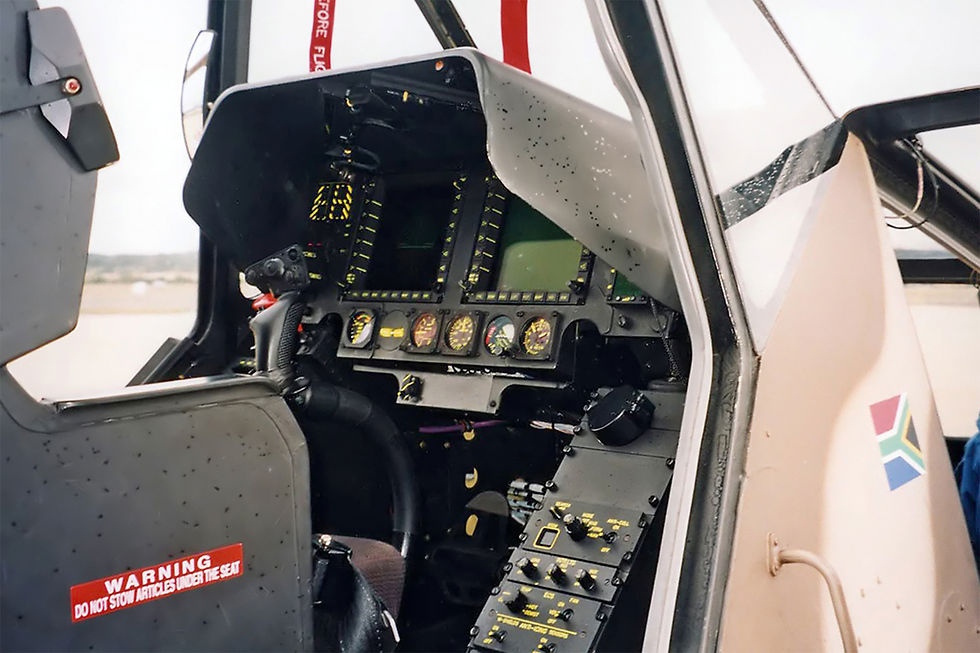
By the time the first production Rooivalk was delivered in 1998, its basic aerodynamic design remained sound, but aspects of its avionics architecture reflected 1980s technology. This undermined its attractiveness on the export market, which had moved towards more networked, digitally integrated platforms.
Export prospects were further hampered by concerns over long-term support. The Rooivalk relied heavily on French-origin dynamic components, later controlled by Airbus Helicopters. As a direct competitor to the Eurocopter Tiger, the Rooivalk faced scepticism from potential buyers regarding future support for critical systems. Political pressure also played a role, with reports that the United States actively encouraged prospective customers to select the Boeing AH-64 Apache instead.
Despite marketing efforts in Malaysia, the United Kingdom and Turkey, no export orders materialised. In 2007, Denel formally ceased marketing Rooivalk as an export product after losing the Turkish attack helicopter tender to the Agusta A129 Mangusta.

While export success proved elusive, the Rooivalk programme had a profound impact on South Africa’s aerospace industry. It fostered high-technology capabilities and contributed to the emergence of companies such as Aerosud and Advanced Technologies and Engineering (ATE). These firms later played roles in major international aerospace programmes, including SAAB Gripen, BAE Hawk and Agusta A109.
Operational readiness within the SAAF progressed slowly. By 2005, only six of the 12 aircraft were available for testing, with software integration and personnel attrition at Denel cited as major challenges. One airframe was written off following an accident in August 2005. A decisive turning point came with the Block 1F upgrade programme, funded by a R962 million government investment announced in 2007. The upgrade introduced improved avionics, enhanced targeting systems and the qualification of the Mokopa anti-tank guided missile. Cooling issues with the F2 20 mm cannon were resolved and gearbox reliability was improved. By 2013, the Rooivalk achieved full operational capability.

Rooivalk’s operational baptism came in 2013, when three aircraft were deployed to the Democratic Republic of the Congo in support of the United Nations Force Intervention Brigade. In November that year, Rooivalks conducted combat strikes against M23 rebel positions using 70 mm rockets. The deployment marked the first combat use of South Africa’s indigenous attack helicopter and demonstrated its value in expeditionary peace enforcement operations.

The Rooivalk is built for operations in challenging conditions and can be maintained with limited logistical support, requiring only a basic set of spare parts and four ground crew members. Its weaponry features a nose-mounted 20 mm cannon, unguided rockets, air-to-air missiles and anti-armour weapons. The helicopter is outfitted with a fire control system, Doppler navigation radar, GPS, electronic countermeasures and dispensers for chaff and flares.

Distinctive features include its tandem cockpit, starboard tail rotor with port tailplane, fixed wheeled undercarriage and wire cutters fitted above and below the cockpit and on the undercarriage. Early flight testing demonstrated the helicopter’s remarkable agility, with Rooivalk becoming the first helicopter capable of sustained inverted flight during demonstrations, although this was stopped in later years.

Plans for further modernisation, including a Mk 1.1 upgrade and a mooted Mk 2 variant, have surfaced intermittently, along with discussions around restarting production, proposals that remain constrained by fleet size, funding realities and market demand.

Today, the prototype Rooivalk XDM is preserved at the South African Air Force Museum at Swartkop Air Force Base, a tangible reminder of one of the most ambitious aerospace projects ever undertaken in South Africa.

36 years after its maiden flight, the Rooivalk stands as a symbol of technological ambition forged under embargo, tempered by budgetary realities and ultimately proven in combat. Its journey has been long, often frustrating, but undeniably significant in the annals of South African military aviation history.
General characteristics
Crew: 2 (pilot & weapon systems officer)
Length: 18.73 m
Rotor diameter: 15.58 m
Height: 5.19 m
Disc area: 190.60 m²
Empty weight: 5,730 kg
Loaded weight: 7,500 kg
Max. takeoff weight: 8,750 kg
Internal fuel capacity: 1,854 L (489.8 US gallons)
Powerplant: 2 × Turbomeca Makila 1K2 turboshafts, 1,420 kW (1,904 shp) each
Performance
Never exceed speed: 167 knots
Cruise speed: 150 knots at sea level (max cruise)
Range: 740 km (380 nmi) at sea level (max internal fuel)
Ferry range: 1,335 km (720 nm) at 5,000 ft (max external fuel)
Service ceiling: 20,000 ft
Rate of climb: 2,620 ft/min
Armament
1 × F2 20 mm cannon, 700 rounds.
8 or 16 × Mokopa ZT-6 long-range anti-tank guided missiles (ATGM),
4 × MBDA Mistral air-to-air missiles,
38 or 76 × 70 mm rockets folding fin aerial rockets (FFAR) or Wrap-Around (WA) (FZ90 70mm WA)





Comments