


148,000 Feet of Chaos - The Hayli Gubbi Eruption Grounded Global Aviation
By Garth Calitz
Ethiopia's geological "sleeping giant" has stirred, and its initial stirrings have thrown the global aviation industry into chaos. On Sunday, 23 November 2025, the Hayli Gubbi volcano in Ethiopia’s Afar region erupted for the first time in over 12,000 years. While the eruption has had a significant local impact on livestock and nomadic communities, the atmospheric effects have led to a logistical crisis extending from the Horn of Africa to the Indian subcontinent. For an industry still vulnerable to atmospheric disturbances, the eruption of a volcano dormant since the last Ice Age is a "black swan" event of immense magnitude.
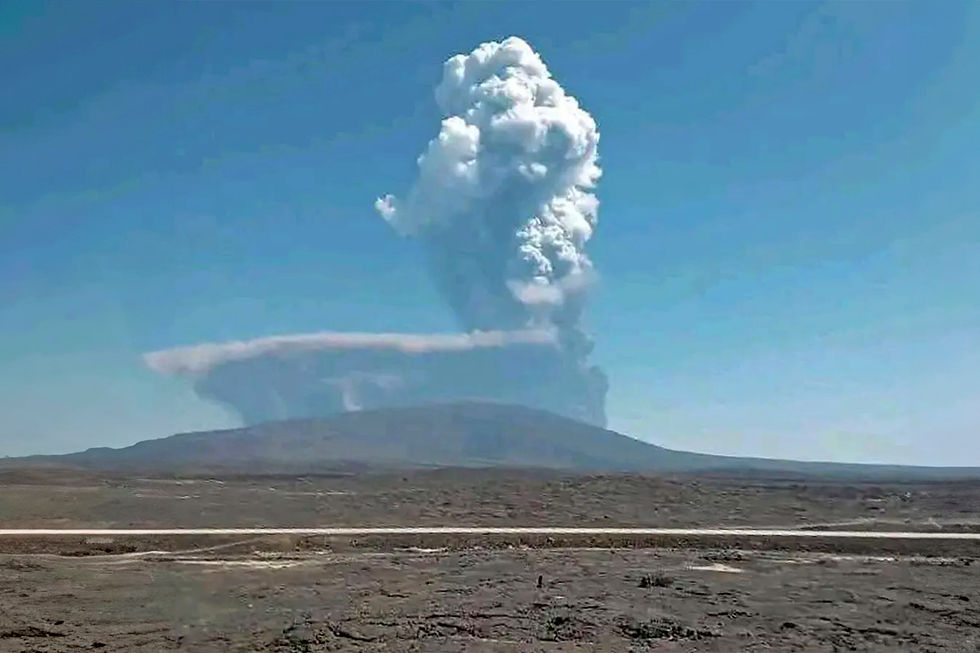
The Toulouse Volcanic Ash Advisory Centre (VAAC) reported that the eruption produced a volcanic ash plume that reached an altitude of 45,000 meters (148,000 feet). For context, commercial airliners generally fly at altitudes of 30,000 to 40,000 feet. This plume not only entered commercial flight paths but also covered them extensively. The ash cloud quickly travelled northwest, crossing the Red Sea and covering Yemen and Oman before moving over the Arabian Sea towards Pakistan and India.

In contrast to the soft ash produced by a wood fire, volcanic ash is composed of sharp particles of rock, minerals and volcanic glass. For aviation, it poses a triple threat:
Engine Failure: The high temperatures inside a jet engine melt the glass-like particles, which then solidify on the turbine blades, choking the engine and causing it to stall.
Abrasive Damage: The particles act like sandpaper, scouring the cockpit windows until they are opaque and damaging the fuselage.
Sensor Malfunction: Ash can block pitot tubes, leading to incorrect instrument readings that can be catastrophic during flight.

Although Ethiopia's main airport in Addis Ababa has continued to operate well beyond expectations, the international impact has been significant. By Monday evening, the ash cloud had extended to Western Rajasthan and was advancing toward Delhi and Mumbai. The Directorate General of Civil Aviation (DGCA) in India responded swiftly by issuing emergency advisories, resulting in a wave of cancellations.
Airline | Impacted Operations |
Air India | Cancelled 11 major flights on Monday and Tuesday. |
Akasa Air | Scrapped routes to Jeddah, Kuwait, and Abu Dhabi. |
IndiGo | Massive rescheduling and cancellations across northern states. |
KLM | Suspended specific long-haul routes crossing Indian airspace. |
The DGCA has directed airports situated along the cloud's trajectory, including those in Delhi, Punjab, and Maharashtra, to inspect runways for ash contamination, as it can reduce braking friction for landing aircraft.

In the UAE, Air Arabia had to cancel several flights departing from Sharjah. At the same time, Oman’s Environment Authority initiated emergency monitoring systems. While ground-level air quality remained breathable in most Gulf cities, the "no-fly zones" set up in the upper atmosphere caused a bottleneck in one of the world's busiest transit corridors.

The magnitude of this disruption immediately brings to mind the 2010 eruption of Eyjafjallajökull in Iceland. That incident resulted in the grounding of 95,000 flights and cost the industry billions. However, the Hayli Gubbi event stands out due to its altitude. While the Icelandic eruption reached approximately 11 km (36,000 feet), the plume from Hayli Gubbi soared to nearly four times that height. On the bright side, the modern aviation industry is now better prepared with satellite tracking and advanced "ash encounter" protocols developed after the 2010 crisis.

Beyond the boardrooms of airlines, the eruption has left tourists and guides stranded in the Danakil Desert. In Ethiopia, the Afar region faces a secondary crisis: the "ash-out" has covered forage for livestock, threatening the livelihoods of thousands of herders.

As the cloud drifts toward China, the India Meteorological Department (IMD) anticipates that skies over the subcontinent will start to clear by Tuesday afternoon. Nonetheless, the accumulation of cancelled flights and the necessary "deep-clean" inspections for aircraft potentially exposed to trace amounts of ash suggest that travel delays are likely to continue throughout the rest of the week.

"It felt like a sudden bomb had been thrown," said Ahmed Abdela, a resident of the village of Afdera. In the aviation industry, the eruption was equally unexpected, demonstrating that a 12,000-year dormancy doesn't diminish a volcano's potential danger.





Comments