


The Mighty Moose vs the Mystical Kunpeng
- May 12
- 4 min read
By Rob Russell
What do you say? Comparing a large animal with a “mystical bird-like character” doesn't quite make sense! But these two nicknames are given to two very different, but actually very similar, transport aircraft.

The moose is the nickname for the Boeing C-17 Globemaster, which continues a very successful line of large military transport. It can trace its success back to WW2, with the C-47 and C-54, followed by the legendary, still-produced C-130 Hercules, then the C-141 Starlifter and its successor, the mighty C-5 Galaxy. The C17 was built and manufactured by Boeing, after McDonnell Douglas developed the original concept, but with the merger of the two Companies, it became known as the Boeing C17 Globemaster. A total of 279 have been built.

The Moose is in service primarily with the USAAF, but also found in many Air Forces around the world, namely in the Middle East, Australia, India and also with the RAF.

The recent US/Iran war has highlighted the vital role that the C-17 played in logistical transport. In 2025, there was talk of Boeing reopening the production line. There was also talk down the corridors of the Pentagon, to build a replacement for the mighty C-5 Galaxy and C-17, a kinda of 1 for 2, but the focus has dramatically shifted back to getting more C-17s, it being far more versatile than the much bigger Galaxy, so expect the production to open again and soon!

The Xi'an Y-20 “Kunpeng” is, however, a little-known large-sized military transport aircraft that was developed by the Xi'an Aircraft Industrial Corporation for the People's Republic of China (PRC). They both share a high wing, T-tail silhouette and fulfil the same role – strategic heavy lift transport.

While the official series name of the aircraft is Kunpeng, a mythical giant fish-bird from the Taoist classic Zhuangzi, it is nicknamed "Chubby Girl" in the Chinese aviation industry, because its fuselage is much wider than aircraft previously developed in China. Aviation enthusiasts regard it as a hybrid aircraft. It looks like a C17, albeit a bit smaller, but the wing design and tail are reminiscent of the legendary Russian Il-76.

To reduce their dependence on their neighbours, namely the Russians, the Chinese are eventually planning to phase out their Il-76s and replace them with the Y-20. Latest figures indicate that there are 55 Y-20 transport, 30 YY-20A transport/tanker and 10 YY-20B transport/tanker in service with various arms of the Chinese Defence Force. A variant of the Y-20B is being developed as an early warning and control model. There are no known operators outside of China, although the manufacturers are keen to market it worldwide; it seems the Chinese hierarchy is not keen on that. It has been seen at various air shows around the world, albeit lowkey, but has not attracted any orders from outside of China.
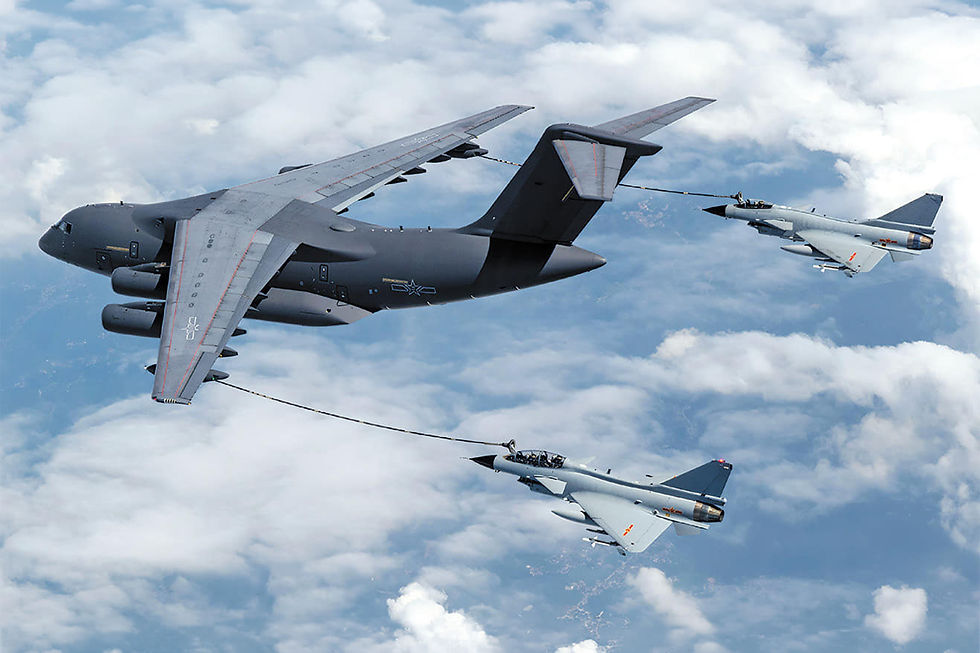
Let's take a look at some of the features of the aircraft:
Capabilities & Size: The Y-20 is designed for long-range transport, including military assault, humanitarian assistance, and aerial refuelling. It is the first home-built Chinese aircraft of its size, closing the gap in strategic logistics power with the US. The Y-20 is approx 47m long vs the 53m of the C17. The wingspan is very similar, being 51,7m for the C17 vs 50m for the Y-20. The C17 has a much larger fuselage and can take a bigger load and was specifically designed to transport both USAAF helicopters and some outsize US Army vehicles.
Payload and Range: The C-17 remains the "gold standard" with a higher payload capacity (approx. 77 tons) compared to the Y-20's 66 tons. This is due to it being slightly longer than the Y-20. Range is dependent on the load that is being carried, but both jets can be refuelled in flight, so range is, in theory, not a limiting factor.
The Y-20 has one advantage over the C17, in that the manufacturer has built a model that is capable of acting as an aerial tanker. Pods are attached under each wing. The C17 has the advantage that it can carry a full load into and out of rough and unprepared strips, whilst the Y-20 has not proven its operations on such strips yet, although the Chinese are working hard to develop such operations.

There is no doubt that the design of the Y-20 has a lot in common with the C17. This was eventually proven true when, on July 13, 2016, Chinese national Su Bin pleaded guilty to charges that he conspired with others to hack into American defence contractor Boeing and steal documents related to the development of the C-17, F-22 and F-35 aircraft.
He admitted to analysing and translating stolen documents from English to Chinese, which he then emailed to the Second Department of the People's Liberation Army General Staff Department. According to Court documents, Su Bin's emails describe how the stolen info "...has extremely vital significance in our country's speeding up the development" of Project A (the Xi'an Y-20). Su Bin was sentenced to 3 years and 10 months in U.S. Federal prison and a $10,000 fine. With time served, he was released in October 2017.

The Y-20 might not be as big as the C17, but the Chinese are working hard to develop a successful home-built large transport aircraft. The Chinese aviation industry is developing fast, and despite building many aircraft under license, are developing its own, albeit primarily civilian, jets. It is only a matter of time before they could be in a position to challenge the world domination of the Boeing 737 and Airbus A320 family. So too are the Chinese slowly building up, developing and improving their military transport aircraft.

Whilst the Kunpeng might not be as big and as successful as the Moose, disrespect it at your peril.






The best part about Drive Mad is how creative the level design becomes over time. Some maps require speed, while others are more about careful control and avoiding sudden flips.