


The Great Glass Cockpit Debate: Garmin vs Everyone Else (With Apologies to Your Wallet)
By Garth Calitz
Walk into any flying club, airport pub or hangar on a Saturday morning and mention the words "best avionics" if you want to witness a debate that makes discussions about oil brands or tailwheel versus nosewheel seem positively civilised.

Within seconds, pilots will divide into tribes. Coffee will be spilt. Someone will begin drawing wiring diagrams on a serviette. An avionics engineer will quietly walk away before being asked for a quote. The truth is, there has never been a better time to equip a general aviation aircraft. Gone are the days when navigating meant folding an impossible paper map while trying not to lose your pencil somewhere beneath the rudder pedals.

Today's cockpits look more like a modern airliner than the average Cessna 172 did just twenty years ago. But every manufacturer believes their system is the one that belongs in your aircraft.

Garmin: The King of the Hill
Garmin has become the default answer to almost every avionics question.
Need navigation? Garmin.
Need an autopilot? Garmin.
Need engine monitoring, weather, traffic, synthetic vision, Bluetooth, Wi-Fi and enough processing power to rival the computer that landed Apollo 11? Garmin has that too.

The company's integrated systems are so comprehensive that installing one often feels like adopting a very intelligent electronic co-pilot. It rarely complains, never forgets frequencies, and politely informs you that the terrain ahead is significantly higher than your current altitude, which, admittedly, is useful.

Of course, Garmin's biggest challenge isn't technology. It's convincing your bank manager that your aircraft genuinely needs another display.

Dynon: The People's Champion
Ask a home aircraft builder about Dynon and prepare for a lengthy presentation complete with spreadsheets, software update histories and photographs of immaculate instrument panels. Dynon has built its reputation on delivering remarkable capability at prices that don't immediately require a second mortgage.

Its SkyView systems are favourites among homebuilders and Light Sport Aircraft owners because they simply work and they continue to evolve through regular software updates.

Dynon owners also enjoy reminding Garmin owners how much money they saved. Garmin owners respond by pointing at their integrated ecosystem. Neither side is entirely wrong.

MGL Avionics: South African Ingenuity
South Africans have every reason to be proud of MGL Avionics. Designed and manufactured in South Africa, MGL has earned a loyal international following, particularly in experimental aviation.

MGL products have always been known for innovation and flexibility. If you can imagine a particular screen layout, chances are an MGL owner has already programmed it. It may take some time and considerable effort to get it sorted out, as it's not a simple, straightforward process.

The company has often introduced features long before they became fashionable elsewhere. There's also a certain satisfaction in telling overseas pilots that your sophisticated glass cockpit was designed in South Africa. It usually earns an impressed nod... followed by the inevitable question:
"So... where exactly is Somerset West?"

Collins Aerospace: The Airline Professional
Walking into a Collins-equipped cockpit feels a little like arriving at a board meeting wearing overalls. Collins systems are legendary in airline and business aviation circles, where reliability is measured not in hours, but in decades. They are beautifully engineered, highly capable and wonderfully sophisticated.
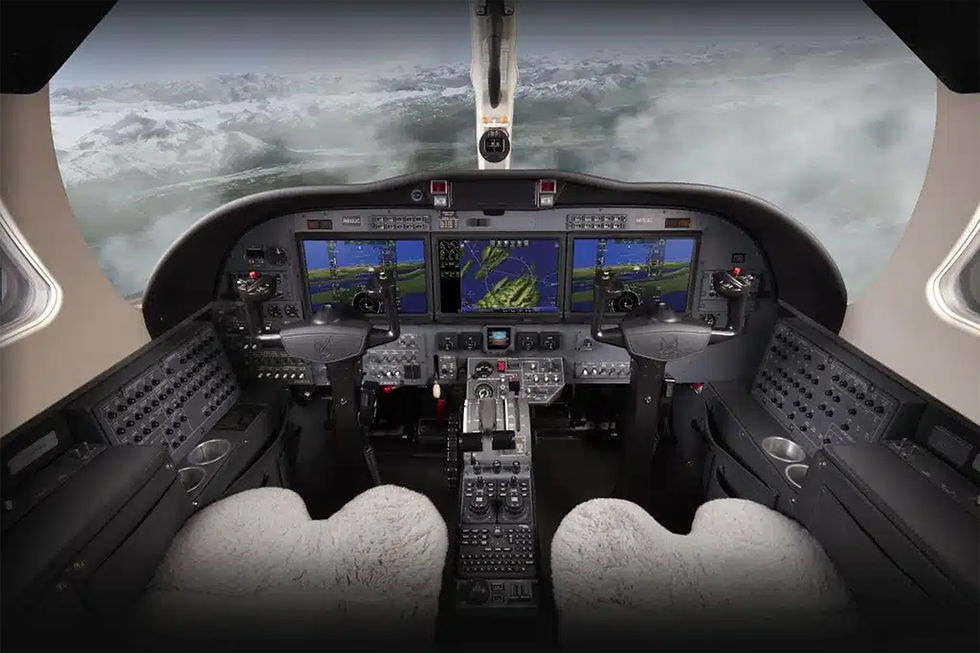
They are also likely to cost considerably more than the average family hatchback. Perhaps several hatchbacks. Still, nobody ever accused Collins of aiming for the budget-conscious weekend flyer.


Honeywell: The Veteran of the Cockpit
Long before glass cockpits became commonplace, Honeywell was helping shape modern avionics. Its systems have earned a reputation for reliability in commercial airliners, military aircraft and business jets, with the Primus Epic flight deck becoming a familiar sight in many corporate aircraft.

Honeywell's approach has always been to present pilots with the right information at the right time, rather than overwhelming them with technology for technology's sake.

Honeywell pilots rarely boast about their avionics; they smile quietly while everyone else debates whose touchscreen is the most intuitive. Just don't look too closely at the price tag. High-end Honeywell avionics have a habit of making aircraft owners wonder whether they should have taken up golf instead.

Avidyne: The Quiet Achiever
While Garmin often dominates the headlines, Avidyne quietly continues producing capable avionics that many pilots genuinely love. Its navigators remain particularly popular among owners upgrading older aircraft who do not want to redesign the entire instrument panel.

Many pilots also appreciate that switching from older equipment can often be accomplished without completely rewiring the aircraft. Your maintenance engineer certainly appreciates that.
The Real Winner
In reality, today's avionics manufacturers all deserve credit.

Whether you fly behind Garmin, Dynon, MGL, Collins, Avidyne or another system entirely, modern technology has dramatically improved situational awareness and safety. Synthetic vision has helped eliminate spatial disorientation. Traffic displays reduce unpleasant surprises. Digital engine monitoring helps detect problems before they become expensive stories told over more than a few cold ones. Autopilots have become remarkably capable and, unlike human copilots, they never complain about your music selection.
It's Still About the Pilot
Of course, the finest avionics package in the world cannot overcome poor decision-making. A glass cockpit cannot improve fuel planning. Synthetic vision cannot make thunderstorms disappear. An autopilot cannot explain to your spouse why upgrading the panel somehow costs more than the family holiday. At the end of the day, avionics are tools. Very clever tools—but still tools.

The best system is the one you understand thoroughly, maintain properly and use competently.
As one old instructor famously observed: "The most dangerous button in any cockpit is the one you've never pressed before." Wise words.

Now, if you'll excuse us, someone in the clubhouse has just claimed steam gauges are more reliable than glass cockpits...
This could take a while...





The article details how Erik Finman built his Bitcoin fortune starting from a young age. It's an interesting case study in early conviction and long-term holding. Worth a look if you enjoy origin stories from the crypto space.
The content about 10.0.0.0.1 is well written and easy to follow. I found the comparison with the correct router address particularly useful, and the overall guide is informative from beginning to end.