


Sling Doubles Down: South Africa’s Aviation Star Goes Twin
By Garth Calitz

After years of talking about building a twin, Sling Aircraft is finally turning the dream into aluminium — with the prototype now taking shape in Cape Town and a maiden flight planned for June 2027.

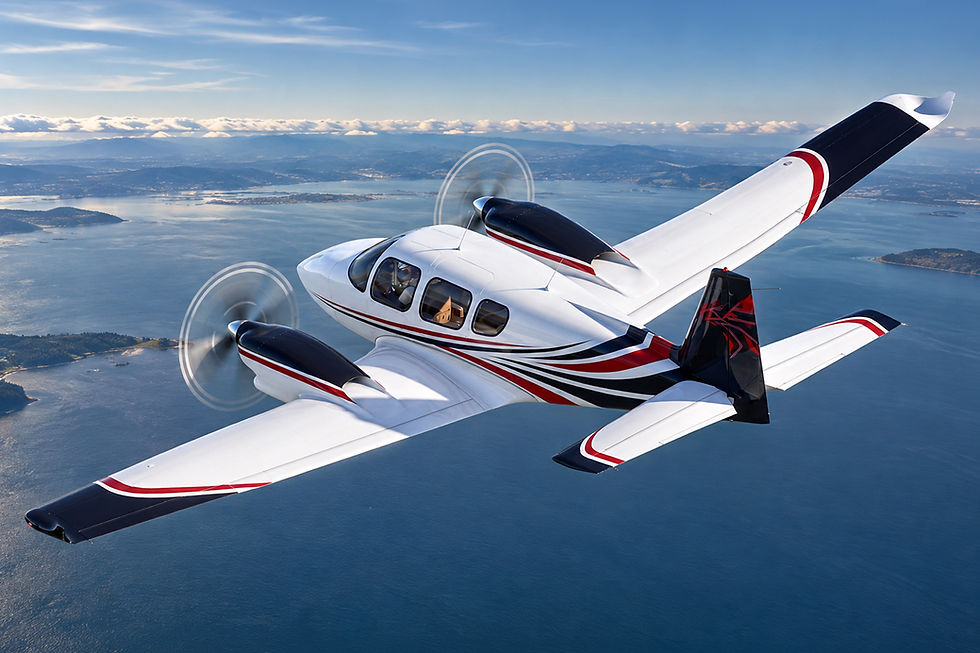
South Africa's Sling Aircraft is taking a major step beyond its successful single-engine aircraft with the development of an entirely new twin-engine Sling, a project that the company says has been made possible by a fundamental shift in the regulatory environment. For now, the aircraft has the straightforward designation Sling Twin, but there is no official production name yet.
More importantly, this is no longer simply a concept. Sling says the design is complete, with parts for prototype 001 already being produced. The aircraft's tail components have been punched and are now being assembled in Cape Town, where the prototype is being built.
The project is being led by Mike Blyth, one of the co-founders of The Airplane Factory, the South African company that later became Sling Aircraft. Blyth, who is now based in Cape Town, has been involved in the development of Sling aircraft from the company's earliest days and brings decades of experience to the new twin.

His involvement gives the Sling Twin an interesting connection to the company's origins. What began as an ambition within the original Aircraft Factory team to build increasingly capable aircraft has now evolved into a clean-sheet twin-engine design, made possible by the regulatory changes introduced through MOSAIC. The target for the Sling Twin's first flight is June 2027, but that is by no means set in stone.
A Twin Dream That Suddenly Became Possible
Sling's move into twin-engine aircraft isn't a decision that appeared overnight. According to Andrew Pitman, co-CEO of Sling Aircraft, building a twin has been an ambition for years. The problem was certification. Sling wanted to develop larger and faster aircraft, and a twin was seen as an obvious step in that direction. But a conventional twin would have required certification, something Sling has deliberately chosen not to pursue with its aircraft.

Then came the FAA's MOSAIC — Modernisation of Special Airworthiness Certification initiative.
The regulatory changes opened the door to aircraft capabilities that previously sat outside the Light-Sport Aircraft environment, including twin-engine aircraft, turbocharged engines and constant-speed propellers. For Sling, that changed the equation completely.
The company realised that a twin which previously would have required certification could potentially be developed within the new MOSAIC framework, while also addressing a significant requirement in the aviation training market. In other words, MOSAIC didn't simply make the Sling Twin easier to build. It made the aircraft Sling had wanted to build for years commercially realistic.

Built for the Training Market
Flight schools are expected to be one of the most important markets for the new aircraft. MOSAIC's expanded capabilities have created an opportunity for a modern light twin to replace some of the ageing aircraft currently used for multi-engine training.
Much of today's piston-twin training fleet is based on designs that date back decades. While aircraft such as the Piper Seminole and Beechcraft Baron remain important parts of the training and general-aviation landscape, operators face the realities of maintaining older aircraft, with acquisition and operating costs becoming increasingly difficult to ignore.
Sling believes there is now an opportunity for a new-generation, lightweight twin designed specifically for the modern training environment.
Two Rotax 916s
The Twin will be powered by two Rotax 916 iS engines. Each turbocharged 916 iS engine can generate up to 160 hp, providing the aircraft with a total maximum output of around 320 hp.

For the initial installation, Sling has selected MT propellers, although the company says it intends to test other propeller options during development. That testing could ultimately play an important role in determining the aircraft's final performance characteristics, and Sling is keeping those numbers firmly under wraps for now.

The company confirms that it already has preliminary performance figures for the Twin, including speed, range, MTOW and useful load — but those figures will not be released until the aircraft has flown.
That is a sensible approach for a clean-sheet aircraft still moving through prototype construction. Until the prototype is airborne and the company has real-world flight-test data, published performance figures would inevitably be subject to change.
Four Seats — or 4+2
The Sling Twin will have two distinct configurations. Under MOSAIC, the aircraft will be limited to four seats. The Experimental version, however, will accommodate up to six people. Sling describes this as a “4+2” configuration, providing the additional capacity without making the six-seat Experimental aircraft the primary configuration. That distinction could prove important for the aircraft's intended market, particularly if flight schools and private operators adopt the MOSAIC version.
A Parachute Built In
While a whole-aircraft ballistic parachute is being considered as a future development for the Sling Twin, it will not be fitted initially. The parachute system remains at an early stage of consideration, with its size, weight and cost yet to be determined. For a light twin aimed partly at flight training, the possibility of eventually incorporating a whole-aircraft parachute adds another interesting dimension to the aircraft’s safety and design philosophy.

More Than a Sling With Two Engines
Although the Twin shares its heritage with Sling's existing aircraft, this is not simply a matter of putting another engine on an existing design. The company says the design is complete, suggesting that the aircraft has been developed from the outset around its twin-engine configuration and the capabilities enabled by MOSAIC.
That opens the possibility of a significantly different aircraft in terms of size, speed and capability, something Sling itself has been working towards for some time. The company has already built a reputation for producing lightweight aircraft that deliver impressive performance with relatively small engines. The Twin embodies the next evolution of this philosophy.
Oshkosh Is on the Radar
With first flight targeted for June 2027, attention will inevitably turn to EAA AirVenture Oshkosh a month or so later. Sling says it would like to fly the aircraft to Oshkosh, but has not committed to making that trip part of the programme. But we all know Sling's history of flying prototypes to Oshkosh.
If the prototype flies on schedule, the Sling Twin could make its public debut at precisely the right time, when the aviation industry will be watching closely to see how MOSAIC begins changing the light-aircraft market
If Sling can deliver on its promise of a modern, lightweight and comparatively affordable twin for the training and general-aviation market, and I personally have no doubt they will, the Sling Twin could become one of the most interesting new aircraft to emerge from South Africa in years.


Comments