


Harith Buys FlySafair: One Airline, One Airport Interest and a Rather Interesting Little Conflict of Interest
By Garth Calitz

South Africa's biggest domestic airline is getting new owners, and while the Competition Tribunal has given the deal its blessing, the arrangement has raised a few questions. Nothing particularly unusual, of course. Just an airline, an airport, an investment company, a pension fund and a handful of competitors who would quite like to know whether everybody will be playing by the same rules.
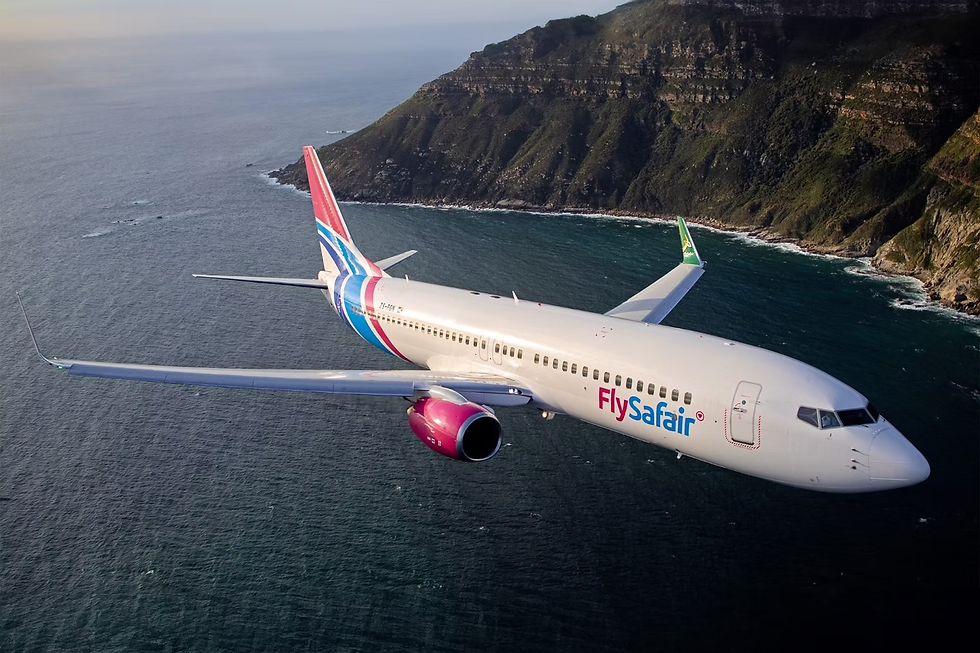
South African aviation has another major corporate development to digest. Harith Aviation Consortium has secured Competition Tribunal approval to acquire 100% of Safair Holdings, the parent company of FlySafair, in a transaction reportedly valued at approximately R7 billion. The approval, granted on 27 October 2026, comes with conditions intended to protect competition and prevent the new ownership arrangement from creating an unfair advantage over competing airlines.

On paper, it is a significant vote of confidence in South African aviation. FlySafair has established itself as the country's dominant domestic low-cost carrier, commanding more than 60% of domestic seat capacity. It has built an enviable business around relatively affordable fares, efficient operations, a standardised fleet and the rather irritating habit of making competing airlines explain why their tickets cost more.
Harith, meanwhile, gets to acquire an established airline rather than go through the expensive, complicated and occasionally terminally unsuccessful exercise of starting one from scratch.
So far, so good. But there is a small detail in this transaction that makes it considerably more interesting than an ordinary change of shareholders. Harith already has a substantial investment in Lanseria International Airport. And therein lies the rub.

Harith holds approximately 37.5% of Lanseria, with the remaining 62.5% held by the Government Employees Pension Fund through the Public Investment Corporation (PIC). Once the FlySafair acquisition is completed, Harith will have a controlling interest in an airline operating from an airport in which it also has a significant investment. In other words, the new owners of FlySafair will also have a seat at the airport investment table.
Nothing illegal about that, and certainly nothing automatically sinister. However, it does create a rather interesting situation when one considers that FlySafair is competing against other airlines that also need and will need access to Lanseria's facilities in the future.

Airports are not simply glorified car parks with runways attached. They control access to essential infrastructure, passenger facilities, operating arrangements, commercial services and charges. The airport operator has considerable influence over the environment in which airlines compete. If one airline's owners also have an interest in the airport, competitors are entitled to ask whether everyone will receive equal treatment.
Airlink has announced plans to expand its domestic operations from Lanseria, making the airport an increasingly important part of its network strategy. It will therefore be competing with FlySafair at an airport in which FlySafair's new investment group has a substantial interest.

Harith has previously faced questions about assurances of equal treatment for airlines operating at Lanseria, particularly in the context of its wider aviation interests. Those assurances will now be tested in a much more commercially significant environment.
Airlink should not have to wonder whether its expansion plans, airport charges, access to facilities or infrastructure requirements will be treated differently from those of FlySafair. CemAir and every other operator should enjoy precisely the same protections.
Of course, Harith will undoubtedly point to the regulatory safeguards attached to the acquisition. The Competition Tribunal has made approval conditional on measures intended to prevent discriminatory treatment and the sharing of commercially sensitive information between the airline and airport interests. These are important safeguards. But there is a difference between having conditions written into a merger approval and ensuring that they are actually enforced.

A competitor does not necessarily have to be denied access to an airport to suffer a commercial disadvantage. Less favourable charges, delayed infrastructure decisions, different service arrangements or access to commercially sensitive information can all influence an airline's ability to compete. It is precisely these possibilities that make independent monitoring and transparent enforcement so important.
The Competition Commission had recommended approval in July, subject to safeguards, while the transaction also attracted opposition from CemAir. CemAir raised concerns about overlapping ownership and governance interests, arguing that the arrangement could create opportunities for commercially sensitive information to move between entities.


The South African Cabin Crew Association also raised employment-related concerns, including consultation, job security and protections for temporary employees. These objections do not establish that Harith will abuse its position, but they do demonstrate that the transaction involves considerably more than simply changing the name on a shareholder register.
The Government Employees Pension Fund, through the PIC, is the majority shareholder in Lanseria. The PIC also has an investment interest in Harith General Partners, the investment manager associated with the acquisition. That creates a complicated web of public pension investments, private infrastructure interests and commercial aviation ownership.
Again, there is nothing automatically improper about these relationships. Nevertheless, when public pension money, airport infrastructure and a dominant airline intersect, transparency becomes rather important. The public deserves to understand how potential conflicts are managed and who is ultimately responsible for ensuring that the rules are followed.

South Africa has already had its fair share of complicated airline ownership arrangements. The proposed Takatso transaction involving SAA provided a lengthy demonstration of how difficult these deals can become once ownership, public interest and commercial relationships start overlapping. One would hope the FlySafair transaction will prove somewhat less entertaining and lucrative for lawyers.
Harith has indicated that FlySafair will retain its existing management team and low-cost operating model. That is probably welcome news. Nobody wants to see a successful low-cost airline suddenly discover the joys of complicated corporate structures, inflated overheads and executive enthusiasm for expensive strategic repositioning.
The real test will be whether FlySafair continues delivering affordable fares and maintaining its competitive position without the acquisition weakening the market around it. With more than 60% of domestic seat capacity, FlySafair is already a powerful market participant. Its new owners will need to demonstrate that their airport interests do not translate into an additional competitive advantage.
There are also questions about the airline's future development. Will Harith provide the capital for more aggressive fleet expansion? Will FlySafair pursue additional regional routes? Could Lanseria become an even more important operational base? These are possibilities, although no firm expansion programme should be assumed simply because the ownership is changing.
The transaction is expected to close towards the end of 2026, subject to outstanding requirements and fulfilment of the approval conditions. The detailed reasons for the Tribunal's decision will also be important in understanding precisely how the competing interests were assessed.
However, for many, the most important question is relatively simple. Can Harith simultaneously have an interest in the airport and own an airline operating from it while convincing every competing airline that the playing field remains level?
Airlink will want fair treatment. CemAir will want fair treatment. Other operators will want fair treatment. And passengers will want airlines competing on price, service and punctuality rather than on who has the more influential shareholders.




Comments