


“Old Shakey”- Douglas C-124 Globemaster
By Rob Russell
The DC 4 gets another panel beating and a new shape!!!

Douglas Aircraft developed the C-124 from 1947 to 1949, from a prototype they created from a World War II-designed Douglas C-74 Globemaster and based on lessons learned during the Berlin Airlift. The aircraft was powered by four large Pratt & Whitney R-4360 Wasp Major piston engines producing 3,800 hp (2,800 kW) each.

The C-124 had its origins in the C-74. The Douglas C-74 Globemaster was a United States heavy-lift cargo aircraft built by the Douglas Aircraft Company in Long Beach, California. The aircraft was developed after the Japanese attack on Pearl Harbour. The long distances across the Atlantic and, especially, the Pacific oceans to combat areas indicated a need for a transoceanic heavy-lift military transport aircraft. Douglas Aircraft Company responded in 1942 with a giant four-engined design.

The Douglas Aircraft Company began studies at their Santa Monica division in early 1942 for a transport capable of fulfilling the global logistical needs of the U.S. military. Its "C-74 Project Group" used its company's tried and trusted DC-4 as a basis and concentrated on enlarging its capabilities. The group's design philosophy was to build a "no-frills" aircraft to carry freight. Not built to be beautiful and sleek but rather as robust and practical as possible. Development and production modifications issues with the aircraft caused the first flight to be delayed until 5 September 1945, after both VJ Day (marking the end of the conflict in World War II, on 15 August 1945) and the formal surrender on 2 September. Total production was limited to 14 aircraft when the wartime contract was cancelled in January 1946.
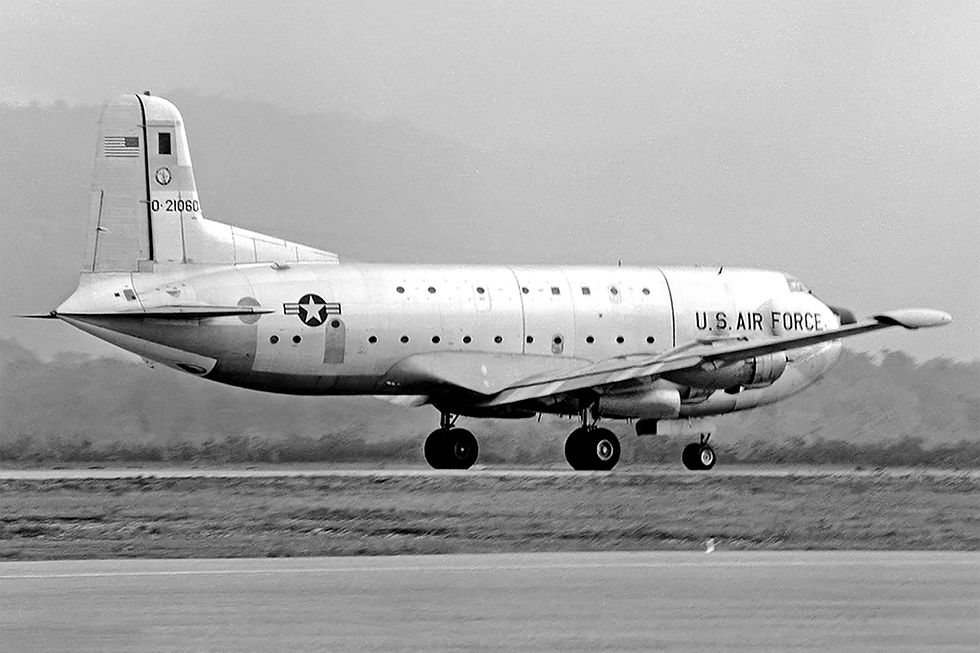
Although not produced in large numbers, the C-74 did fill the need for a long-range strategic airlifter. Not to be upset and disillusioned, Donald Douglas set about updating and modernising the C-74, as all signs pointed to the need for another large long-range aircraft. And so the C-124 emerged from the drawing boards and into fruition.

The C-124's design featured two large, clamshell doors and a hydraulically actuated ramp in the nose, as well as a cargo elevator under the aft fuselage. The C-124 was capable of carrying 68,500 lb (31,100 kg) of cargo, and the 77 ft (23 m) cargo bay featured two overhead hoists, each capable of lifting 8,000 lb (3,600 kg). As a cargo hauler, it could carry tanks, guns, trucks, and other heavy equipment, while in its passenger-carrying role, it could carry 200 fully equipped troops on its double decks or 127 litter patients and their nurses.

It was the only aircraft of its time capable of transporting fully assembled heavy equipment such as tanks and bulldozers. There were many people who were sceptical about the use of a “double-decker” and felt there was no need for a passenger version. Ironically, 60-odd years later, one of the world’s most successful long-range wide-bodied aircraft is the Airbus A380 – a purpose-built and designed double-decker!

The C-124 first flew on 27 November 1949, with the C-124A being delivered from May 1950. The C-124C was version 2, being upgraded, featuring more powerful engines, and an APS-42 weather radar fitted in a "thimble"-like structure on the nose. Wingtip-mounted combustion heaters were added to heat the cabin and enable wing and tail surface de-icing. The C-124As were later upgraded with these improvements.

The USAF's Strategic Air Command (SAC) was the initial operator of the C-124 Globemaster, with 50 in service from 1950 through 1962. Four squadrons operated the type, consisting of the 1st, 2nd, 3rd, and 4th Strategic Support Squadrons. Their primary duty was to transport nuclear weapons between air bases and to provide airlift of SAC personnel and equipment during exercises and overseas deployments.

It was soon to become the primary heavy-lift transport for the United States Air Force (USAF) Military Air Transport Service (MATS) during the 1950s and early 1960s, until the Lockheed C-141 Starlifter entered service. Unbelievable politics within the USAAF resulted in the Strategic Air Command and Military Air Transport Service almost competing against each other and literally not speaking to each other! Those on the top floor of the Pentagon who suggested the two commands should combine and operate more effectively and operationally were soon disposed of and never heard of again.

The C-124 served in MATS, later Military Airlift Command (MAC), and units of the Air Force Reserve and Air National Guard until retired in 1974. The C-124 was seen in the Vietnam War and proved to be a very reliable aircraft, primarily used for long-range and/or heavy loads. The Military Air Transport Service (MATS) was the largest operator until January 1966, when the organisation was renamed Military Airlift Command (MAC). Within a few years following the formation of MAC, the last remaining examples of the C-124 were transferred to the Air Force Reserve (AFRES) and the Air National Guard (ANG), said transfers being complete by 1970.

Specifications
Crew: 6 or 7: Aircraft Commander, Pilot, Navigator, Flight Engineer, Radio Operator, 2 Loadmasters
Capacity: 200 troops / 123 litter patients with 45 ambulatory patients and 15 medical staff. Maximum payload 74,000 lb (34,000 kg)
Length: 130 ft 5 in (39.75 m)
Wingspan: 174 ft 1.5 in (53.073 m)
Height: 48 ft 3.5 in (14.719 m)
Wing area: 2,506 sq ft (232.8 m2)
Empty weight: 101,165 lb (45,888 kg)
Gross weight: 185,000 lb (83,915 kg)
Max takeoff weight: 194,500 lb (88,224 kg)
Fuel capacity: 11,128 US gal (42,120 L; 9,266 imp gal) ; 2x 30 US gal (110 L; 25 imp gal) water/alcohol tanks
Powerplant: 4 × Pratt & Whitney R-4360-63A Wasp Major 28-cylinder air-cooled radial piston engines, 3,800 hp (2,800 kW) each with water/alcohol injection
Propellers: 3-bladed Curtiss Model C634S-C402, 16 ft 6 in (5.03 m) diameter fully-feathering reversible-pitch constant-speed propeller
Performance
Maximum speed: 304 mph (489 km/h, 264 kn) at 20,800 ft (6,300 m)
Cruise speed: 230 mph (370 km/h, 200 kn)
Range: 4,030 mi (6,490 km, 3,500 nmi) with 4,030 lb (1,830 kg) payload
Ferry range: 6,820 mi (10,980 km, 5,930 nmi)
Service ceiling: 21,800 ft (6,600 m)
Rate of climb: 760 ft/min (3.9 m/s)
Wing loading: 73.8 lb/sq ft (360 kg/m2)
Power/mass: 0.041 hp/lb (0.067 kW/kg)





Comments