





Lucky Lady II and the Flight That Shrunk the World
By Garth Calitz

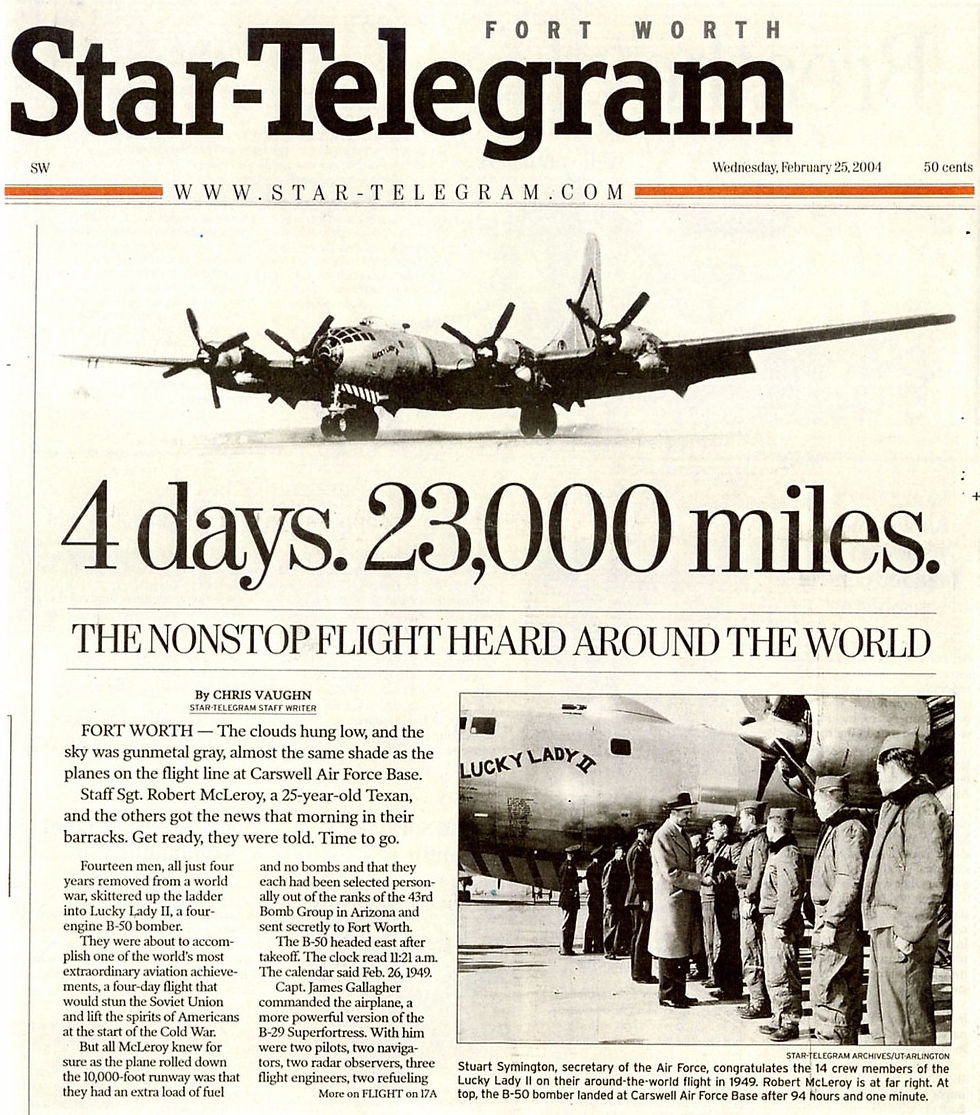
In an era when long-distance flight still carried an air of daring uncertainty, a silver bomber named Lucky Lady II quietly redefined what was possible. In early 1949, a modified Boeing B-50 Superfortress completed the first non-stop flight around the globe, remaining airborne for just over 94 hours. At a time when even transoceanic travel remained a complex undertaking, this mission demonstrated that the physical limits of distance could be overcome through innovation, planning and endurance. It was not merely a feat of aviation bravado, but a turning point that signalled a new era in both military capability and global connectivity.

The late 1940s were marked by shifting geopolitical tensions as the Cold War began to take shape, reshaping alliances and strategic priorities across the globe. For the newly independent United States Air Force, established in 1947, demonstrating the ability to project power rapidly and decisively across continents became a central objective. The leadership recognised that future conflicts would not be limited by geography, and that airpower would play a decisive role in maintaining strategic balance.

The concept behind Operation Lucky Lady II was therefore both symbolic and practical: prove that a strategic bomber could take off from the United States, circle the Earth without landing and return safely, entirely sustained by aerial refuelling. While the idea was ambitious, it was grounded in emerging technologies and a growing confidence in long-range aircraft design. Success would send a powerful message, not only about capability, but about reach, readiness, and technological superiority.

Lucky Lady II was no ordinary bomber, but rather a carefully prepared aircraft configured specifically for the demands of extreme endurance flight. The B-50 itself was an advanced evolution of the B-29, featuring more powerful Pratt & Whitney engines, a strengthened airframe, and systems optimised for long-duration operations. For this mission, additional modifications ensured compatibility with aerial refuelling systems and improved reliability across the many hours of continuous flight.

Commanding the aircraft was Captain James Gallagher, leading a highly trained and disciplined crew of 14. Each crew member was selected not only for technical expertise but also for the ability to function effectively under sustained pressure and fatigue. Over the course of nearly four days, they would manage navigation across multiple continents, maintain constant communication with tanker aircraft and monitor the aircraft’s performance with unwavering attention. In such a mission, human endurance and coordination were just as critical as engineering excellence.

On 26 February 1949, Lucky Lady II lifted off from Carswell Air Force Base and began its historic journey eastward. The route had been meticulously planned to align with refuelling points and favourable conditions, taking the aircraft across the Atlantic Ocean, over Europe and the Middle East, through Asia and then across the vast Pacific before returning to the United States. Covering approximately 23,452 miles, the flight required continuous precision in navigation and timing.

What made the mission extraordinary was that the aircraft never landed. Instead, it relied entirely on a series of carefully choreographed mid-air refuelling operations conducted by KB-29 tanker aircraft. These rendezvous were executed at predetermined locations, often requiring precise timing and coordination under varying weather conditions. Each successful refuelling extended the aircraft’s range indefinitely, transforming what would have been an impossible journey into a controlled and repeatable operation. After 94 hours and 1 minute in the air, the aircraft returned to Carswell, completing a milestone that had previously existed only in theory.

Central to the success of the mission was the practical demonstration of aerial refuelling as a reliable and scalable capability. Using a probe-and-drogue system, tanker aircraft transferred fuel to the B-50 in flight, allowing it to remain airborne far beyond the limits imposed by its internal fuel capacity. While aerial refuelling had been tested before, Lucky Lady II marked the first time it had been used to sustain a continuous, around-the-world mission.

This breakthrough fundamentally altered the relationship between aircraft and distance. No longer constrained by the need for forward bases or frequent landings, aircraft could now operate with unprecedented flexibility and reach. The implications extended beyond military applications, influencing the development of long-haul commercial aviation and global air transport networks. In many respects, the mission validated a concept that would become indispensable to modern aviation.
The success of Lucky Lady II resonated far beyond the aviation community, carrying significant strategic implications at a time of growing global tension. It demonstrated unequivocally that the United States possessed the capability to project airpower anywhere on Earth without reliance on overseas bases. This capability introduced a new dimension to deterrence, reinforcing the credibility of long-range strike operations and reshaping strategic planning, which has lasted to the present day.

In the broader context of the Cold War, the mission served as both a technological demonstration and a psychological signal. It underscored the idea that geography could no longer provide security in an age of advanced aviation. The principles proven during this flight would go on to underpin strategic bomber operations, aerial refuelling doctrines, and global force projection strategies for decades to come.

While the aircraft and technology were central to the mission’s success, the human element remained equally vital. The crew endured nearly four days of continuous operations within the confined environment of the bomber, managing complex systems while coping with fatigue and limited rest. Maintaining focus and discipline under such conditions required exceptional professionalism and resilience.

Equally demanding was the coordination between the bomber and tanker crews. Each refuelling operation depended on precise timing, stable flight conditions and clear communication between aircraft operating at high altitude. Even minor errors could have had serious consequences, making each successful transfer a testament to the skill and training of all involved. The mission highlighted not only technological progress but also the importance of human capability in executing complex aviation operations.

Today, the flight of Lucky Lady II stands as one of the defining achievements in aviation history, representing the moment when global non-stop flight transitioned from ambition to reality. It bridged the gap between experimental capability and operational doctrine, proving that aircraft could sustain continuous operations on a truly global scale. The mission’s success laid the groundwork for future advancements in both military and civilian aviation.

Lucky Lady II was retired from service after a serious accident on 13 August 1950, when all four engines failed during a maintenance flight near Davis-Monthan AFB. While the crew survived, the airframe was severely damaged and subsequently used as a travelling recruiting tool before being acquired for preservation. She is currently preserved as part of the Planes of Fame Air Museum collection, though it is split between two locations. The front section of the aircraft is on display at the museum's main facility at Chino Airport in Chino, California. It has recently become more prominent to visitors following the asphalt renovations at the museum. The tail section, along with wings, landing gear and engines salvaged from a similar Boeing KC-97G for future restoration, is currently stored at the museum's second location in Valle, Arizona

The aircraft's crew were each awarded the Distinguished Flying Cross and was honoured by the National Aeronautic Association with its annual Mackay Trophy, recognising the outstanding flight of the year and by the Air Force Association with its Air Age Trophy.
Its legacy is evident in modern long-haul airline routes, global air mobility operations, and the continued reliance on aerial refuelling in military strategy. By demonstrating that distance was no longer an insurmountable barrier, Lucky Lady II effectively reshaped how the world understood air travel and power projection. In doing so, it did more than complete a journey around the globe; it fundamentally changed the scale at which aviation could operate.





Comments