





Doolittle Raid: The Bold Mission That Changed the Course of the Pacific War

Few missions in aviation history have combined daring, innovation and strategic impact quite like the Doolittle Raid of April 18, 1942. Conducted only months after the devastating Japanese attack on Pearl Harbour, the raid marked the first American air strike against the Japanese home islands and provided a much-needed boost to Allied morale during one of the darkest periods of World War II.

The operation, officially led by James H. Doolittle, demonstrated the growing adaptability of military aviation and highlighted the importance of long-range planning, joint operations and innovation under pressure.

By early 1942, the United States was still reeling from the surprise attack on Pearl Harbour. Japanese forces had rapidly advanced across the Pacific and Southeast Asia, capturing territory and threatening Allied positions. American public confidence had been shaken, and military leaders sought a way to strike back quickly.

The challenge was immense. Japan’s home islands lie beyond the normal operating range of land-based bombers available to the United States in the Pacific. Aircraft carriers could approach closer, but carrier aircraft lacked the payload and range desired for a meaningful strike. The solution was unconventional: launch medium bombers from an aircraft carrier, attack targets in Japan, then continue westward to airfields in China.

The aircraft selected for the mission was the North American B-25 Mitchell. Known for its rugged construction, solid payload capacity and relatively short takeoff distance, the B-25 offered the best compromise between performance and practicality.

Sixteen B-25s were modified for the raid. Additional fuel tanks were installed, defensive armament was adjusted, and unnecessary equipment was removed to reduce weight. Crews underwent intensive training in short-field takeoffs at Eglin Field in Florida, practising launches that simulated the confined deck of an aircraft carrier.

The bombers were loaded aboard the USS Hornet (CV-8), a fleet carrier not originally designed to operate Army bombers. The mission itself represented a rare and effective cooperation between the U.S. Navy and the U.S. Army Air Forces.

Task Force 16, commanded by Admiral William F. Halsey, sailed deep into the Pacific in April 1942. The plan called for the bombers to launch roughly 400 nautical miles from Japan. However, after the task force was spotted by a Japanese picket vessel, commanders decided to launch earlier than planned, approximately 650 nautical miles from the target area.

Despite rough seas and limited deck space, all 16 bombers launched successfully on 18 April 1942. James H. Doolittle personally piloted the first aircraft off the deck, proving that medium bombers could operate from a carrier under combat conditions.

The raiders attacked military, industrial and logistical targets in several Japanese cities, including Tokyo, Yokohama, Nagoya and Kobe. Physical damage was relatively limited when compared with later strategic bombing campaigns, but the psychological effect was profound.

For the Japanese public and military leadership, the raid shattered the belief that the home islands were beyond enemy reach. For Americans and Allied nations, it delivered proof that Japan could be struck directly.
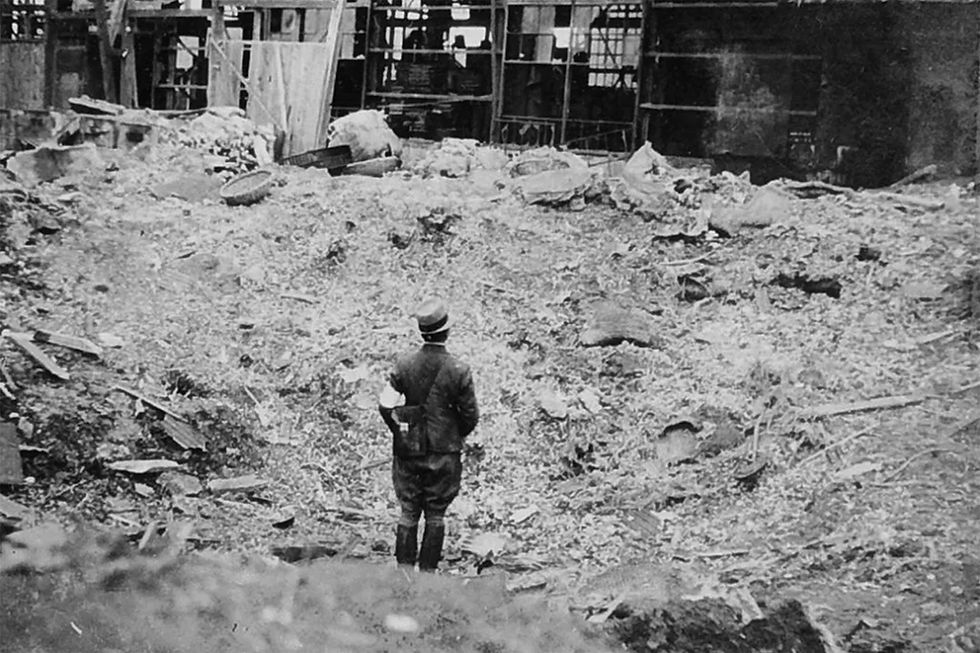
After completing their attacks, the crews continued toward China as planned. Because of the earlier launch distance, fuel shortages became critical. Most aircraft ran out of fuel before reaching their designated landing zones. Crews were forced to bail out or crash-land in difficult terrain across China. Several airmen were captured by Japanese forces. Some died in captivity, while Chinese civilians and resistance networks risked severe reprisals to assist the surviving crews. Japanese retaliation in occupied China was brutal, leading to significant civilian suffering.

Although all 16 aircraft were lost, most of the raiders survived the mission.
The Doolittle Raid had consequences beyond morale. Japanese planners, alarmed by the vulnerability of the home islands, accelerated operations aimed at extending their defensive perimeter. This contributed to the chain of events leading to the Battle of Midway in June 1942, where Japan lost four fleet carriers in a decisive turning point of the Pacific War.

From an aviation perspective, the mission showcased how creative use of available aircraft and carrier power could produce outsized strategic results.
The Doolittle Raid remains one of the most celebrated missions in military aviation history. It combined technical improvisation, pilot skill and extraordinary courage at a time when victory seemed uncertain.

For aviation historians, the raid is a reminder that aircraft are not defined solely by design specifications, but by how imaginatively they are employed. More than eight decades later, the launch of sixteen B-25s from the deck of USS Hornet (CV-8) continues to stand as one of the boldest moments ever witnessed in combat aviation.





Una buena presentación hace que cualquier tema sea más fácil de consultar. Para quienes disfrutan de referencias relacionadas con la fortuna, números de la suerte pueden convertirse en una consulta entretenida, rápida y sencilla que añade variedad a la rutina diaria.
Fascinating read on the Doolittle Raid! It's incredible how this bold mission not only showcased innovation but also had a significant impact on morale during WWII. The adaptability of military aviation is truly remarkable. Word to markdown, this article is a must-read for history enthusiasts.
The best part about Drive Mad is how creative the level design becomes over time. Some maps require speed, while others are more about careful control and avoiding sudden flips.
If you’re looking for a game that instantly grabs your attention, Run 3 is the answer. Its dynamic levels, clever mechanics.