


Blohm & Voss BV 141 - Asymmetric Reconnaissance From WWII
By Garth Calitz

The Blohm & Voss BV 141 stands out in aviation history as one of the most unusual and radical aircraft designs ever flown. Developed in Germany in the late 1930s, its quirky, asymmetrical structure was born from a particular operational need: maximum observational visibility. However, it ended up being one of the Luftwaffe’s most fascinating engineering experiments. Despite strong performance in flight tests, it never achieved full-scale production, overshadowed by conventional designs and competing requirements.

In 1937, the Reichsluftfahrtministerium (RLM), the German Air Ministry, issued a requirement for a single-engine, three-seat tactical reconnaissance aircraft that offered outstanding visibility for observation missions. At the time, reconnaissance was seen as a critical function on the battlefield, providing real-time intelligence on enemy movements and artillery spotting.

Blohm & Voss, primarily known for shipbuilding and flying boats, was not initially invited to participate in the official competition. Nevertheless, its design team, led by Dr Richard Vogt, decided to pursue the challenge as a private venture. Vogt’s answer was radical: instead of a conventional, symmetrical fuselage, he proposed an asymmetric layout that placed the crew cabin on one side and the engine and tail boom on the other.

At first glance, the Bv 141’s design looks like it was drawn up by someone who lost a bet. The crew cabin was stuck on the starboard side in a glass bubble, giving the crew a panoramic view perfect for spying. Meanwhile, the engine, a lone BMW radial piston, was slapped on the front of a boom fuselage to port, with the tail surfaces hanging off the back like an afterthought.

The Bv 141's design was primarily focused on visibility. For reconnaissance missions, pilots and observers needed to have a clear view of the ground in every direction. Conventional aircraft, with their centrally located fuselages and cabins, often had blind spots due to structural components. By positioning the crew nacelle to one side and using uninterrupted glazing, these blind spots were greatly minimized.
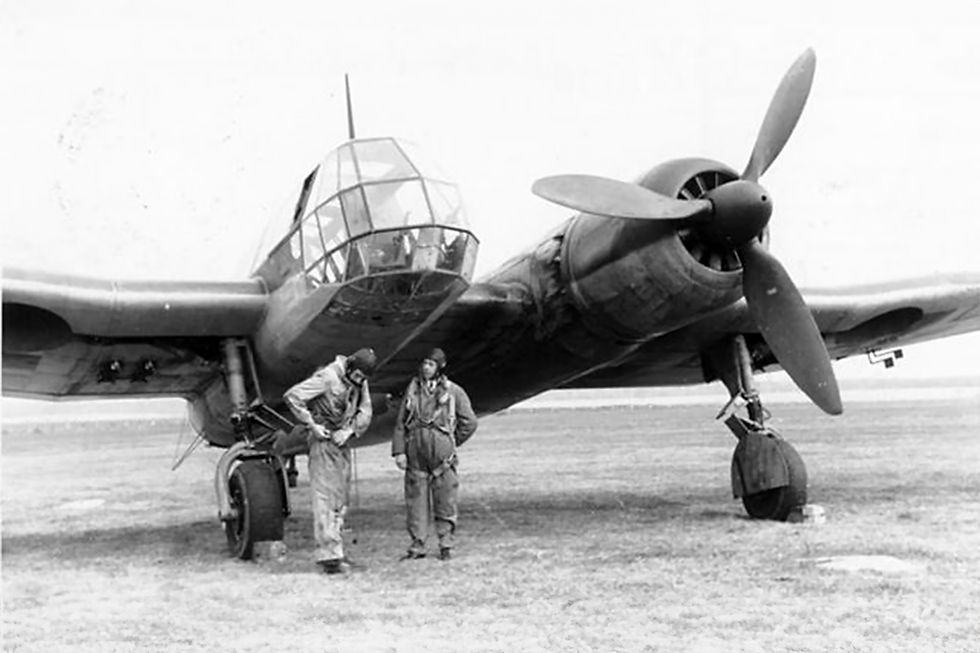
Engineers also had to address the aerodynamic challenges inherent in such an uneven distribution of mass and drag. The wings were carefully designed so that lift helped balance the aircraft and the flight controls were tuned to counteract any yaw or handling issues from the asymmetric layout. Remarkably, flight testing showed that the Bv 141 handled predictably and did not suffer severe stability problems typical of such unconventional configurations.

Initially, three prototypes were constructed, named Bv 141 V1, V2, and V3, with the maiden flight taking place on 25 February 1938. These early prototypes demonstrated the feasibility of the concept, prompting the Luftwaffe to order a limited series of pre-production aircraft, designated Bv 141 A-0.

However, the initial production models were powered by an underpowered BMW 132N nine-cylinder radial engine, which limited performance. To address this, later versions were equipped with a much more powerful BMW 801A 14-cylinder radial engine, delivering significantly better performance.
Variants included:
Prototypes (V1–V3) — initial flight-test models.
Bv 141 A-0 — pre-production evaluation aircraft.
Bv 141 B-0 and B-1 — improved versions with upgraded powerplants and other refinements.
In total, around 28–38 examples were constructed, including prototypes and pre-series aircraft, but none were ever mass-produced.
Technical Specifications:
Though specifications varied slightly among versions, the Bv 141B, the most advanced iteration, is most representative of the aircraft’s capabilities:
Crew: 3 (pilot, observer, rear gunner)
Length: 13.95 m
Wingspan: 17.45 m
Powerplant: 1 × BMW 801A radial piston engine 1,500 hp
Maximum Speed: 272 mph at altitude
Range: up to 1,900 km (1,181 mi)
Service Ceiling: 32,800 ft
Armament: machine guns and provision for light bombs for self-defence and limited strike roles.
This combination of performance and range made it competitive with other reconnaissance aircraft of the era, particularly given its excellent observational capabilities.

Although the Bv 141 performed comparatively well in flight testing, it never advanced beyond limited operational use. A few aircraft were used for service trials, including missions over the United Kingdom and the Eastern Front in 1941. These missions helped validate the aircraft’s handling and visibility but did not lead to full deployment.
Several factors contributed to the program’s cancellation by 1943. Competition from the twin-engine Focke-Wulf Fw 189 “Uhu,” which the Luftwaffe favoured for tactical reconnaissance roles.

Due to engine prioritisation, the BMW engines needed for the Bv 141 were also in demand for high-priority fighter aircraft such as the Fw 190. The Luftwaffe leadership, following conservative procurement policies, often favoured conventional designs and was cautious of the logistical and production challenges posed by unconventional airframes.

Although the Bv 141 never became a primary aircraft on the front lines, it remains one of the most inventive and unique aircraft of World War II. Its asymmetrical design defied traditional ideas about aircraft structure and impacted subsequent experimental aircraft globally. 8Today, no original Bv 141 aircraft are known to survive, making it a rare subject of study for aviation historians and modellers. Its innovative mindset and technical daring continue to captivate enthusiasts interested in unconventional engineering solutions.





Comments