


2,000 E-Jets: Apparently Airlines Like the Right-Sized Aircraft
- 10 hours ago
- 4 min read
By Garth Calitz

There are aircraft programmes that arrive with grand promises, enormous launch orders and enough PowerPoint slides to fill a hangar. Then there is the Embraer E-Jet, which quietly went about its business, convinced airlines that a 70- to 150-seat jet could actually be useful, and has now reached the rather significant milestone of 2,000 deliveries.

Embraer celebrated the delivery of its 2,000th E-Jet on September 2, 2026, with the milestone aircraft, an E195-E2, handed over to Brazilian carrier Azul Linhas Aéreas. And because aviation apparently enjoys symmetry, the aircraft is also Azul's 50th E2, giving both companies something rather more substantial than a cake and a photograph beside an aeroplane to celebrate.

The achievement places the E-Jet family among the three largest commercial jet programmes in the world, according to Embraer. That is quite an accomplishment for an aircraft family that was originally designed to occupy the space between traditional regional jets and the increasingly oversized single-aisle aircraft that airlines were being encouraged to buy whether they needed all those seats or not.
The first E-Jet entered commercial service in 2004, when LOT Polish Airlines began flying the E170. Twenty-two years later, the family has expanded to include the E170, E175, E190, and E195, followed by the second-generation E190-E2 and E195-E2. The result is an aircraft family that has managed something remarkably difficult in commercial aviation: staying relevant while the market around it changed repeatedly.
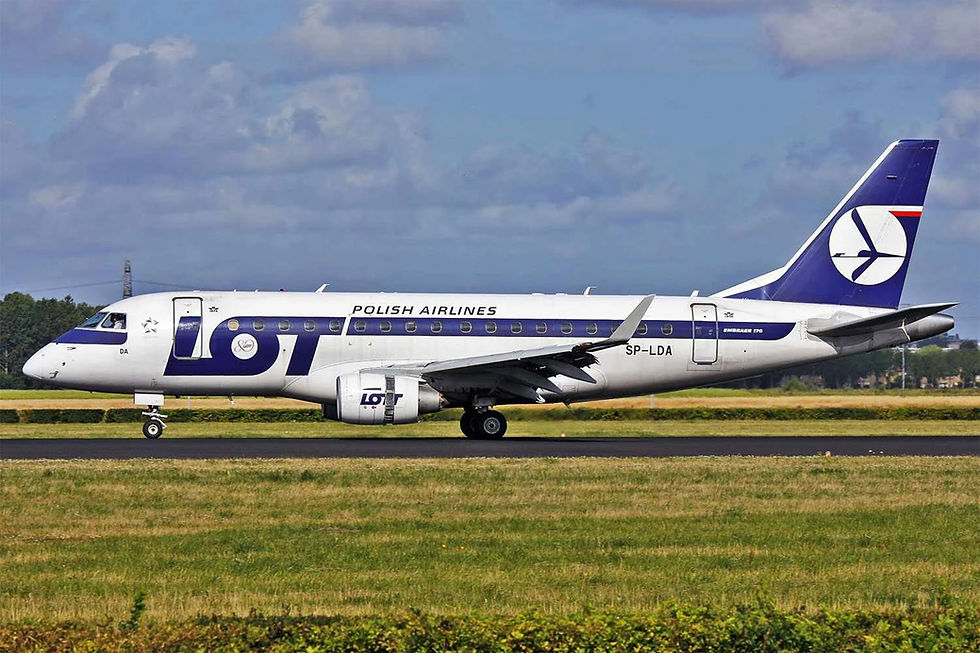
And the numbers are difficult to argue with. The global E-Jet fleet has accumulated approximately 48 million flight hours and carried more than 2.85 billion passengers. More than 80 airlines in over 60 countries have operated E-Jets, turning what was once something of a niche aircraft concept into a genuinely global programme.

The road to 2,000 deliveries was not exactly a straight line, however. Embraer reached its 1,000th E-Jet in 2013, followed by the 1,500th in 2018. The final 500 have taken almost eight years, a period that conveniently included a global pandemic, a collapse in air travel, supply chain problems, and the transition from the original E-Jet generation to the considerably more sophisticated E2 family.

The E-Jet's success has also been helped by something that sounds almost embarrassingly sensible in an industry that sometimes likes to make things complicated: size matters. Not every route needs a Boeing 737 or Airbus A320. Not every city can fill one. And not every airline wants to operate a 180-seat aircraft with a respectable number of empty seats simply because the timetable says there should be a jet there.
The E-Jet filled that gap exceptionally well. It gave airlines enough capacity to open routes that would have been uneconomic with larger aircraft, while offering considerably more range, comfort and capability than the regional jets it increasingly replaced.
That philosophy became even more apparent with the E2 generation.
The E195-E2, which forms the centrepiece of the 2,000th-delivery celebration, is considerably more than a re-engined version of its predecessor. With new Pratt & Whitney PW1900G engines, a completely redesigned wing and extensive aerodynamic improvements, the E2 was developed to reduce fuel burn and operating costs while retaining the basic proposition that made the original E-Jets successful.

Azul has been there almost from the beginning of that particular story. The airline became the launch customer for the E195-E2, receiving its first aircraft in 2019. Since beginning operations in 2008, Azul has operated more than 140 E-Jets, making it one of the programme's most important customers and giving the 2,000th delivery an appropriately Brazilian ending.

Embraer was traditionally associated with regional aircraft. The E-Jet changed that perception. It allowed the Brazilian manufacturer to move decisively into the lower end of the mainline commercial jet market and establish itself as a serious competitor to aircraft produced by manufacturers with substantially deeper pockets and considerably more experience producing large commercial jets.
The fact that the E-Jet family now sits alongside the Boeing 737 and Airbus A320 families among the world's three biggest commercial jet programmes is therefore rather more significant than the number 2,000 might initially suggest.
There have been plenty of predictions over the years that airlines would simply migrate towards larger aircraft, that regional jets would disappear, or that the E-Jet's particular slice of the market would eventually be swallowed by something bigger. Instead, the market seems to have spent the past two decades proving that airlines quite like having the right-sized aircraft.
The 2,000th E-Jet is therefore not merely another aircraft rolling out of São José dos Campos. It is evidence that there was, and remains, a substantial market for an aircraft that doesn't insist on pretending every route is a trunk route. And somewhere in Brazil, 2,000 E-Jets later, Embraer is probably entitled to enjoy the moment.

After all, the little regional jet that was never quite supposed to become a global commercial heavyweight has now joined the aviation industry's 2,000-aircraft club. Not bad for a programme that started life by simply trying to put the right number of seats in the right-sized aircraft.





Comments