


Vertical Aerospace Prepares for Final Transition Testing After Successful Wingborne Flights

Vertical Aerospace, a leading global aerospace and technology company at the forefront of electric aviation innovation, has announced the successful completion of Phase 3 piloted wingborne flight testing for its VX4 prototype.

The full-scale VX4 has successfully completed takeoff, flight, and landing operations akin to a conventional aircraft, utilising lift generated by its wings. This quiet, low-power mode is crucial for the practicality, scalability, and economic viability of electric air travel.

During the wingborne phase, Chief Test Pilot Simon Davies and Test Pilot Paul Stone executed flights, alternating between direct (manual) control and flight (computer-assisted) control modes. The VX4's performance matched simulator predictions, validating both the design integrity and the aircraft's ease of handling.

Working closely with the UK Civil Aviation Authority (CAA), which is collaborating with the European Union Aviation Safety Agency (EASA) for their concurrent validation and certification of the VX4 to the highest safety standards required for commercial use, Vertical secured approvals for flight testing in open airspace by extending its Permit to Fly following a rigorous review of safety and technical documentation.
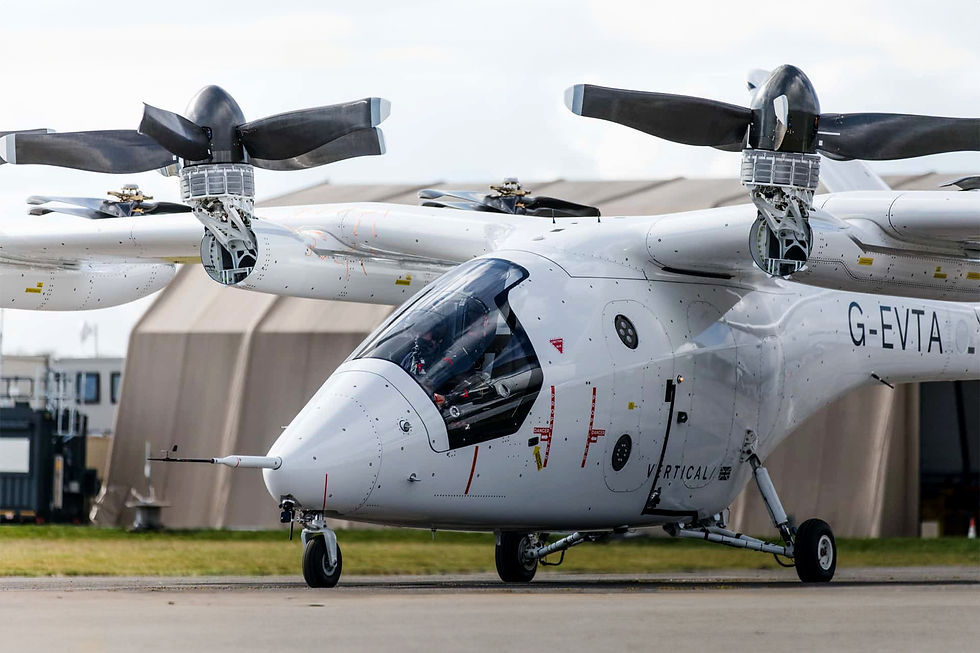
After successfully executing Europe's inaugural piloted wingborne flight of a winged eVTOL in May 2025, Vertical has:
Completed piloted flight tests covering 250 miles / 400 km
Reached a top speed of 120 knots / 222 km/h and an altitude of 2,000 ft
Collected over 22 billion data points, validating aerodynamic models, acoustic levels, system reliability and performance

Vertical is advancing to the final testing phase: transition. This stage will demonstrate the VX4's capability to seamlessly switch between vertical lift ("helicopter mode") and wingborne flight ("aeroplane mode"). This defining feature of a tiltrotor eVTOL aircraft enables it to take off and land in confined spaces. This will be the operational mode utilised in passenger services.


Simon Davies, Chief Test Pilot, said: “Paul Stone and I have had the privilege of flying this machine through its wingborne test phase. It’s been incredibly rewarding, with the aircraft performing just like the simulator during our first flights in open air space. With the high-quality data we’ve gathered and the ability to test at both high and low speeds, we are in the best possible place to explore transition with our proven tools and flight test team.”

Vertical continues to target type certification in 2028, working concurrently with the CAA and EASA, with validation across other regulators to follow. On 3 September, Vertical also announced the appointment of Patrick Ky, former EASA Executive Director, to its Board.

Patrick will join Professor Scott Galloway, Sri Tony Fernandes, founder of Air Asia Group, Lord Parker, former MI5 Director General and members of Vertical’s Executive team and Board at Vertical’s Capital Markets Day on 17 September in New York to share further updates and views on the business’ progress.




Comments