


Two Engines, Twice the Trouble? The Future of the Piston Twin
By Garth Calitz
For decades, the light piston twin was the aircraft of choice for pilots who wanted to travel farther, carry more and enjoy the reassurance of having a second engine. From the Beechcraft Baron and Piper Seneca to the Cessna 310, these aircraft became familiar sights at airports around the world, serving private owners, businesses, flying schools and charter operators.

Today, however, the piston twin finds itself at a crossroads. Modern single-engine aircraft offer impressive performance, turboprops deliver greater speed and payload, and the cost of maintaining two engines has become increasingly difficult to justify. Even some of the most established names in general aviation are facing an uncertain future.

So, is the piston twin becoming aviation's equivalent of the fax machine, or is there still life left in the old two-engine formula?
The answer is more interesting than simply declaring the category obsolete. The traditional light twin may be losing ground, but a new generation of aircraft is attempting to reinvent it. The appeal of a twin-engine aircraft is easy to understand. Two engines provide a degree of propulsion redundancy, while many designs offer greater payload, higher cruise speeds and improved performance compared with similarly sized single-engine aircraft. The difficulty is that redundancy comes at a price.
Two engines mean two sets of maintenance requirements, more components to inspect and potentially two propellers requiring attention. Fuel consumption, insurance and overhaul costs can quickly turn an attractive aircraft purchase into an expensive exercise in financial endurance. For an owner flying 200 hours annually, the economics may be manageable. For someone flying 50 hours a year, the additional costs can be difficult to defend.

And there is another inconvenient truth: a second engine does not automatically make an aircraft safer in every situation. Following an engine failure, a light twin's performance depends on aircraft weight, density altitude, remaining engine power, pilot proficiency and the surrounding terrain. In some circumstances, the aircraft may struggle to maintain altitude. The twin remains a valuable tool, but its benefits need to be understood rather than assumed.
Meanwhile, high-performance singles have become formidable competitors. Aircraft such as the Cirrus SR22 and the non-type-certified RV 10 combine respectable speed, modern avionics and, in equipped versions, a whole-aircraft parachute system. The result is an aircraft that can satisfy many private owners without the maintenance burden of a second engine. For manufacturers, the challenge is no longer simply building a twin that flies well. It is building one that makes financial sense.

Fortunately, not everyone has abandoned the concept. Italian manufacturer Tecnam is developing the piston twin along rather different lines with its P2006T NG. The four-seat aircraft uses two Rotax 912iSc3 engines and modern Garmin G1000 NXi avionics, with an emphasis on fuel efficiency, training and private ownership.

Tecnam announced in January 2026 that FAA certification for the North American market was expected in the fourth quarter of 2026, with initial deliveries planned for the first quarter of 2027, subject to certification. The aircraft had already entered service in other markets. The significance is not merely that another twin is available. It is that manufacturers are rethinking what a light twin should cost to operate.
The P2006T family has established a presence in multi-engine training, where operating costs directly affect a school's ability to remain competitive. Its latest evolution also offers configurations aimed at private owners and specialised missions.


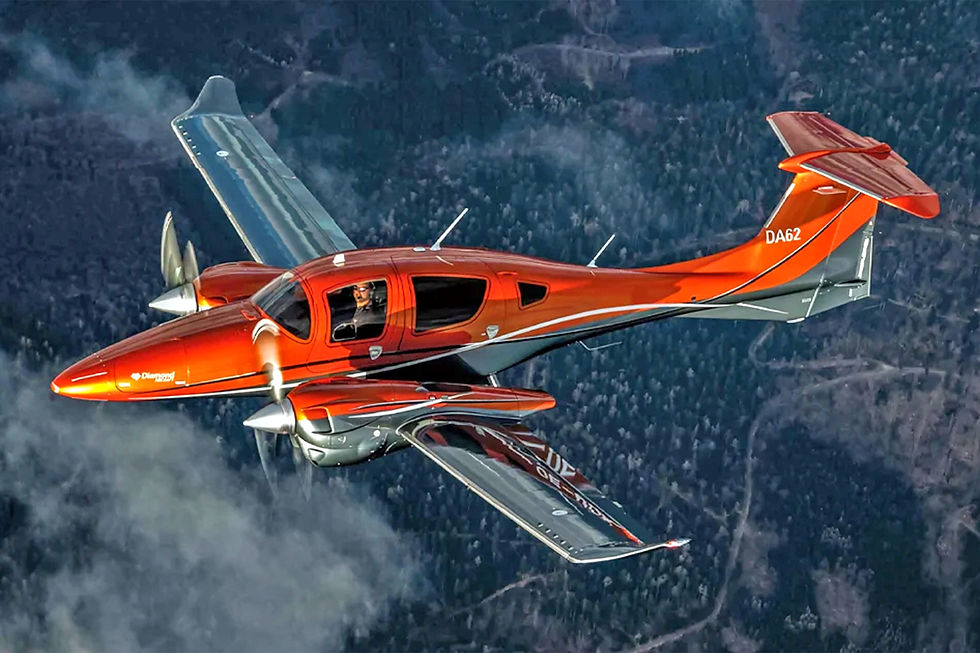
Diamond Aircraft has taken another route with its DA62. Using diesel-cycle engines that burn Jet A fuel, composite construction and a modern cockpit, the DA62 demonstrates how efficiency and useful capability can coexist in a premium twin.

The aircraft is also available in specialised surveillance configurations, illustrating an important point: the future of the piston twin may depend less on recreational ownership and more on finding jobs where two engines genuinely earn their keep.

Perhaps the most interesting development for South African general aviation is taking place much closer to home. Sling Aircraft, already known internationally for its lightweight, Rotax-powered aircraft, is developing a new twin-engine design that could offer a distinctly different approach to the traditional light twin.

The Sling Twin, which has yet to receive an official production name, is being developed under the leadership of designer Mike Blyth, one of the founders of the company that became Sling Aircraft. The design is complete, and construction of prototype 001 is under way in Cape Town, where the aircraft's tail components have already been produced, and assembly has begun. First flight is targeted for June 2027, although, as with any new aircraft programme, the schedule remains subject to development progress.
The project is particularly interesting because of the regulatory changes that have helped make it commercially feasible. The US Federal Aviation Administration's Modernisation of Special Airworthiness Certification initiative, better known as MOSAIC, has expanded the possibilities for light-sport aircraft, including twin-engine designs. Sling sees an opportunity to develop a modern aircraft that could serve the multi-engine training market without inheriting all the cost and complexity associated with older designs.

One of the most dependable markets for light twins remains professional flight training. Pilots seeking multi-engine qualifications need aircraft that can demonstrate asymmetric flight, engine-out procedures and the handling characteristics associated with operating two engines. Flight schools, therefore, have a practical reason to maintain twin-engine fleets. However, training organisations are highly sensitive to operating costs. Every additional litre of fuel, maintenance hour or component replacement affects the price charged to students.
This is where lighter, fuel-efficient twins could make a difference. An aircraft designed around economical training operations may be more attractive than an older, heavier design with substantially higher running costs. There are encouraging signs of continued demand. In September 2026, Tecnam announced that Epic Flight Academy in the United States had added two P2006T aircraft to its fleet for multi-engine training. That is hardly evidence of a mass-market revival, but it demonstrates that the aircraft still has a defined commercial purpose.

The piston twin's future may also lie in specialised operations rather than conventional passenger transport. Surveying, mapping, environmental monitoring, aerial photography and surveillance can all require aircraft capable of carrying specialist equipment over extended periods. A twin may offer useful redundancy and equipment-carrying capacity without the acquisition and operating costs of a turboprop.
In South Africa, these applications deserve attention. Our distances are substantial and aerial work supports sectors ranging from agriculture and conservation to infrastructure development and security. Nevertheless, the economics must be examined carefully.

A twin is not automatically the best choice simply because it has two engines. For some missions, a single-engine aircraft may offer lower costs and perfectly adequate performance. For others, a turboprop may provide the payload, speed or operational capability required. The winning aircraft will be the one that best matches the mission, rather than the one with the most impressive specification sheet.
South Africa has a long-established general aviation community, but local operators face familiar challenges: expensive maintenance, parts availability, fuel costs and a relatively small market for new aircraft. A modern, economical piston twin could appeal to flying schools and private operators, particularly where multi-engine training or regular business travel justifies the investment.
Jet A compatibility could also be attractive in locations where avgas availability or pricing is problematic. However, fuel compatibility alone will not solve the problem. Acquisition costs, maintenance expertise, certification, insurance and long-term manufacturer support remain essential considerations.
The second-hand market will continue to play an important role. Older Barons, Senecas and other established twins may remain practical choices for owners who understand their maintenance histories and operating requirements. Yet age brings its own complications, and a low purchase price can conceal a substantial maintenance liability.
The retirement of established production lines would make long-term parts support particularly important. Textron Aviation announced in November 2025 that production of the Beechcraft Baron G58 and Bonanza G36 would end once existing orders had been fulfilled, highlighting the commercial pressures facing traditional piston aircraft. Existing aircraft will not simply disappear, but the decision underlines how difficult it can be to sustain mature designs in a changing market.
The piston twin is unlikely to return to the prominence it enjoyed during general aviation's post-war expansion. Modern singles have captured much of the private-owner market, while turboprops dominate applications requiring greater performance and payload. But disappearance is another matter.

Efficient engines, modern avionics, improved aerodynamics and more specialised configurations could give the piston twin a sustainable future. Electric and hybrid propulsion may eventually contribute, although battery weight, range and certification remain formidable obstacles for practical multi-seat aircraft. Ultimately, the twin must justify its second engine through meaningful operational benefits.
For South African aviation, the most promising opportunities may be multi-engine training, specialised aerial work and private operations where the aircraft's capabilities justify the additional cost.
The piston twin is not dead. It is simply being forced to explain itself.
And in an industry where fuel bills, maintenance invoices, insurance premiums and TBO's have become almost as intimidating as a crosswind landing, that may be the most important test of all.
The future belongs not to the aircraft with two engines, but to the aircraft whose owner can afford to keep both of them running.





Comments