


The Lockheed C-5A Galaxy - 58 Years Since the Giant Took Flight
By Garth Calitz

30 June 2026 marks 58 years since one of the most ambitious aircraft ever built first took to the skies. On 30 June 1968, the Lockheed C-5A Galaxy made its maiden flight from Lockheed's production facility in Marietta, Georgia, introducing a military transport aircraft unlike anything the world had seen before.

At the controls was Lockheed chief engineering test pilot Leo Sullivan, who guided the massive prototype through a successful 84-minute first flight. For the engineers and designers who had spent years overcoming unprecedented technical challenges, it was proof that the world's largest military transport aircraft could fly exactly as intended.

More than half a century later, the Galaxy remains one of the cornerstones of the United States strategic airlift and continues to perform missions that few other aircraft on Earth can accomplish.

The origins of the C-5 Galaxy lie firmly in the geopolitical tensions of the Cold War. During the early 1960s, the United States recognised that existing transport aircraft, including the Douglas C-124 Globemaster II and the Lockheed C-141 Starlifter, lacked the capacity to move increasingly large armoured vehicles, helicopters and missile systems rapidly across the globe.
The U.S. Air Force issued the Cargo Experimental Heavy Logistics System (CX-HLS) requirement, calling for an aircraft capable of carrying more than 100 tonnes of cargo over intercontinental distances without refuelling. It also needed to operate from relatively austere airfields and allow rapid loading and unloading in combat zones.

Several manufacturers competed for the contract, including Boeing, Douglas and Lockheed. In 1965, Lockheed emerged as the winner, securing what would become one of the most significant military aviation programmes of the twentieth century. The contract not only saved Lockheed's military aircraft division but also established the Marietta plant in Georgia as one of the world's premier military aircraft production facilities.

When engineers began designing the aircraft, they quickly realised there were few precedents to follow. Everything about the C-5 had to be developed on a scale never before attempted. Measuring 75.5 metres in length with a wingspan of 67.9 metres and standing nearly 20 metres tall, the Galaxy was so large that many existing hangars could not accommodate it.
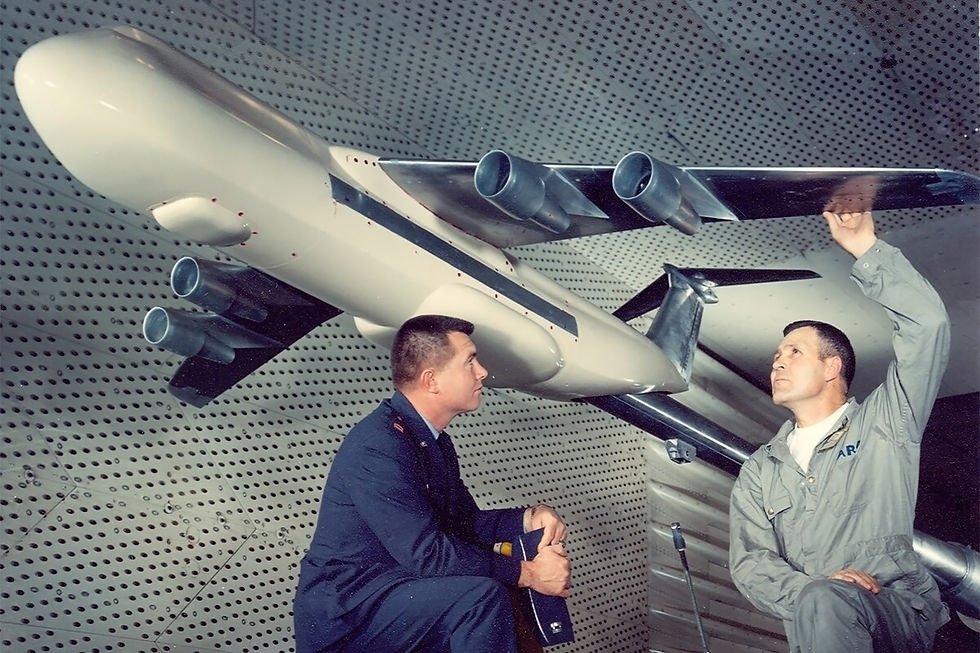
Its cargo compartment remains one of the largest ever built into a military aircraft, stretching over 36 metres in length and providing enough internal volume to carry six helicopters, multiple armoured vehicles or two M1 Abrams main battle tanks.

The aircraft introduced several innovations that have since become standard on heavy military transports.
The distinctive upward-opening nose allowed cargo to be loaded from the front, while a rear loading ramp enabled complete drive-through loading. Combined with the aircraft's unique kneeling landing gear, vehicles could simply drive on at one end and off the other, dramatically reducing turnaround times.

The landing gear itself remains an engineering marvel. With 28 wheels spread across five landing gear assemblies, the Galaxy can distribute its enormous weight over a surprisingly small footprint, allowing it to operate from airfields that would otherwise struggle to support such a massive aircraft.

When the C-5 entered service in 1970, it became the world's largest operational aircraft. It held that title until the Soviet Union unveiled the Antonov An-124 Ruslan in the 1980s. Even today, only a handful of aircraft surpass the Galaxy in overall size or payload capability.

Despite being eclipsed in some respects, the C-5 remains one of the largest aircraft ever to enter regular military service and continues to rank among the world's most capable strategic airlifters.

Notwithstanding its impressive capabilities, the C-5 programme experienced significant growing pains. Costs escalated rapidly during development, making it one of the most expensive defence projects of its era. Technical issues, particularly involving wing fatigue, emerged after the aircraft entered service. Cracks began appearing in the wings far earlier than expected, prompting payload restrictions and generating widespread criticism.

The controversy became a political storm in Washington and contributed to sweeping reforms in military procurement. Fortunately, engineers developed a completely redesigned wing structure. Between 1981 and 1987, every operational C-5A received new wings, restoring the aircraft's full performance and extending its operational life by decades.

Few aircraft have transported such an extraordinary range of cargo. Throughout its career, the Galaxy has carried everything from Apache and Black Hawk helicopters to Patriot missile batteries, bridge-laying equipment, combat engineering vehicles, satellites, humanitarian relief supplies and even sections of spacecraft.

During Operation Desert Shield and Desert Storm in 1990 and 1991, C-5 Galaxies transported nearly half of all oversized cargo delivered to the Middle East while flying only a small percentage of total airlift missions. The aircraft has also supported disaster relief worldwide, delivering food, medical equipment, field hospitals and emergency vehicles following earthquakes, tsunamis and hurricanes. Its versatility has earned it the unofficial nickname "America's oversized cargo truck."

Beyond its size, the Galaxy possesses several fascinating characteristics.
The upper deck contains seating for more than 70 passengers, allowing troops to travel above the cargo compartment while equipment occupies the main deck below.
The flight deck sits almost six storeys above the ground, giving pilots a commanding view but also requiring lengthy access stairways.
Its cargo hold is pressurised and climate-controlled, enabling it to transport sensitive military electronics, medical equipment and even live animals.
One unusual capability is its ability to carry aircraft. Smaller helicopters can be loaded with their rotor blades removed, while complete fighter aircraft have occasionally been transported after partial disassembly.
By the early 2000s, replacing the C-5 fleet would have been prohibitively expensive. Instead, the U.S. Air Force embarked on the Reliability Enhancement and Re-engining Program (RERP), transforming selected aircraft into the C-5M Super Galaxy.

New General Electric F138 engines increased thrust by over 20% while reducing fuel consumption and maintenance requirements. Combined with modern digital avionics, autopilot systems and improved reliability upgrades, the modernised aircraft can climb faster, operate from shorter runways and achieve mission completion rates exceeding 80%, dramatically higher than the original C-5A fleet.

Today, approximately 50 C-5M Super Galaxies remain in service with the U.S. Air Force's Air Mobility Command, where they operate alongside the Boeing C-17 Globemaster III.
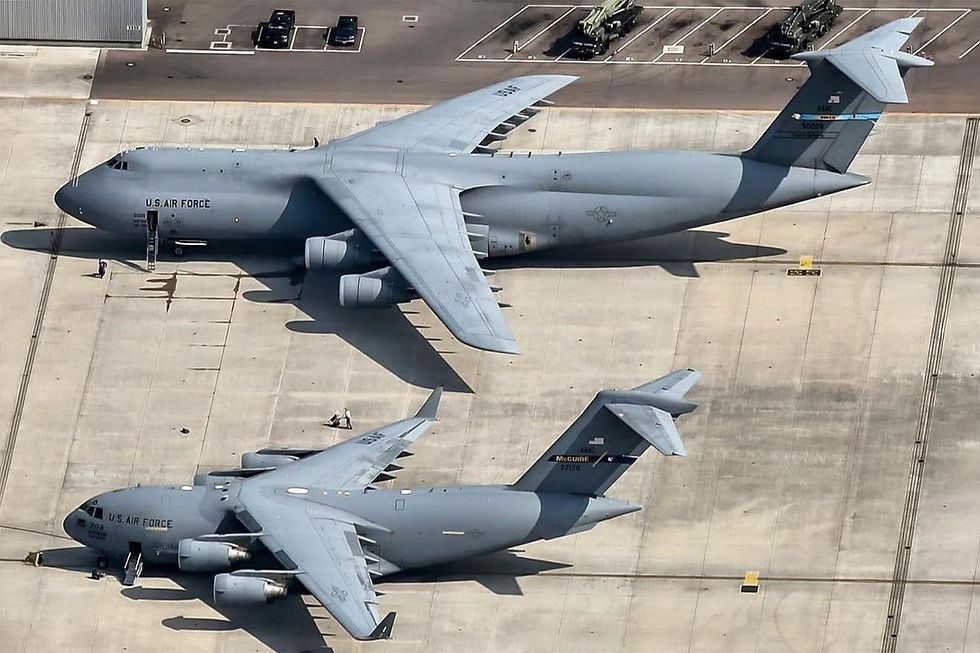
Fifty-eight years after its maiden flight, the Lockheed C-5 Galaxy remains one of aviation's true engineering icons. Despite its turbulent beginnings, the aircraft evolved into one of the most successful strategic airlifters ever built. Its enormous cargo capacity, innovative loading systems and remarkable longevity have allowed it to support military operations, humanitarian relief missions and global logistics for more than five decades.

Few aircraft can claim to have changed military logistics as profoundly as the C-5 Galaxy. As it approaches six decades of service, the giant that first lifted off over Georgia in June 1968 continues to prove that some engineering achievements truly stand the test of time.





It’s amazing that the C-5 Galaxy has been around for so long. Those huge transport planes are still impressive to look at, even after all these years. Aviation history is always interesting to read about. When I’m taking a break from browsing articles, I sometimes play a few free games on minigame. You can just click and play, which is pretty handy.
The controls in Drive Mad feel responsive, and restarting a failed level is fast enough that I kept playing longer than expected.