





The Impact of War on Civilian Aircraft Development
By Garth Calitz
Throughout the history of aviation, war has been one of the most powerful, even if uncomfortable, forces shaping the development of civilian aircraft. While conflict brings devastation and human suffering, it has repeatedly accelerated technological progress, industrial capability and operational expertise that later migrated into commercial aviation. From jet propulsion and advanced materials to navigation systems and global airline networks, the influence of war on civilian aircraft design and operation remains unmistakable.

Periods of war compress decades of research and development into a few urgent years. Military necessity demands aircraft that fly higher, faster, further and more reliably, often under extreme conditions. These pressures have historically driven breakthroughs that would have taken far longer in peacetime.

The jet engine stands as the clearest example. Developed independently in Germany and the United Kingdom during the Second World War, jet propulsion was initially pursued to gain a military advantage. Within a few years of the war’s end, the technology transitioned into civil aviation, fundamentally reshaping air travel. Aircraft such as the de Havilland Comet, followed by the Boeing 707 and Douglas DC-8, ushered in the jet age, cutting travel times dramatically and making intercontinental air travel routine.
Advances in aerodynamics also followed a similar path. Swept wings, high-speed airfoil designs and pressurised cabins were refined through military research for bombers and fighters operating at high altitude and speed. These technologies later became standard features of modern airliners, improving efficiency, passenger comfort and operational capability.

War not only drives technological innovation; it also transforms how aircraft are built. The enormous production demands of major conflicts forced rapid advances in materials science and manufacturing processes. Aluminium alloys were refined for strength and weight reduction, while later conflicts accelerated the development of composites and titanium structures.
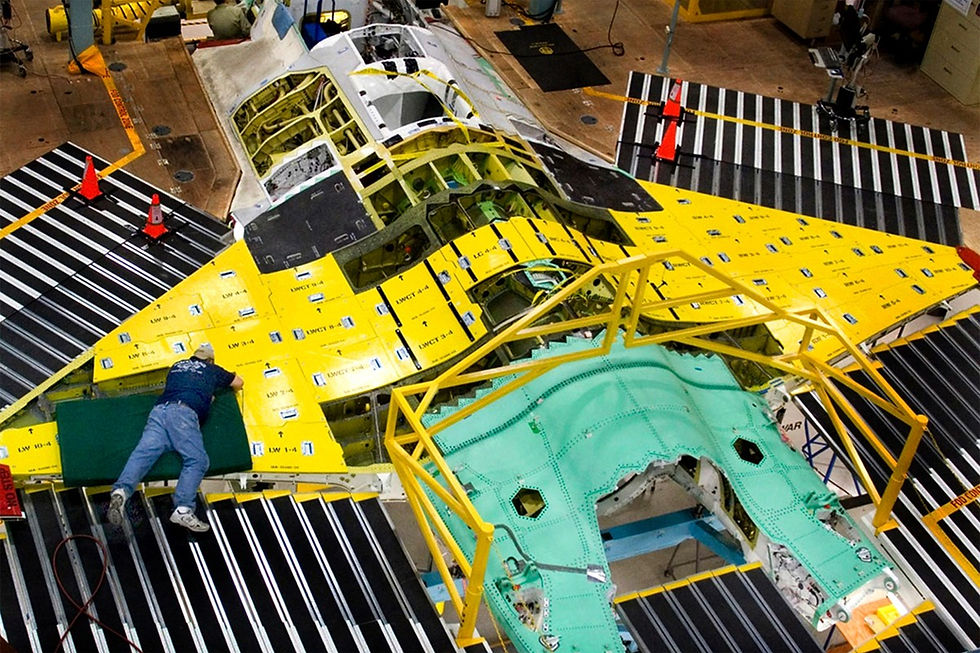
Equally significant was the shift to mass production. During the Second World War, aircraft manufacturers perfected large-scale production lines capable of delivering thousands of airframes. Companies such as Boeing, Douglas and Lockheed emerged from the conflict with vast industrial infrastructure, experienced workforces, and refined production techniques. This industrial base proved critical to the rapid expansion of commercial aviation in the late 1940s and 1950s.

Without wartime mobilisation, the global airline industry may have developed far more slowly, constrained by limited manufacturing capacity and higher costs.
Modern airline safety owes much to technologies first developed for military use. Wartime operations demanded reliable navigation in poor weather, at night and over hostile territory. As a result, radio navigation aids, radar and early avionics systems advanced rapidly.
These technologies later transitioned into civilian service, forming the backbone of instrument flight rules (IFR) operations and air traffic control systems. Radar-based surveillance, inertial navigation systems, and eventually satellite navigation all trace their roots to military requirements. What began as tools for survival in combat environments became essential components of safe and efficient airline operations.
One of the most immediate effects of major conflicts has been the availability of surplus aircraft and trained personnel. After both world wars, large numbers of military aircraft were converted for civilian transport roles. Perhaps the most influential example is the Douglas DC-3. Although designed as a civilian airliner, it was produced in vast numbers for military service as the C-47. After the war, these aircraft formed the backbone of airline fleets across the world, particularly in developing regions.

The DC-3 helped establish reliable air transport networks, proved the commercial viability of air travel, and enabled airlines to reach remote and underserved areas. At the same time, thousands of pilots, engineers, and maintenance personnel left military service with extensive experience, providing the human capital needed to grow the post-war aviation industry.

While not a single global conflict, the Cold War sustained an extraordinary level of military aviation investment over several decades. Competition between major powers drove advances in propulsion, avionics, flight control systems and aerodynamics. High-bypass turbofan engines, initially developed to improve the efficiency and range of military transport aircraft, became a cornerstone of modern civil aviation, delivering quieter, more fuel-efficient airliners.

Fly-by-wire systems, advanced cockpit automation and digital avionics also migrated from military programmes into civilian aircraft, improving safety and reducing pilot workload. Even ambitious civil projects such as Concorde were shaped by Cold War-era thinking, blending military-derived technology with national prestige, albeit with mixed commercial results.

Despite its role as an accelerator, war can also distort civilian aircraft development. Military priorities may favour performance over cost, efficiency, or maintainability, characteristics that are critical for commercial success. Some post-war airliners struggled precisely because they were too closely derived from military concepts rather than civil requirements. The Lockheed L-100 was a perfect example of this; it is a formidable workhorse, but sadly, its operating costs are prohibitive for everyday operations.

There is also the broader ethical reality: many of the advances that benefit civil aviation were forged in times of immense human suffering. The comfort, safety and global connectivity offered by modern air travel stand in stark contrast to the conditions that drove many of the underlying innovations.

War has rarely been the origin of aviation progress, but it has repeatedly acted as a brutal accelerator. Civil aviation has inherited technologies, skills and industrial capacity shaped by conflict, transforming them into tools for commerce, mobility and global connection. The enduring challenge for the aerospace industry is to sustain innovation at pace, without relying on war as the driving force behind progress.





Comments