


The Airbus H160 Revolutionising Emergency Response in Australia

Australia is a country celebrated for its breathtaking beauty and hospitable nature, but it is also marked by its extremes. Vast deserts stretch for hundreds of kilometres, rugged coastlines confront harsh seas, and bushland gives way to ravines and mountain ranges that challenge even experienced travellers. For emergency medical services (EMS) operators, the main threat isn't just the terrain or wildlife; it's the distance. When accidents or medical emergencies occur, patients are often located far from major hospitals. In this environment, a rapid and reliable aeromedical response is crucial, not merely a luxury.

Recognising these unique needs, Airbus Helicopters brought its next-generation H160 to Australia for a month-long demonstration tour, showcasing the aircraft's capabilities to helicopter emergency medical services (HEMS) operators across the continent. The tour included stops at key locations such as Melbourne, Sydney, and Brisbane, allowing local operators to experience firsthand an aircraft designed to meet modern mission requirements. The feedback was clear: the H160 has the potential to transform emergency medical aviation in Australia.

Australia's immense size presents a major challenge for HEMS operators, with communities being widely dispersed, requiring long-distance patient transport to specialised medical facilities. Richard Ward, Sales Manager at Airbus Helicopters, mentions that the H160 is perfectly equipped to handle these operational needs. “Australia is a vast country with a population distributed over huge distances, requiring aircraft with longer range,” Ward explains. “The H160 offers that capability, combined with a spacious cabin that is ideal for HEMS and search and rescue missions. Its maintenance-friendly design also ensures high aircraft availability, which is absolutely critical for emergency services.”
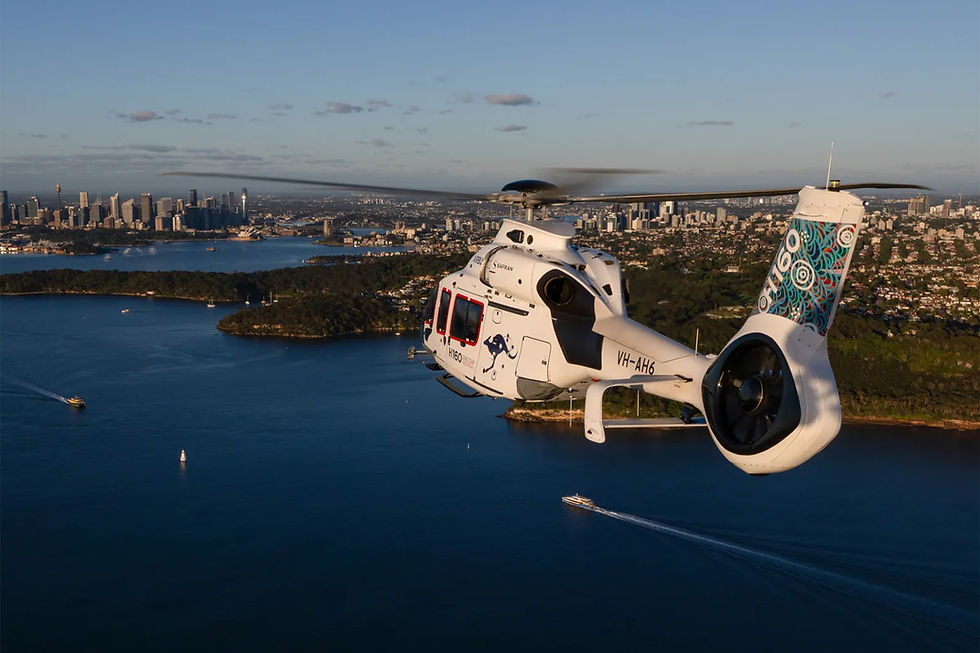
In Australia, range and availability are vital, often influencing life or death situations. The H160's ability to quickly cover large distances allows operators to extend their reach, ensuring that patients in remote areas receive advanced medical care within critical time limits.

Alongside its size and performance, the H160 marks a major leap forward in passenger and patient comfort. Ward highlights features that are particularly crucial for emergency medical missions, where patients may stay on board for long periods. “In HEMS operations, critically ill or injured patients can spend increasing amounts of time in the aircraft,” he says. “High vibration and noise levels can exacerbate patient distress and negatively affect their medical condition, while also increasing demands on the medical crew.”

The H160 tackles these issues directly. Boasting the lowest noise and cabin vibration levels in its class, the aircraft offers a quieter and more stable setting for both patients and medical personnel. This smoother experience enables clinicians to concentrate on treatment instead of adjusting for aircraft movement, while patients experience less stress during transport. “Ultimately, the H160 combines range, cabin size, comfort and efficiency,” Ward adds. “It is one of the most effective ways to transport patients over vast distances in the Australian environment.”

For pilots, emergency medical missions are some of the most demanding operations in aviation. Elements like time pressure, adverse weather, and complex terrain contribute to the heavy workload. Olivier Gensse, the main pilot for the Australian demo tour, asserts that the H160 offers a substantial benefit in these scenarios. “One of the ambitions behind the H160’s design was to create avionics that truly support the pilot and allow them to focus on the mission,” Gensse explains. “We wanted to make a step-change in safety. Pilot workload is very low, which is a key point, especially for HEMS missions.”

Australia's varied climate significantly affected Gensse throughout the tour, with weather conditions ranging from coastal patterns to harsh inland climates. However, he is confident that the H160's advanced systems can effectively manage these challenges. Features such as a highly capable autopilot and automated flight assistance systems are designed to reduce human error, even in difficult environments. “The pilot can use the autopilot to recover and stabilise the helicopter in almost any conditions,” he says. “There is even a pre-alert for vortex phenomena, and with the press of a single button, the autopilot can manage the situation. These systems give pilots an extra margin of safety when it matters most.”

The Australian demo tour offered operators a glimpse into the future of helicopter emergency medical services. It featured a larger, more versatile cabin tailored for advanced critical care, delivering smoother and quieter flights that benefit both patients and crews. The extended range also makes it possible to reach remote communities. Furthermore, the avionics allow pilots to concentrate on patient outcomes, while the high availability ensures the aircraft is always ready to respond.

In a country where distances are vast and conditions can be challenging, the Airbus H160 represents more than just a new helicopter; it sets a new standard for emergency response. For Australia's HEMS operators, advanced emergencies increasingly necessitate a next-generation solution, and the H160 is proving its ability to fulfil that need.





Comments