


South African Aircraft Dodge US Tariff Bullet — For Now
By Garth Calitz

South Africa’s aerospace industry has been handed an important reprieve in the latest round of US trade measures, with civil aircraft and aircraft parts and components specifically excluded from the 12.5% tariff imposed on South African exports. For an industry that has spent years building a reputation for producing capable, internationally competitive aircraft, the exemption is more than a footnote in a lengthy tariff schedule. It could make the difference between an aircraft remaining commercially attractive in the United States or suddenly becoming thousands of dollars more expensive at the point of entry.

Yet while the immediate news is positive, the wider picture is considerably more complicated, with Washington simultaneously examining imports of commercial aircraft, engines and aircraft components under a separate national-security investigation.

The importance of the exemption becomes particularly clear when looking at South Africa’s light-aircraft industry and, in particular, Sling Aircraft. The Johannesburg-based manufacturer has developed an unusually strong presence in the American market, with the United States accounting for roughly 50% to 55% of Sling’s total revenue. When the Trump administration first announced its tariff measures, Sling described the development as a major disruption to its business and was forced to rethink its market strategy almost immediately. The company responded by expanding its focus on Europe, South America, the Middle East and Asia while increasing production of ready-to-fly aircraft. Despite the disruption, Sling says 2025 ultimately became its best year ever, with 139 aircraft sold. It is perhaps a useful reminder that while politicians can redraw trade maps with a signature, manufacturers still have to build the aircraft.

The US market, however, remained too important to simply walk away from. Sling’s current product range includes the Sling LSA, Sling 2, Sling 4, Sling TSi and Sling High Wing, while its aircraft are already being used by flight schools across the United States. The company's 2026 documentation lists FAA-approved Sling aircraft operating at flight schools in states ranging from California and Florida to Texas, Hawaii, Missouri and New York. That established customer base gives the company something considerably more valuable than a collection of aircraft sales: it gives South African manufacturing a genuine foothold in the world's largest general aviation market. It also means that the fate of a South African aircraft manufacturer is, at least to some extent, being influenced by decisions made several thousand kilometres away by people who presumably have never had to explain a customs classification to a customer waiting for an aircraft.

The scale of Sling’s American operation is also illustrated by its latest production plans. The company says it is currently selling and delivering between three and four Sling NGT trainers per month into the United States, with those deliveries expected to continue for the year. That is a significant commitment to the American training market and illustrates why tariff policy matters so much to a South African manufacturer. Even a relatively modest import duty applied to a high-value aircraft can quickly become a substantial amount of money for the customer, distributor or manufacturer to absorb. Aviation already has enough expensive ways of making an aircraft more expensive without adding another one called "tariff".


The latest tariff decision therefore comes as welcome news. The United States Trade Representative has imposed a 12.5% Section 301 tariff on products from South Africa, but the accompanying exemptions specifically include civil aircraft and aircraft parts and components. South Africa’s Trade, Industry and Competition Minister Parks Tau confirmed that civil aircraft and their associated parts were among the products excluded from the tariff. The exemption places aircraft in a distinctly different position from many other South African manufactured products now facing additional costs when entering the American market. For once, the small print contains something an aviation manufacturer actually wants to read.

For a South African aircraft manufacturer, the mathematics are straightforward. On an aircraft with a customs value of $500,000, a 12.5% tariff would amount to $62,500 before other costs are considered. That money has to come from somewhere. The manufacturer could absorb it and sacrifice margin, the distributor could take the hit, or the cost could be passed directly to the customer. None of those options is attractive in a highly competitive market where buyers can choose between aircraft manufactured in numerous countries. Keeping civil aircraft outside the tariff regime therefore protects the price position of South African manufacturers and, perhaps more importantly, preserves the predictability needed for distributors and customers to continue placing orders. Predictability, of course, is paramount in business, although international trade policy is currently doing its best to test that theory.
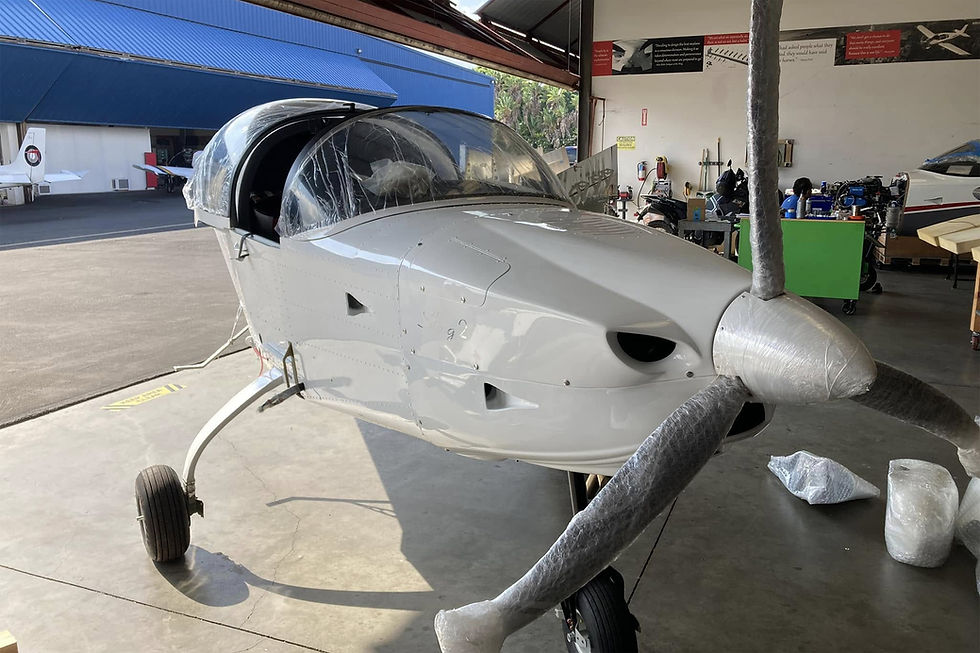
Sling is not the only example of South Africa's aerospace capability, although it is one of the clearest examples of a company whose business is directly connected to the civil-aircraft exemption. South Africa has a much broader aerospace manufacturing base, including sophisticated aerostructure and component manufacturing, as well as companies involved in military and specialised aircraft. Paramount’s AHRLAC programme is an excellent illustration of the latter. Developed and manufactured in South Africa, the AHRLAC was designed as a highly configurable aircraft for surveillance and other specialised missions, with Paramount previously stating that approximately 98% of the aircraft’s non-engine components were produced locally.

The AHRLAC example also highlights why tariff headlines need to be treated carefully. The current US exemption is specifically for civil aircraft and civil aircraft parts and components. It should not automatically be interpreted as a blanket exemption for every aircraft produced in South Africa. Military aircraft, defence systems and other products can fall under different US export-control, customs and national-security regimes. For companies such as Paramount, therefore, the broader US trade-policy environment remains a much more complicated proposition than the situation facing a civil manufacturer such as Sling. In other words, the fact that something has wings, an engine and a registration certificate does not necessarily mean Washington considers it the same thing for tariff purposes.

On 9 July 2026, President Donald Trump issued a proclamation following a US Commerce Department Section 232 investigation into imports of commercial aircraft, jet engines and aircraft and engine parts. The investigation concluded that imports were entering the United States in quantities and under circumstances that the administration considered capable of threatening US national security. Rather than immediately imposing Section 232 tariffs, however, the administration ordered the Commerce Department and US Trade Representative to pursue negotiations with foreign trading partners and to continue monitoring imports. An update on those negotiations is due within 180 days of the proclamation.

South African civil-aircraft manufacturers may have escaped the latest 12.5% tariff, but they have not escaped the uncertainty surrounding America's evolving aerospace trade policy. If Washington ultimately decides that foreign-built aircraft or components require additional protection for the US aerospace industrial base, the exemption South African manufacturers currently enjoy could become considerably less valuable. Being exempt from today's tariff is therefore encouraging, but hardly the sort of thing an aircraft manufacturer should engrave on a plaque.

There is also a broader strategic issue. Modern aircraft are international products, even when they carry a national manufacturer's name. A South African-built aircraft can contain engines, avionics, propellers, instruments and other equipment sourced from several countries. Conversely, South African aerospace companies may manufacture components that ultimately find their way into aircraft assembled elsewhere. Attempts to impose significant new tariffs across the aerospace supply chain could therefore have consequences well beyond the companies that Washington initially intends to protect. Aircraft, rather inconveniently for trade officials, are assembled from thousands of parts that have little regard for political boundaries.

For Sling, the immediate priority is therefore clear: keep the US market moving while continuing to diversify globally. The company's presence at EAA AirVenture Oshkosh 2026, where Sling North America and Sling Pilot Academy joined the South African team to display the company's aircraft, underlines just how important the American market remains. Sling is not treating the United States as a market it can afford to lose; it is treating it as a core part of its international operation while building additional markets elsewhere. That is probably a sensible strategy in a world where the definition of a "stable export market" increasingly appears to be something that needs to be checked before breakfast.

South African exports classified as aircraft and spacecraft to the United States were valued at approximately $54 million in 2025, although that broad trade category includes several different types of aerospace products and should not be interpreted as representing finished civil aircraft alone. More detailed trade data also show South Africa exporting aircraft in excess of 2,000 kg and advanced UAV systems to the United States, demonstrating that the American market is not merely a destination for small recreational aircraft or components.

For South Africa, the opportunity is therefore bigger than simply avoiding a 12.5% tariff. Aerospace is one of the country's higher-value manufacturing sectors, capable of generating engineering expertise, skilled employment and export revenue far beyond the value of a single aircraft. Maintaining access to the United States allows South African manufacturers to grow those capabilities while continuing to demonstrate that sophisticated aircraft can be designed, engineered and built competitively at the southern tip of Africa.
For now, the message coming out of Washington is unusually favourable for South African civil aviation: the tariff wall has a door in it and aircraft are on the exempted side. But nobody in the South African aerospace industry should mistake that for permanent protection. The United States has made it clear that it intends to scrutinise foreign aerospace imports much more closely, and the outcome of the Section 232 negotiations could ultimately prove more important than the tariff decision announced in July and that is scary.

South African aircraft manufacturers have survived difficult markets before. What they now face is a different challenge, navigating a world in which aircraft competitiveness is increasingly determined not only by aerodynamics, engineering and price, but also by geopolitics, trade policy and where an aircraft happens to cross an international border. The aircraft itself, naturally, remains blissfully unaware of all this. It just wants to fly.
For the moment, South Africa’s civil aircraft have cleared the latest US tariff hurdle. The question now is whether they will still be cleared for take-off when Washington decides what comes next. In aviation, "for now" is rarely a particularly reassuring phrase.





Comments