


NASA AD-1 - The Plane That Flew Sideways
By Garth Calitz

In the long history of experimental aviation, few aircraft have looked as unconventional or as quietly influential as NASA’s AD-1. With its single pivoting wing mounted diagonally across the fuselage, the AD-1 appeared less like a conventional aeroplane and more like a designer’s sketch brought to life. Yet behind its unusual appearance lay a serious aerodynamic concept that aimed to address one of aviation’s most enduring challenges: how to reduce drag and improve efficiency at high subsonic and transonic speeds.
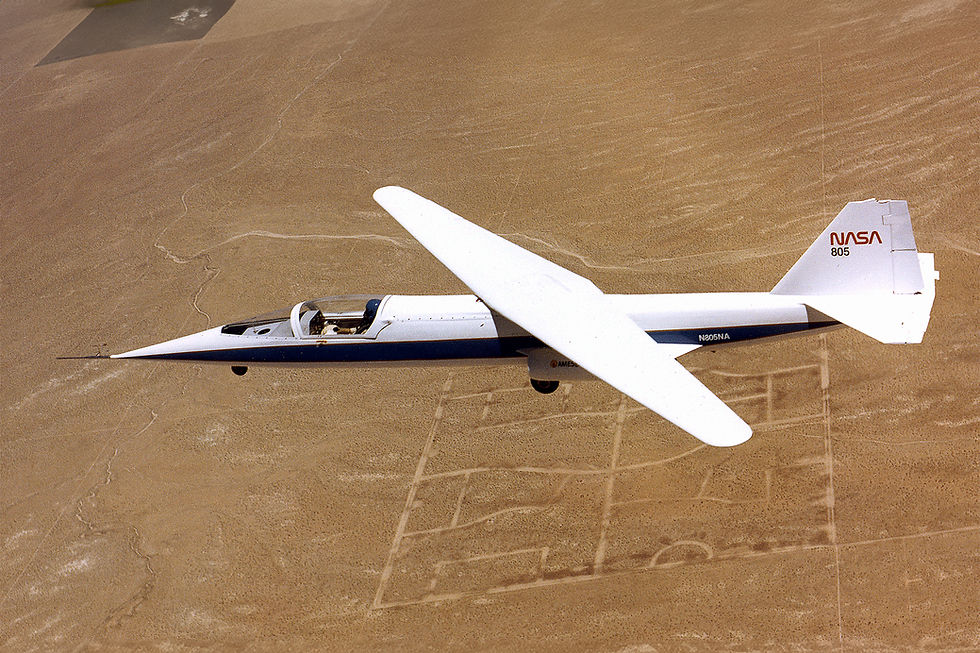
The AD-1 (Ames-Dryden-1) was developed in the late 1970s as part of NASA’s research into advanced transport aircraft concepts. At the time, the global aviation industry was grappling with the twin pressures of rising fuel costs and growing environmental concerns. Engineers were searching for configurations that could deliver better cruise efficiency without the complexity and weight penalties associated with variable-sweep wings, which had proven effective but mechanically complex on aircraft such as the F-14 Tomcat and B-1 bomber.
The idea behind the oblique wing is deceptively simple. Instead of sweeping both wings symmetrically backwards at high speed, a single wing pivots so that one side sweeps back while the other sweeps forward. In theory, this configuration reduces wave drag in transonic and supersonic flight while maintaining favourable lift characteristics at lower speeds. The concept dates back to German aerodynamic research in the 1940s, but it was never seriously tested in flight until NASA’s AD-1 programme.

The AD-1 featured a single, straight wing mounted on a central pivot above the fuselage. In its unswept position, the wing sat perpendicular to the fuselage, allowing conventional take-off and landing performance. In flight, the wing could rotate up to 60 degrees, creating the distinctive oblique configuration. This allowed NASA engineers to study the aerodynamic behaviour, structural loads and handling qualities of an asymmetric wing layout in real-world conditions.

The aircraft itself was a modest, low-cost research platform built by Ames Industrial Company under contract to NASA. First flown in August 1979, the AD-1 was powered by two small turbojet engines and designed to operate at relatively low subsonic speeds. While it was never intended to demonstrate the full high-speed performance benefits of the oblique wing concept, it served as a flying laboratory to validate aerodynamic models and assess pilot handling qualities.
Between 1979 and 1982, the AD-1 completed more than 70 research flights from NASA’s Dryden Flight Research Centre at Edwards Air Force Base. Test pilots gradually increased the wing sweep angle over successive flights, eventually reaching the design maximum of 60 degrees. As expected, the aircraft displayed increasingly unusual handling characteristics as the wing rotated, including asymmetric lift and changes in yaw and roll behaviour. Pilots reported that while the aircraft remained controllable, it required constant attention and careful trimming at higher sweep angles.

Despite these quirks, the AD-1 programme was considered a technical success. The aircraft demonstrated that an oblique wing could be safely flown and that the aerodynamic models used in wind tunnel and computational studies broadly matched real-world behaviour. Crucially, the programme provided valuable data on structural loads and aeroelastic effects, key considerations for any future large-scale oblique wing transport design.

On paper, the oblique wing offered compelling advantages. By reducing wave drag at high speed without the need for complex variable-sweep mechanisms, it promised lighter structures, lower fuel burn and potentially quieter operation. For long-range transport aircraft, these benefits could translate into significant efficiency gains over the aircraft’s service life.

However, the concept also came with formidable challenges. Structural design of a large oblique wing would be complex, particularly in managing asymmetric loads and torsional stresses. Cabin layout and passenger comfort raised additional questions, as the asymmetric wing configuration could lead to unusual ride characteristics. Certification and operational considerations also loomed large, with regulators likely to demand extensive testing to validate the safety of such a radically different configuration.

In the end, while the AD-1 proved the basic feasibility of the concept, the oblique wing did not progress to large-scale commercial development. Advances in wing design, materials and computational aerodynamics enabled more conventional swept-wing aircraft to achieve significant efficiency gains without the operational complexities associated with an asymmetric wing.

Although the AD-1 never led directly to a production aircraft, its legacy endures in the broader field of advanced aerodynamic research. The programme demonstrated NASA’s willingness to explore unconventional ideas and to validate them through flight testing rather than relying solely on theory and simulation. Many of the data sets generated by the AD-1 programme continue to inform research into unconventional wing configurations and aeroelastic behaviour.
In recent years, renewed interest in radical airframe concepts, driven by the push for lower emissions and higher efficiency, has seen engineers revisit ideas once considered too unconventional for mainstream adoption. Concepts such as blended wing bodies, truss-braced wings and distributed propulsion systems echo the same spirit of experimentation that underpinned the AD-1 programme.
The AD-1 stands as a reminder that progress in aerospace engineering is often driven by a willingness to test ideas that look strange, impractical or even absurd at first glance. While the oblique wing may never grace the flight line of a commercial airport, the lessons learned from the programme contributed to a deeper understanding of aerodynamics and aircraft design at a critical period in aviation history.
Today, the AD-1 is preserved as a museum exhibit, its diagonal wing still striking to modern eyes. It represents a moment when NASA dared to ask a simple question: What if we turned the wing sideways? and then built an aircraft to find out. In an era increasingly defined by incremental upgrades and evolutionary design, the AD-1 remains a powerful symbol of the value of bold experimentation in shaping the future of flight.





Aviation history fascinates me because experimental aircraft always seem slightly unreal until you imagine sitting inside one mid-flight. As I moved from reading about unusual designs into evaluating modern reliability narratives, alaska airlines reviews surfaced in my notes in contrast to bold engineering stories from decades past. The contrast wasn’t theoretical. It sharpened my attention to how operational steadiness often carries more long-term value than spectacular innovation. That awareness changed how I interpret airline news; performance consistency now matters more to me than technological spectacle.