




From Historic Firsts to the Future of Flight

Few aircraft have changed the way people move, work and respond to emergencies quite like the helicopter. From battlefields and remote agricultural fields to offshore oil platforms, city police departments and rescue operations, rotorcraft have become an indispensable part of modern aviation.

Few manufacturers have been as closely associated with that evolution as Bell. Over the decades, Bell aircraft have been involved in some of the most significant developments in vertical flight, helping transform the helicopter from an experimental machine into a practical tool that operates in almost every corner of the world.

Bell’s history is filled with pioneering aircraft and landmark flights. Some established entirely new categories of aviation, while others demonstrated how helicopters could be used to save lives, improve productivity and reach places inaccessible to conventional aircraft.
As Bell looks towards the future, many of the technologies being developed today have their roots in these earlier milestones.
The Bell 47: Making the Helicopter Commercially Practical
The post-war years were a turning point for the helicopter. While rotorcraft had demonstrated their potential during the Second World War, the industry still had to prove that helicopters could become practical commercial aircraft; the Bell 47 played a major role in making that happen.

In 1946, the Bell 47 became the world's first helicopter to receive commercial certification. With its unmistakable bubble canopy, exposed tubular structure and relatively simple design, it quickly became one of the most recognisable aircraft of its era. More importantly, the Bell 47 demonstrated that helicopters could move beyond military experimentation and become useful civilian machines.

Agriculture, law enforcement, aerial photography, surveying and media organisations were among the industries that began discovering what vertical flight could offer. Helicopters could hover, land in confined areas and operate without the need for conventional runways. The Bell 47 effectively opened a new dimension in aviation.

Its influence can still be seen today, not only in the enormous variety of commercial helicopter operations but also in the basic concept of using rotorcraft to bring aviation directly to the task rather than forcing the task to take place at an airport.
The H-13 Sioux and the Birth of Modern Medevac
If the Bell 47 helped establish the commercial helicopter, the Bell H-13 Sioux demonstrated its extraordinary potential as a lifesaving machine. During the Korean War in the early 1950s, H-13 helicopters were used extensively to evacuate wounded soldiers from the battlefield. The ability to reach casualties rapidly and transport them to medical facilities dramatically changed battlefield medicine.

The H-13 could operate close to the front lines, collect wounded personnel and fly them to treatment in a fraction of the time that would have been required using ground transportation. The concept became known as MEDEVAC and would eventually develop into one of the most important applications of the helicopter.

What began as a military necessity became a global model for civilian emergency medical services. Today, helicopters are routinely used to transport critically injured patients from accident scenes, remote areas and disaster zones to hospitals.

The principle remains essentially unchanged: "bring the aircraft to the patient rather than waiting for the patient to reach the aircraft."
Bell's modern helicopters continue to perform lifesaving missions in police, emergency medical and rescue roles. The technology may have advanced enormously, but the operational philosophy pioneered by aircraft such as the H-13 remains firmly embedded in modern rotorcraft operations.
The XV-15: When Helicopters Learned to Fly Like Fixed-Wings
Bell's contribution to aviation history was not limited to conventional helicopters. In 1977, the Bell XV-15 made its first flight, introducing the aviation world to a practical demonstration of tiltrotor technology.

The concept was deceptively simple but technically challenging. Instead of using separate propulsion systems for vertical and forward flight, the XV-15 used engines and rotors mounted on tilting nacelles. For take-off and landing, the rotors pointed upwards like a conventional helicopter. Once airborne, the nacelles could rotate forward, allowing the aircraft to transition into wing-borne flight. The result combined the vertical take-off and landing capability of a helicopter with many of the speed and range advantages of a fixed-wing aircraft.

The XV-15 proved that the concept was more than an engineering curiosity. Its successful development helped pave the way for the Bell Boeing V-22 Osprey, which brought operational tiltrotor capability to the military.
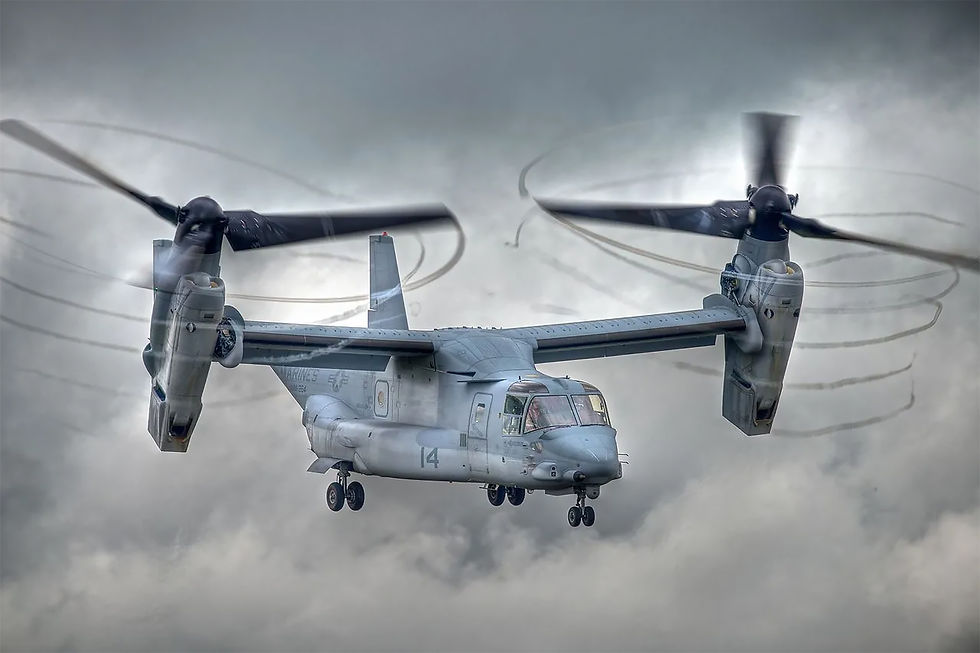
Today, Bell continues to develop the concept for a new generation of aircraft, including the MV-75 Cheyenne. The evolution of tiltrotor technology demonstrates how an experimental aircraft developed decades ago can influence the design philosophy of aircraft still being developed today.

The Bell 525 and the Digital Helicopter
Bell's innovation has also moved into the digital age. The Bell 525 represents another significant milestone in rotorcraft development, having been designed around a fly-by-wire flight-control system.

Rather than relying entirely on conventional mechanical connections between the pilot's controls and the aircraft's flight-control systems, fly-by-wire uses electronic signals and computers to manage aircraft control inputs. The technology has been commonplace in modern airliners and high-performance military aircraft for years. Bringing it into the commercial helicopter sector represents another important step in rotorcraft development.

The Bell 525 is designed for demanding missions including offshore transportation, search and rescue and corporate operations. Its advanced avionics and flight-control systems are intended to reduce pilot workload while improving precision and situational awareness.

The aircraft illustrates an important trend in modern aviation: the helicopter is becoming increasingly digital. As aircraft systems become more automated and integrated, pilots are moving away from simply manipulating controls and increasingly becoming managers of sophisticated aircraft systems. Bell's history demonstrates that innovation in aviation rarely happens overnight. Today's technology is often the result of decades of experimentation, testing and lessons learned from earlier aircraft.

The Bell 47 helped make helicopters commercially viable. The H-13 demonstrated their lifesaving potential. The XV-15 proved that vertical and conventional flight could be combined in a single aircraft, while the Bell 525 represents the increasing integration of digital flight-control technology into commercial rotorcraft.
Tiltrotors, advanced avionics, automation, uncrewed aircraft and new propulsion technologies are already beginning to reshape the definition of vertical flight. Bell's ongoing work suggests that the future helicopter may look considerably different from the machines that established the industry.

Yet the fundamental requirement remains the same: the ability to take off and land vertically, reach places conventional aircraft cannot and perform missions where speed, flexibility and access are critical. From the battlefields of Korea to modern urban skies, Bell aircraft have repeatedly demonstrated that helicopters are much more than transportation machines.

They are lifelines, workhorses, explorers and technological pioneers, and if Bell's history is any indication, the next chapter of vertical flight is unlikely to be a quiet one.





Comments