


Dassault Falcon 10X Takes to the Skies for the First Time

Dassault Aviation has reached a major milestone in the development of its new flagship business jet, the Falcon 10X, with the successful completion of the aircraft’s maiden flight. The achievement marks the beginning of an extensive flight-test campaign as the manufacturer moves closer to certification and entry into service.

The first Falcon 10X departed Bordeaux-Mérignac Airport in southwestern France at 11:10 local time on 19 June, with test pilot Sébastien Dupont de Dinechin and co-pilot Fabrice Dougnac at the controls. The flight lasted approximately two and a half hours and was designed to evaluate the aircraft’s initial handling characteristics and system performance.

During the sortie, the crew assessed the aircraft at various flight conditions, beginning at 15,000 feet before progressing through a series of system checks. The landing gear and flight-control surfaces were exercised before the aircraft climbed to 40,000 feet and accelerated to Mach 0.82. The flight concluded with a smooth landing back at Bordeaux-Mérignac at 13:40 local time.
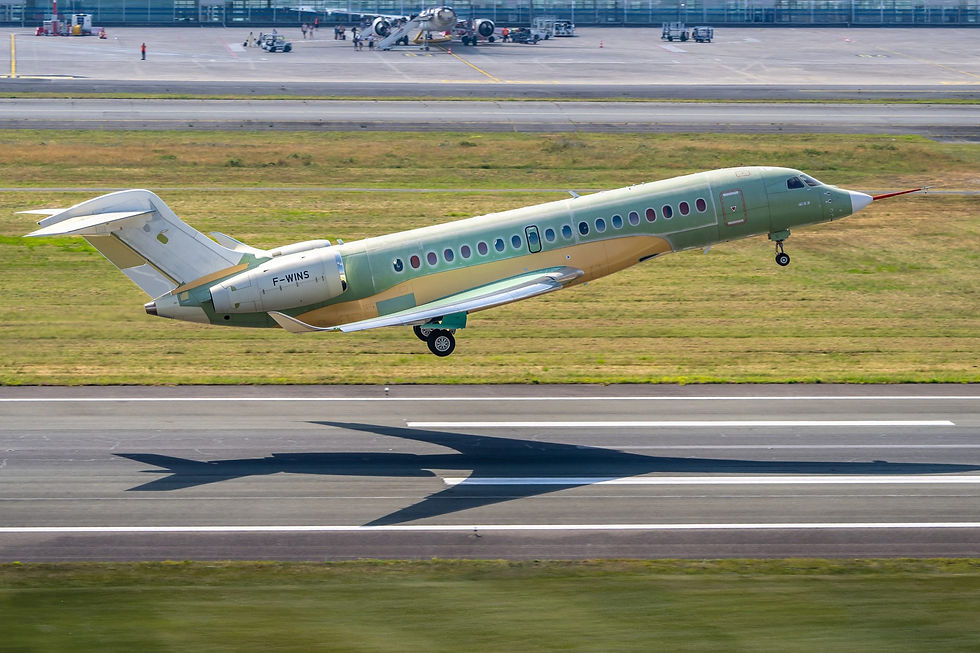

Dassault Chairman and Chief Executive Officer Eric Trappier described the flight as a significant step forward for the programme. “This inaugural flight is another milestone for Dassault,” said Trappier. “It reflects the dedication and expertise of our engineering, production and flight teams, as well as the contribution of our global network of partners.”

Test pilot Dupont de Dinechin noted that the aircraft performed as expected throughout the mission, describing the flight as the culmination of years of development work by thousands of employees and suppliers.

Flight-Test Campaign Expands
The Falcon 10X flight-test programme is expected to accelerate in the coming months. A second test aircraft is nearing completion and will soon join the campaign, while a third aircraft, fitted with a complete interior, will focus primarily on cabin systems, functionality and reliability testing.

The programme represents Dassault’s latest effort to strengthen its position in the ultra-long-range business aviation market, a segment that continues to see strong demand from corporate operators, charter companies and private owners seeking larger cabins and greater range.

Designed for the Ultra-Long-Range Market
At the heart of the Falcon 10X are two Rolls-Royce Pearl 10X turbofan engines, each producing more than 18,000 pounds of thrust. The aircraft incorporates a range of advanced technologies derived from Dassault’s experience in both civil and military aviation. Rolls-Royce flight-test campaign for the Pearl 10X turbofan lasted over six months; the powerplant was evaluated on the engine maker’s Boeing 747 testbed aircraft, logging around 36,000 nm during the course of more than 25 flights conducted in the U.S.

Among the notable features are an integrated Smart Throttle system that manages both engines, an enhanced head-up display, automatic recovery functions for unusual flight attitudes, terrain avoidance capability and automated windshear recovery. These systems are designed to improve both safety and pilot workload management while retaining the handling characteristics for which Falcon aircraft are known.
The Falcon 10X is also intended to set new standards in cabin space. Dassault says the aircraft will offer the largest cabin cross-section in the business jet market, measuring 9 feet 1 inch wide and 6 feet 8 inches high. The cabin can accommodate up to 19 passengers and be configured with three or four distinct living zones, each featuring independent temperature control.

The spacious interior is aimed at enhancing passenger comfort on long-haul flights while providing flexible arrangements for work, relaxation and rest.
Efficiency Through Advanced Design
To combine a large cabin with long-range performance, Dassault has introduced several aerodynamic refinements, including redesigned nose and fuselage fairings and an optimised tail section to reduce drag. The aircraft also features an all-new composite wing designed to improve aerodynamic efficiency while reducing structural weight.

When it enters service, the Falcon 10X is expected to offer a range of 7,500 nautical miles at a cruising speed of Mach 0.85. This capability will allow non-stop connections between major global city pairs such as New York and Shanghai, Los Angeles and Sydney, Paris and Santiago, and São Paulo and Dubai.

With its first flight now complete, the Falcon 10X enters the next phase of development as Dassault works toward certification of what is set to become the largest and longest-range aircraft in the Falcon family.





I love following jet developments during my morning commute, that massive cabin cross-section sounds like absolute luxury. While most of us won't fly private anytime soon, I was just looking up the allegiant air phone number yesterday to sort out a family holiday flight, it is thrilling to watch aerospace engineering push boundaries with composite wings and ultra-long range.