


Bell Advances High-Speed Vertical Lift with DARPA’s X-76 SPRINT X-Plane

Bell Textron has reached a major milestone in the development of next-generation military aircraft, successfully completing the Critical Design Review (CDR) for the Defence Advanced Research Projects Agency’s ambitious SPeed and Runway INdependent Technologies (SPRINT) program. The achievement clears the way for the company to begin construction of a new experimental aircraft, now officially designated the X-76, which aims to combine jet-like speed with the flexibility of vertical take-off and landing.

The announcement marks an important step forward in DARPA’s effort to revolutionise future battlefield mobility. Designed to operate without the need for traditional runways, the SPRINT demonstrator seeks to achieve cruise speeds far beyond those of conventional helicopters while maintaining the ability to hover and operate from confined or unprepared locations.

Bell revealed the milestone at its headquarters in Fort Worth, Texas, confirming that the completion of the design review signifies that the aircraft’s engineering configuration has been validated and is ready to move into the build phase.

Jason Hurst, Bell’s Senior Vice President for Engineering, highlighted the significance of the designation. “Bell is honoured to receive the X-76 designation and continue the spirit of American innovation, honouring the founding of the United States in 1776,” he said. “This is an important milestone as the Bell and DARPA team advances to a historic first in aviation history and fulfils our mission of developing next-generation vertical-lift aircraft.”
The X-76 will incorporate a groundbreaking “stop/fold” propulsion concept—technology that could fundamentally reshape the performance envelope of future military aircraft. While detailed specifications remain classified, the concept involves rotors that can provide vertical lift during take-off and landing, then stop and fold away during high-speed cruise to reduce drag and allow for much faster forward flight.

This innovative approach aims to bridge the long-standing gap between helicopters and fixed-wing aircraft. Helicopters offer unmatched flexibility and vertical lift capability, but are typically limited to speeds around 150 to 180 knots. Fixed-wing aircraft, by contrast, can achieve much higher speeds but require prepared runways for take-off and landing.
The SPRINT programme seeks to combine the best of both worlds. DARPA’s goal is an aircraft capable of cruising between 400 and 450 knots, more than twice the speed of most helicopters, while still retaining the ability to hover and land in austere environments such as remote clearings, ship decks, or improvised forward operating bases.
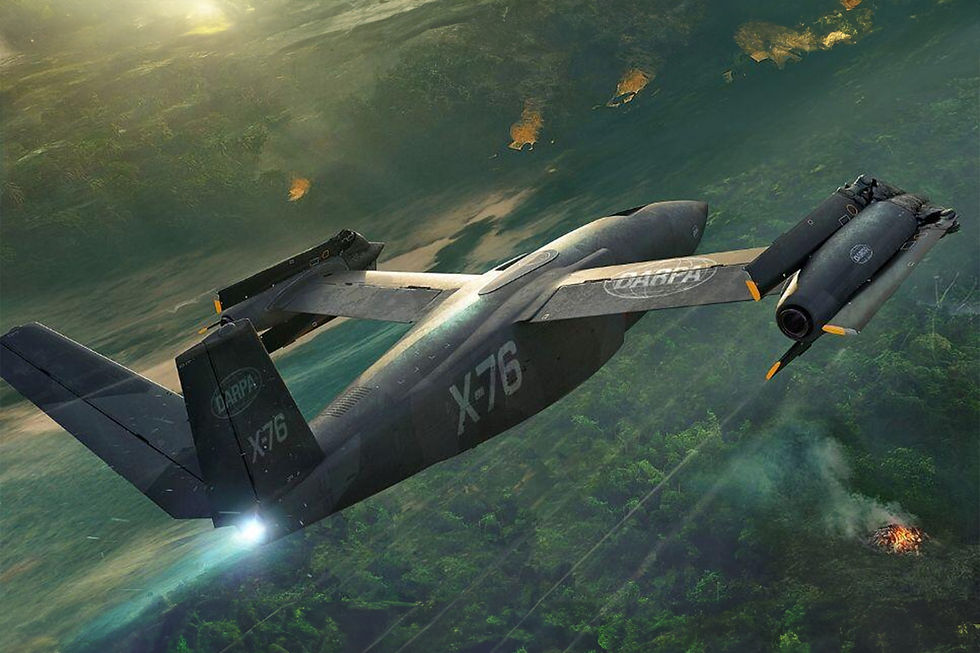
The programme is jointly funded by DARPA and U.S. Special Operations Command, reflecting a strong operational interest in aircraft capable of rapidly inserting and extracting personnel in remote or hostile environments where runways may not exist.
Bell was selected in July 2025 to advance to Phase 2 of the SPRINT programme after completing early conceptual and preliminary design work during Phase 1A and 1B. Those initial phases focused on refining the aircraft’s configuration, validating aerodynamic concepts, and demonstrating the feasibility of the stop/fold propulsion system. With the Critical Design Review now complete, Phase 2 will move into detailed engineering, aircraft construction and ground testing. This stage will see the physical demonstrator take shape, culminating in flight testing planned for Phase 3.
The development of the X-76 continues Bell’s long tradition of pioneering experimental aircraft. Over the decades, the company has played a central role in advancing vertical lift and high-speed flight concepts through a series of influential research programmes.
Among the most famous was the Bell X-1, the rocket-powered aircraft that famously broke the sound barrier in 1947. Bell later pushed the boundaries of rotorcraft technology with experimental tiltrotor aircraft such as the XV-3 and XV-15, programmes that ultimately paved the way for the operational V-22 Osprey and the next-generation V-280 Valour tiltrotor.
The SPRINT demonstrator builds upon lessons learned from these earlier programmes but introduces an entirely new propulsion architecture aimed at unlocking significantly higher speeds. According to Bell, the X-76 will demonstrate technologies that could eventually be scaled across a wide range of military platforms. If successful, the concepts developed through the programme could influence future troop transport aircraft, special operations platforms and even next-generation unmanned systems.

The ability to travel at jet-like speeds while operating independently of runways could transform the way military forces deploy and sustain operations. Rapid insertion, long-range mobility and the ability to operate from unpredictable locations are all capabilities increasingly valued in modern conflict scenarios. While the X-76 remains an experimental platform, its development reflects a broader push within the aerospace sector to reimagine the performance limits of vertical lift aircraft.

For Bell and DARPA, the next major milestone will be the first flight of the demonstrator, an event that could mark the beginning of a new era in high-speed vertical aviation. “The Bell team looks forward to seeing X-76 take flight and bringing this capability to our warfighters,” Hurst added.





Comments