


Atlantic Aerodrome: Build a Runway, They Said…
By Garth Calitz

Cape Town's newest aviation project is promising an opening, a longer runway and a growing hangar complex. There is just one small problem: according to SACAA, the aerodrome doesn't have its licence yet — and its formal Part 139 approval process has not even fully commenced.

Atlantic Aerodrome is getting bigger, more ambitious and, apparently, rather more complicated. The new aviation development has been promoting an increasingly impressive proposition for the Western Cape general aviation community, including a Phase 1 opening, a 1,241-metre runway, substantial hangar facilities and accommodation for everything from flight training and general aviation to charter, helicopter and selected light-jet operations.
On paper, it is an attractive proposition. There is, however, a rather important piece of paperwork still missing. Atlantic Aerodrome does not currently hold an aerodrome licence issued by the South African Civil Aviation Authority (SACAA).


According to SACAA, the formal approval process under Part 139 has not yet fully commenced. That puts a rather different complexion on the project's planned opening and its public claims regarding regulatory compliance. Flightline Weekly approached SACAA with a series of questions concerning Atlantic Aerodrome's licensing status, inspections, operational approvals, safety systems and proposed opening. The answers were remarkably clear.
SACAA confirmed that Atlantic's application is still in progress and that the application is currently at the publication stage. A Gazette notification was published on 28 August 2026, allowing the public to submit written representations either in support of or opposition to the application. That comment period closes on 28 September 2026. Only after that process has concluded can the next stages of the approval process proceed.

In other words, while Atlantic has been preparing the physical facility and promoting an opening date, the regulator is still waiting for the public-comment process to finish before the formal Part 139 approval process can fully get underway.
Atlantic has now moved its advertised Phase 1 opening date to 31 October 2026. That is a significant change from the previously advertised September opening and, on the face of it, gives the project additional breathing room. But it does not remove the regulatory question.

The Gazette comment period closes on 28 September. The new opening date is therefore just 33 days later. During that period, the application would still need to progress through the remaining regulatory requirements, including the necessary inspection and assessment process, consideration of the required documentation and satisfaction of SACAA that all applicable Part 139 requirements have been met.
SACAA has made it clear that no approval will be issued until all the requirements under Part 139 have been met. That means 31 October is best viewed as an operator's target date, rather than a date that currently has regulatory approval behind it. There is nothing inherently wrong with setting a target. Projects need deadlines. But in aviation, the calendar belongs to the regulator as much as it does to the developer. And the inspection hasn't started yet.
Perhaps more significant is SACAA's confirmation that the authority has not completed its final inspection or assessment of the aerodrome. That inspection cannot be conducted until the public-comment process has been concluded and there are no objections to the establishment of the new aerodrome.
This means that claims about the facility being ready for operations need to be considered against the fact that the regulator has not yet completed its regulatory inspection process. The same applies to the runway, taxiways, apron, lighting, markings, signage and associated infrastructure.
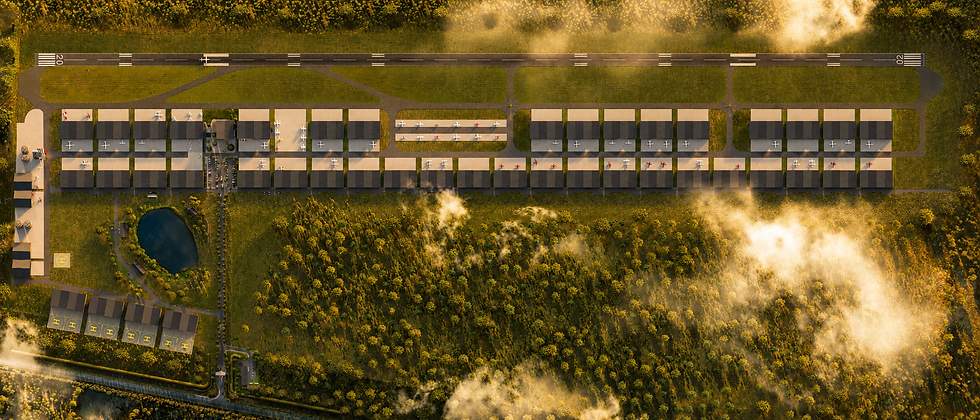
SACAA confirmed that these facilities have not yet undergone the required SACAA inspections and approvals. Again, this does not mean that the infrastructure is necessarily defective. It means that the regulator has not yet completed the process by which it determines whether the facility meets the applicable requirements.
A runway can be physically complete and still not be a legally approved runway. A hangar can be finished and still not make the aerodrome operational. And an aerodrome can be ready for photographs without being ready for an aircraft to legally depart from it. Aviation, as usual, insists on being rather particular about such distinctions.

“Fully compliant” — with an asterisk
Atlantic's publicly available material describes the facility as “fully compliant with SACAA Part 139, Subpart 5 civil aviation licensing standards.” That is a particularly interesting statement in light of SACAA's response. The regulator definitely did not endorse that description.
Instead, when asked whether the statement could be regarded as accurate while the formal licence remains outstanding, SACAA referred back to its answer concerning the legality of operating at an uncertified and unlicensed aerodrome. The situation is therefore somewhat less definitive than the phrase “fully compliant” might suggest.

Being designed or developed with the intention of complying with Part 139 is one thing. Having the regulator formally approve the aerodrome is another. The aviation world, rather inconveniently for marketing departments everywhere, tends to care about the second one.
Atlantic has applied under Civil Aviation Regulation Part 139, Subpart 5, Type B Aerodrome. That classification relates to an aerodrome where Part 61 pilot training takes place, excluding training for gliders and balloons. But SACAA confirmed that the aerodrome's Standard Operating Procedure and risk assessment have not yet been submitted. Those documents are important because the risk assessment must identify hazards and specify mitigating measures. The authority also confirmed that the aerodrome's Safety Management System has not yet been assessed and accepted. Emergency response, rescue and firefighting arrangements have likewise not yet been approved, with SACAA stating that these matters will be considered when evaluating the relevant documentation.
Nor has the aerodrome been promulgated in the South African Aeronautical Information Publication. That, too, is unsurprising given the current status: SACAA says the aerodrome cannot be published in the AIP until it has been approved, met all requirements and been issued with the necessary approval. So there is still a chain of regulatory events to complete.
It would be easy to turn all of this into a story suggesting Atlantic Aerodrome is somehow doomed. That would be both premature and unfair. There is nothing in SACAA's responses stating that Atlantic will not ultimately receive its licence.
The authority has simply made clear that the licence has not yet been issued, the final inspection has not yet taken place, required documentation remains outstanding, and the formal Part 139 approval process will only commence following the conclusion of the Gazette publication period. That is a very different story from an application being rejected. Indeed, the project could ultimately work its way through the process, satisfy the regulator and receive its approval. But until that happens, it remains an aerodrome seeking approval, rather than an approved aerodrome. That becomes particularly important when an opening date is being advertised.
All of which brings us back to the physical development. Atlantic's decision to expand its Phase 1 runway from the originally envisaged 884 metres to 1,241 metres remains one of the more interesting aspects of the project. The longer runway, substantial hangar development and ambition to attract a broad range of aviation users suggest that Atlantic is attempting to establish itself as a significant new player in Western Cape general aviation.

The eventual plan calls for the runway to reach approximately 1,524 metres, making the current Phase 1 development considerably more capable than the original concept. There is clearly a market for additional aviation infrastructure. But the regulator's answers provide a useful reminder that building an aerodrome and licensing an aerodrome are two entirely different projects. The first involves earthmoving equipment, concrete, tar, buildings and money. The second involves paperwork, inspections, safety systems, risk assessments, public consultation and a regulator saying “yes”. At present, Atlantic is still working through the second part.
The move to 31 October 2026 is therefore worth watching closely. Unlike the previous September date, the new target at least falls after the scheduled conclusion of the public-comment period. But it leaves only a little over a month between the end of that process and the operator's intended opening.
That does not mean the opening cannot happen. It means that a considerable amount of regulatory work would have to be completed during that period. SACAA has already told Atlantic that no approval will be issued until every applicable Part 139 requirement has been met. So the question is no longer simply whether Atlantic can physically finish Phase 1 by 31 October. The more important question is whether the regulatory process can reach the same finish line by 31 October. That is something only SACAA can ultimately determine.

The runway may be ready. The hangars may be ready. The clubhouse may be ready. The aircraft owners may be ready. But until SACAA is ready to issue the approval, the aerodrome isn't ready to legally operate in the manner being advertised. That may be the most important story about Atlantic Aerodrome right now. Because for all the talk of longer runways, bigger hangars and a new aviation destination for Cape Town, there is one rather fundamental question that still needs answering:
Will Atlantic Aerodrome be a licensed aerodrome by 31 October — or will 31 October simply become the next date on the calendar?
At this stage, nobody outside the regulatory process can answer that with certainty.





Building a runway sounds like quite the adventure! Reminds me of when I was obsessed with Doodle Jump—just like leveling up in that game, nailing each stage in aerodrome development is all about perfect timing and strategy.