


AAD 2026: International Airshow or South African Air Force Open Day?
By Garth Calitz

International flags are everywhere at Africa Aerospace and Defence 2026. There are expected to be delegations from more than 50 countries, hundreds of exhibitors and a considerable international defence industry presence on the ground. So, naturally, you might expect at least a respectable collection of foreign military aircraft to accompany all those international visitors.
Well… about that.
The AAD 2026 flying programme released yesterday makes for rather interesting reading. While the exhibition is being promoted as an international gathering of the global aerospace and defence industry, the flying display is a standard country airshow with some extra SAAF participation.
There is absolutely nothing wrong with that. The South African Air Force somehow managed to get an almost impressive collection of aircraft flying for the show; the Gripen, Hawk, Rooivalk, C-130, PC-7 and various rotary-wing types should provide plenty of entertainment.
But AAD isn't marketed as “South Africa's Really Quite Good Airshow.” If you were hoping to see some foreign military hardware in the air, there is good news. The Zimbabwe Air Force is coming.

Its K-8 is scheduled to appear on both public flying days, making Zimbabwe the most obvious international military participant in the published flying programme and frankly, Zimbabwe deserves a round of applause. Because when it comes to foreign military participation, the K-8 is currently carrying rather a lot of international responsibility on its shoulders. One K-8 does not exactly constitute an international aerial armada. It is, however, better than nothing.

The remainder of the military flying is overwhelmingly South African, with Gripens, Hawks, Rooivalks, C-130s, PC-7s and SAAF helicopters providing the backbone of the programme. There will also be the usual civilian, vintage, aerobatic and some UAV displays thrown in for good measure, so nobody is going to be staring at an empty sky. But if your definition of an international airshow involves aircraft actually flying in from other countries, the programme currently leaves rather more to be desired.
This is where the comparison with previous editions becomes slightly uncomfortable. AAD 2024 gave spectators something genuinely special. China's Xi'an Y-20 made its African flying-display debut. Brazil's Embraer C-390 Millennium was also associated with the event, while the ever-faithful Zimbabwean K-8 added another foreign military type to the programme.
The Y-20 and C-390 were exactly the sort of aircraft that made AAD internationally interesting. It wasn't something South African enthusiasts could simply drive to an airshow and see on the following weekend. They arrived from China and Brazil; they were enormous, they were unusual, and most importantly, they flew.
And then there is AAD 2022; this is where the 2026 programme starts looking even more curious. AAD 2022 was the first edition after the COVID-19 pandemic forced the cancellation of the 2020 event, and expectations were understandably high. The show returned with a significant international presence, including a particularly strong United States contingent. The US Air Force brought two Boeing C-17 Globemaster IIIs, a KC-46A Pegasus tanker, an HC-130J Combat King II and an HH-60 Pave Hawk. The HC-130 and Pave Hawk even provided an aerial-refuelling demonstration. Zimbabwe was also represented with two K-8 jet trainers and a C-212.

That is the sort of participation that makes an international aerospace and defence exhibition stand out.
Let's not depress ourselves reminiscing on 2012, 2014, 2016 or 2018 versions on AAD or even mention The Cape Town Era, DEXSA, SAAF 75 or SAAF 80. There is enough disappointment in the modern world without adding these to the mix.
There is currently no foreign heavy transport making a dramatic appearance. No European fighter deployment. No American tactical aircraft. No Brazilian transport taking to the sky. No Asian combat aircraft demonstration. Instead, we have one Zimbabwean K-8. It is almost as if the international air forces were invited to the party, looked at the price of aviation fuel and decided to send their regards.
Africa's Gateway… with a very local boarding pass
The event is promoted as a major international aerospace and defence exhibition and as a gateway to global defence and aerospace collaboration. And on the ground, it undoubtedly is. The international defence industry will be there. Foreign delegations will be there. Manufacturers will be there. Defence officials will be there.
But the public doesn't experience international defence cooperation through a PowerPoint presentation. They experience it by looking up. And when thousands of spectators arrive at Waterkloof with cameras, binoculars and several thousand rand worth of airshow merchandise, they generally aren't hoping to photograph a delegation. They want aircraft, preferably aircraft they haven't seen before. Static display isn't the same thing.

A foreign aircraft on the ground is still an impressive sight, but there is something fundamentally different about watching a military aircraft arrive from another country, hearing its engines fire up and then watching it perform over Waterkloof. That demonstrates international cooperation in a way that a parked aircraft simply cannot.
It also gives airshow photographers something they can't easily get elsewhere.
The appearance of a French Air and Space Force Airbus A400M Atlas heading towards southern Africa yesterday caused a small frenzy among aviation enthusiasts hoping that the rumours were true and it might be AAD-bound. Sadly, the aircraft turned north up the Mozambique Channel, apparently heading on other business. France is currently conducting its long-range PEGASE 26 deployment, which includes two A400Ms, so there was a perfectly good operational reason for its presence in the region. Still, the episode highlighted just how keen enthusiasts are for international participation — when a foreign military transport merely points its nose towards South Africa, the immediate question becomes: “Is it coming to AAD?” Sadly, this one wasn't.
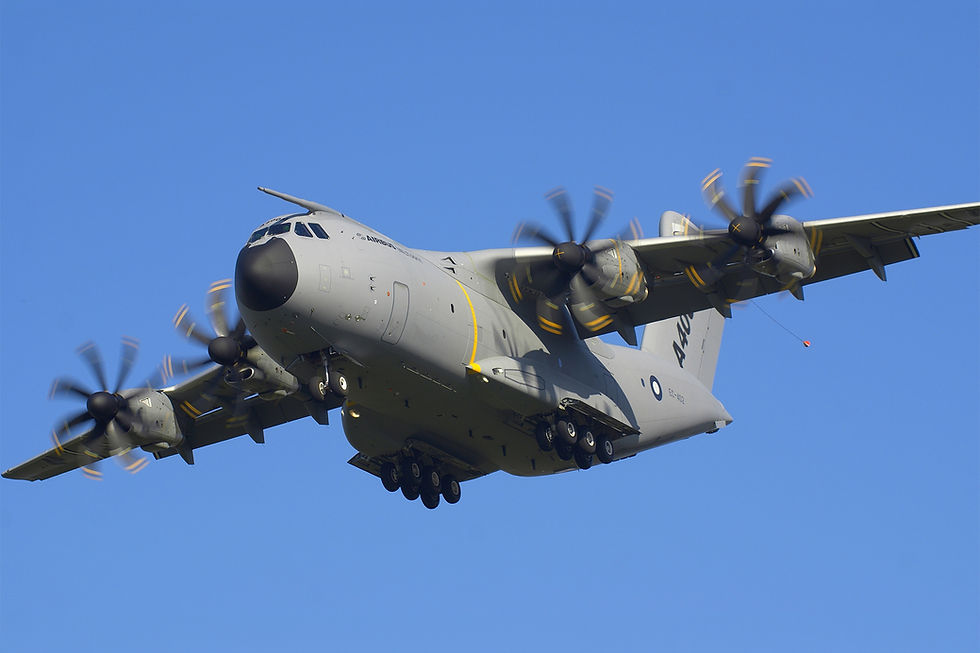
The 2026 programme, at least in its current form, is looking considerably more like a South African airshow taking place inside an international defence exhibition. The obvious question is why more foreign air forces aren't participating, and there are plenty of perfectly reasonable explanations.
Military aircraft aren't travelling airshow props. Deploying them internationally requires diplomatic clearances, operating budgets, logistics, maintenance support, aircrew availability and, most importantly, permission to take an operational aircraft away from whatever its home air force considers more important. And as we all know, a lot is going on in the world.
European air forces have increasingly busy operational and exercise schedules. The United States has no shortage of global commitments. Other countries have their own priorities and budgets. Getting a fighter halfway around the world so that a few thousand aviation enthusiasts can photograph it doing a pass over Waterkloof is probably not at the top of every defence minister's priority list.
There are also geopolitical considerations surrounding South Africa's international relationships. But there is no evidence to suggest that geopolitics is specifically responsible for the current flying programme, and it would be unfair to claim otherwise. The simpler explanation may simply be that sending military aircraft internationally is expensive, complicated and increasingly difficult to justify.
AAD has successfully persuaded the international aerospace and defence industry to come to South Africa. It just seems to have had considerably less success persuading the world's air forces to bring their aircraft with them.
AAD: “Come to South Africa and showcase your aerospace and defence capabilities.”
The lack of foreign military participation shouldn't obscure the fact that AAD 2026 should still deliver a substantial flying programme. The Gripen remains an impressive sight, particularly when flown aggressively. The Rooivalk remains one of the world's most distinctive attack helicopters. The Hawk provides plenty of speed, while the PC-7s bring the precision associated with the SAAF's training establishment. The C-130 will provide some heavy-metal presence, helicopters will add variety, and the civilian, vintage, aerobatic and UAV displays will keep the sky busy. And then there is Zimbabwe's K-8.
But there may yet be a surprise; airshow programmes are notoriously fluid. Aircraft become unavailable. Diplomatic clearances arrive late. Operational requirements change. Aircraft that were never publicly announced suddenly appear, while aircraft that were confidently expected never leave their home bases. So the final word hasn't necessarily been written, as a prominent airshow safety boss said: if you want an accurate full programme, come to me an hour after the show.
There may yet be an unexpected foreign arrival, and if one does appear over Waterkloof, airshow photographers will probably react traditionally: several thousand cameras will suddenly point in the same direction. Until then, however, the published programme tells a fairly clear story. AAD 2026 is shaping up to be an international defence exhibition with a predominantly South African flying display. But perhaps next time, AAD could put a little more emphasis on the “international” part when handing out invitations to air forces.
Because if Africa really is the gateway to global aerospace and defence collaboration, it would be nice if a few more of the world's aircraft actually bothered to fly through it. For now, however, at least Zimbabwe has remembered to bring an aeroplane.
And the SAAF, as usual, will apparently have to do the rest.





Many kitchen reno projects use full-height backsplash materials to create a more continuous appearance around countertops and cabinetry.