


South Africa’s First Powered Flight: Africa Takes to the Skies
It is widely accepted that modern aviation was born on 17 December 1903, when Orville Wright lifted off the sands of Kitty Hawk, ushering in a new era of powered flight. Yet what is less commonly known is that South Africa entered the age of aviation remarkably soon thereafter. Just six years later, the first powered flight in South Africa and indeed the first heavier-than-air powered flight on the African continent, took place on local soil.

Interestingly, the origins of South Africa’s aviation story lie not in America or even England, but in France. In the years following the Wright brothers’ success, several European pioneers began refining and commercialising the fledgling technology. Among the earliest of these was the company founded by Gabriel Voisin and his brother Charles in 1906, Appareils d'Aviation Les Frères Voisin.

Their company produced the Voisin-Farman I, regarded as one of the first successful manned heavier-than-air aircraft manufactured commercially. The type achieved prominence in Europe and would ultimately play a central role in Africa’s first powered flight.

South Africa quickly followed these advancements. In 1907, John Weston, an engineer from the Free State, built the nation's first aircraft in Brandfort. The Voisin configuration largely inspired his design. Regrettably, the aircraft lacked sufficient power and was unable to maintain flight.

Undeterred, Weston travelled to Europe to refine his machine. After modifications and improvements, the aircraft was shipped back to South Africa. On 16 June 1911, just outside Kimberley, Weston successfully flew what became known as the Weston-Farman biplane. The flight lasted eight-and-a-half minutes, a South African nonstop record at the time, earning Weston the distinction of piloting the first South African-designed and built flying machine.


Weston’s passion extended beyond personal achievement. In 1911, he founded the Aeronautical Society of South Africa, laying early foundations for organised aviation development in the country.
While Weston was perfecting his aircraft abroad, public curiosity about “flying machines” was rapidly growing at home. In early 1909, the East London town council issued a public invitation for an aeroplane demonstration during the December Gala Season. The offer was accepted by Howard Farrar & Co, a prominent manufacturer of mining and engineering equipment, which undertook to import a modern aircraft and a qualified aviator for the event. The company purchased a Voisin biplane and recruited French mechanic and pilot Albert Kimmerling to conduct the demonstration. The aircraft arrived in East London on 18 December 1909 and was assembled in time for a special show on 28 December at Nahoon Racecourse, the site where Stirling High School now stands.
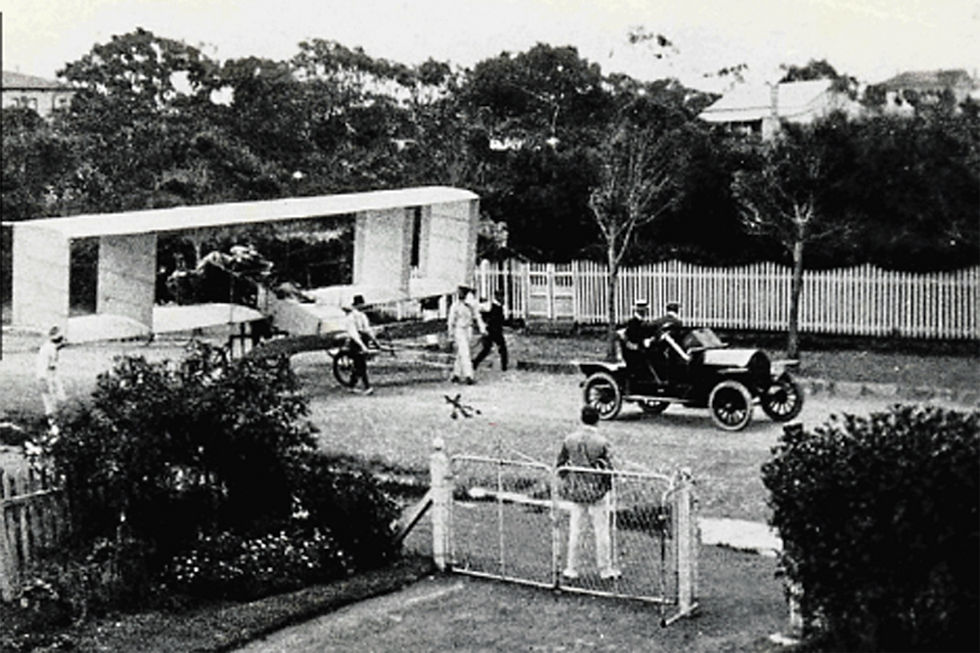
The Voisin was a pusher-type biplane fitted with two main wheels, a nose wheel and twin tail wheels. Power came from a seven-cylinder Gnome 7 Omega 50hp rotary engine driving a two-bladed aluminium propeller, modest by today’s standards, but revolutionary at the time.

According to The Daily Dispatch, spectators witnessed Kimmerling sweeping across the racecourse at approximately 30 miles per hour. The report described the scene at sunset, with the aircraft silhouetted against church spires and Southern Wood residences. Twice, Kimmerling appeared perilously close to the grandstand before expertly banking away. That December evening in 1909 marked the first powered heavier-than-air flight in South Africa and on the African continent. Kimmerling’s South African tour continued into 1910, with demonstrations in Durban and Johannesburg. It was in Johannesburg, on 19 March 1910, that aviation history took another step forward.

Thomas Thornton became the first fare-paying passenger in South Africa when he paid £100, an astonishing sum at the time, equivalent to roughly R200,000 today, for a brief flight over what is now Orange Grove. On the same day, journalist Julia Stansfield became the first woman in South Africa to take to the skies as a passenger.

The longest flight during Kimmerling’s tour covered approximately 20 kilometres at a height of 300 feet, modest numbers today, but extraordinary achievements in 1910.

South Africa almost achieved the milestone of the first powered flight in the southern hemisphere. However, this honour goes to Australia, where powered flight took place just three weeks earlier, on December 9, 1909. Captain Colin Defries completed a brief, 345-foot powered flight at Victoria Park, Sydney, using an imported Wright biplane.

Nonetheless, South Africa’s achievement remains historically significant. In 1978, the National Monuments Council erected a commemorative plaque at the corner of Gleneagles and John Bailie roads in East London, near Stirling High School, marking the site of Africa’s first powered flight.

Tragically, Albert Kimmerling’s life was cut short. Shortly after returning to France, he was killed in an aircraft accident in Mourmelon at just 29 years of age, a sobering reminder of the risks faced by early aviators who pushed the boundaries of possibility.

Yet his contribution to South African aviation history endures. From East London’s windswept racecourse to Weston’s determined experiments in Kimberley, the country embraced powered flight within a mere six years of Kitty Hawk.

Today, as South Africa maintains a vibrant aviation industry spanning commercial airlines, general aviation, aerospace manufacturing and unmanned systems, it is worth remembering those early pioneers. Their fragile wood-and-fabric machines may have skimmed the earth at only a few hundred feet, but they launched a legacy that continues to soar more than a century later. His legacy is continued today by truly South African aircraft manufacturers like Sling Aircraft and Bat Hawk.
For Africa, the age of flight began not in a distant land but on a racecourse in East London, beneath a glowing December sky.





Comments