


Riyadh Reopens, But the Danger Has Not Departed
By Garth Calitz

Saudi Airports Return to Operations After Missile and Drone Attacks, but Airline Suspensions and Conflict-Zone Warnings Continue to Threaten Regional Aviation

Commercial aviation has spent decades refining its ability to manage turbulence, technical failures, airspace congestion and the occasional passenger who believes cabin crew are employed as personal servants. Its latest challenge is considerably more serious: operating in a region where missiles and drones threaten the airports, aircraft and infrastructure on which international air travel depends.
Riyadh's King Khalid International Airport reopened on 18 October following a prolonged suspension of operations, but the return to service has not restored normality. Airlines continue to cancel flights, extend suspensions and reassess their exposure to a volatile security environment. The distinction matters: an airport reopening is an operational milestone, not a declaration that the surrounding threat has disappeared.

For airlines, the question is no longer simply whether an aircraft can safely cross a particular piece of airspace. It is whether the departure airport will remain operational, whether the destination can accept the aircraft and whether the route will remain safe throughout the flight. In other words, the flight plan may be perfectly safe. The world around it may have other ideas.
King Khalid International Airport became the focus of a major aviation-security crisis in early October after missile and drone attacks attributed to Yemen's Houthi movement struck Saudi targets. Reuters reported that an attack on 10 October killed at least 13 people and injured more than 300, followed by another attack on 11 October that killed one person and injured 11. The reported death toll across the two incidents reached 18.
Saudi authorities suspended operations while safety checks and assessments were conducted. The closure was subsequently extended through 17 October, with the airport reopening the following day. However, airlines were already making independent decisions about when to resume services. The physical availability of an airport does not automatically resolve concerns about missile threats, airspace restrictions, defensive operations or the reliability of security information. The runway can be available while the risk assessment remains decidedly uncomfortable.
The disruption has extended beyond the airport closure. According to The National, Lufthansa suspended flights to Riyadh until 18 November and Dammam services until 30 November. KLM extended cancellations to Riyadh and Dammam until 31 October, while Philippine Airlines suspended Riyadh services until 29 November. IndiGo cancelled flights to Riyadh, Jeddah, Dammam and Madinah through 24 October. Delta Air Lines also postponed the planned launch of its Atlanta–Riyadh service until March 2027.
These dates remain subject to change and should be checked against current airline notices. They nevertheless illustrate why reopening an airport does not automatically restore its international connections.
Different carriers can reach different decisions based on their own risk assessments, regulatory obligations, insurance considerations, crew arrangements and available alternative routes. The result is a fragmented recovery rather than a simple switch from closed to open.
For passengers, the consequences include cancellations, missed connections, additional accommodation costs and rerouting. Airlines face disrupted aircraft rotations, crew scheduling complications and lost revenue. Commercial aviation is remarkably good at recovering from disruption. It is less capable of doing so when the disruption comes with missiles.
An international airport combines extensive exposed areas, parked aircraft, fuel infrastructure, passenger terminals and navigation facilities. Protecting every component against missile and drone attacks presents an enormous challenge. Even when a weapon is intercepted, debris can fall over airport infrastructure or populated areas. Defensive activity can introduce additional hazards, while drones may force temporary suspensions as authorities establish whether a threat remains active.

Closing an airport is expensive and disruptive, but sometimes it is the only defensible option. The consequences of continuing operations without an acceptable safety case could be considerably worse.
The European Union Aviation Safety Agency's Conflict Zone Information Bulletin, CZIB-2026-09-R1, was revised on 9 October and remains valid until 16 November unless reviewed earlier. It covers the Jeddah Flight Information Region at all altitudes and flight levels for operators within its stated scope.
EASA identifies a volatile security environment and increased missile and drone activity, including threats reaching areas deeper inside Saudi Arabia such as Riyadh, Tabuk, Medina and Yanbu. Its recommendations identify areas operators should avoid and advise caution elsewhere in the region.
Other authorities have introduced additional restrictions. Canada's Department of Transport recommended that Canadian operators and owners of Canadian-registered aircraft avoid entering the Jeddah FIR, with its published notice valid through 23 October. French and German operators have also received more restrictive airspace guidance.
These advisories are not necessarily blanket prohibitions on every flight. Their applicability depends on the operator and the terms of the relevant notice. Nevertheless, they demonstrate that the threat can no longer be assessed solely by proximity to Yemen.
The attacks have raised questions about warning systems and the communication of security information. Reuters reported on 12 October that Saudi Arabia's public early-warning system had stopped issuing alerts before the deadly attacks. That reporting does not establish what every airline, airport operator or air traffic control unit knew before each incident, but it raises an important question: how effectively was threat information gathered, assessed and communicated?
Airlines need timely information about airport status, airspace restrictions, missile and drone activity, navigation interference and diversion options. A decision based on accurate information at 08:00 can become obsolete by lunchtime if the security situation deteriorates.
Conflict-zone operations demand the same discipline applied to weather and technical risks, but the information can be incomplete, politically sensitive and subject to rapid change. Transparency and coordination are therefore essential.
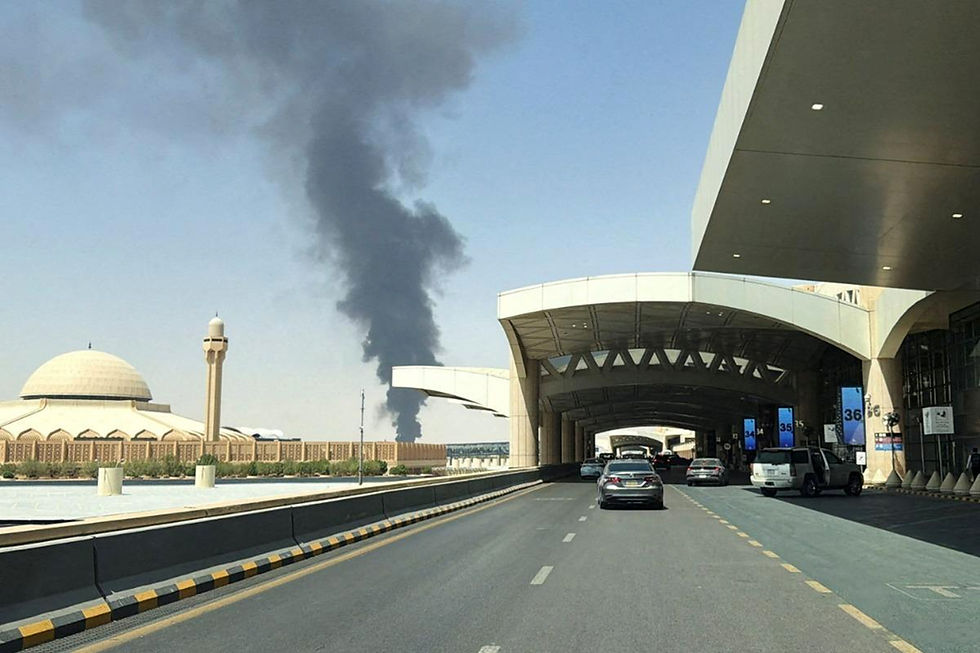
The crisis is developing beyond Riyadh. Reuters reported on 14 October that the Houthis had threatened to intensify attacks on Saudi airports and oil infrastructure. On 18 October, Reuters reported that Egypt had declared its readiness to provide military support to Saudi Arabia amid escalating tensions.
For airlines, a route that avoids one airport may still be affected by restrictions elsewhere, changes to available air corridors or the closure of alternative destinations. Longer routes can also increase fuel consumption, complicate crew duty planning and raise operating costs.
South African travellers are not insulated from the disruption. Passengers connecting through international hubs may face cancellations, missed connections or rerouting, depending on their airline and itinerary. Not every Gulf hub is subject to identical restrictions, and it would be misleading to suggest that all regional services have been suspended.
Travellers should check every flight sector directly with their airline before leaving for the airport. Those travelling on separate tickets should be particularly careful, as disruption to one booking may not automatically protect an onward reservation.
There is no basis to conclude that South African airlines have been ordered to suspend all operations in Saudi airspace without a specific operator notice or regulatory directive.
Several questions remain. How quickly can authorities establish that airport infrastructure is safe following an attack? What information is supplied to airlines before services resume? How are conflicting national restrictions reconciled, and what happens when an airport closes with aircraft already airborne? These questions cannot be answered simply by confirming that a runway is open.
Airlines and governments have strong incentives to restore schedules and protect revenue. Saudi Arabia's ambitions to expand tourism, investment and international connectivity make prolonged disruption particularly costly. But commercial pressure cannot determine whether a flight is safe to operate.
The runway may be open. The question is whether the conditions exist to use it safely.





Comments