


NATO Selects Saab's GlobalEye as Its Next-Generation Eyes in the Sky

NATO has taken a major step toward modernising its airborne surveillance capability by selecting Saab's GlobalEye as its preferred Airborne Early Warning and Control (AEW&C) platform. During the NATO Summit in Ankara, Türkiye, NATO Secretary General Mark Rutte announced that the Alliance will begin formal negotiations with Swedish defence and aerospace company Saab for the potential acquisition of up to ten GlobalEye aircraft.

While the announcement represents a significant milestone for Saab, the company has confirmed that no contract has yet been signed and no formal order has been placed. The negotiations will determine the scope, timing and value of what could become one of NATO's most important airborne surveillance procurements in decades.

NATO has been evaluating options to replace its ageing fleet of Airborne Warning and Control System (AWACS) aircraft as part of a broader strategy to strengthen the Alliance's intelligence, surveillance and command capabilities. The current NATO E-3A Sentry fleet has served the Alliance since the early 1980s and, despite numerous upgrades, is approaching the limits of its operational life. Selecting a modern replacement has become a strategic priority as NATO faces increasingly sophisticated aerial, maritime and missile threats across Europe and beyond.

The decision to enter negotiations with Saab signals NATO's confidence that GlobalEye offers the best combination of performance, flexibility and future growth potential.

Saab President and CEO Micael Johansson described the announcement as a landmark moment for the company. "We are honoured and proud to support NATO in its next-generation AEW&C capability. We are confident that GlobalEye is the right choice for the Alliance, delivering proven capability, adaptability and long-term operational advantage. Today's announcement clearly positions GlobalEye as the world-leading solution for advanced airborne early warning and control. We look forward to the next steps in the negotiations."

If negotiations conclude successfully, the programme would further cement Saab's position as one of the world's leading providers of airborne surveillance systems.
Unlike many legacy airborne early warning aircraft, GlobalEye is designed as a true multi-domain surveillance platform. Built on the long-range Bombardier Global 6500 business jet, the aircraft combines excellent endurance with lower operating costs than larger commercial airliner-based platforms. The aircraft's efficient design also allows for rapid deployment while offering exceptional range and high availability.

At the heart of the system is Saab's Erieye Extended Range (ER) radar, an advanced Active Electronically Scanned Array (AESA) radar capable of simultaneously monitoring air, land and maritime environments. Rather than focusing solely on aircraft detection, GlobalEye integrates multiple sensors with an advanced command-and-control suite, enabling operators to build a comprehensive real-time operational picture across several domains.

Today's battlespace is far more complex than when NATO's current AWACS fleet entered service. Modern military planners must contend with low-observable aircraft, swarms of drones, cruise missiles, ballistic missiles and even emerging hypersonic weapons, all while operating in environments saturated with electronic warfare and signal jamming.
The system offers long-range detection with rapid update rates, enabling operators to identify and track fast-moving or low-signature targets over vast areas. Its sophisticated sensor fusion capabilities help distinguish genuine threats from background clutter, whether over land, at sea or in congested airspace. This capability significantly improves situational awareness and allows commanders to respond more rapidly to developing threats.

An airborne early warning aircraft acts as an airborne command post, extending radar coverage hundreds of kilometres beyond ground-based systems. Operating at high altitude, GlobalEye can continuously monitor large portions of airspace while coordinating fighter aircraft, naval forces, missile defence systems and ground assets.

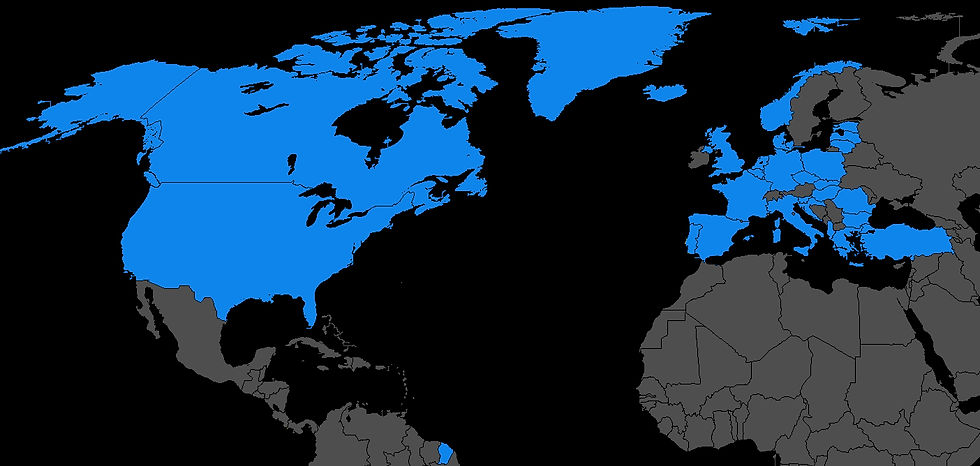
NATO, whose member nations span much of Europe and North America, is maintaining persistent surveillance across multiple theatres increasingly important amid heightened geopolitical tensions. The addition of GlobalEye would strengthen the Alliance's ability to monitor its borders, protect critical infrastructure, support maritime security operations and provide early warning of potential missile attacks.
GlobalEye has already attracted international customers, with the United Arab Emirates operating the system and Sweden ordering aircraft for its own air force. Additional export interest has emerged from several countries seeking modern airborne surveillance capabilities without the size and operating costs associated with traditional AWACS aircraft.

A NATO acquisition would represent the programme's largest and most prestigious order to date, reinforcing GlobalEye's position as one of the world's leading AEW&C solutions. Although negotiations are only beginning, the Alliance's selection of Saab marks an important milestone in NATO's ongoing modernisation programme and highlights the growing importance of advanced airborne surveillance in an increasingly contested security environment.





Comments