


Helium Hiccups Put Artemis II Timeline Under Review as NASA Prepares Possible Rollback

NASA’s carefully choreographed countdown towards the first crewed Artemis mission around the Moon has hit a familiar speed bump, with engineers now preparing for the possibility of rolling the Space Launch System (SLS) rocket and Orion spacecraft back to the Vehicle Assembly Building (VAB) at Kennedy Space Center. The precaution follows an overnight observation on 21 February that helium flow to the rocket’s interim cryogenic propulsion stage (ICPS) was interrupted, prompting teams to pause forward work and reassess the path to launch.

While the stack remains in a safe configuration on Pad 39B, the issue has introduced fresh uncertainty into Artemis II’s near-term schedule. NASA teams are actively reviewing data and preparing rollback positions to preserve as many troubleshooting options as possible, whether repairs are ultimately carried out at the pad or inside the controlled environment of the VAB. As with most things in rocketry, the technical problem is only half the story; the other half is logistics, weather, and the unforgiving reality of launch infrastructure.
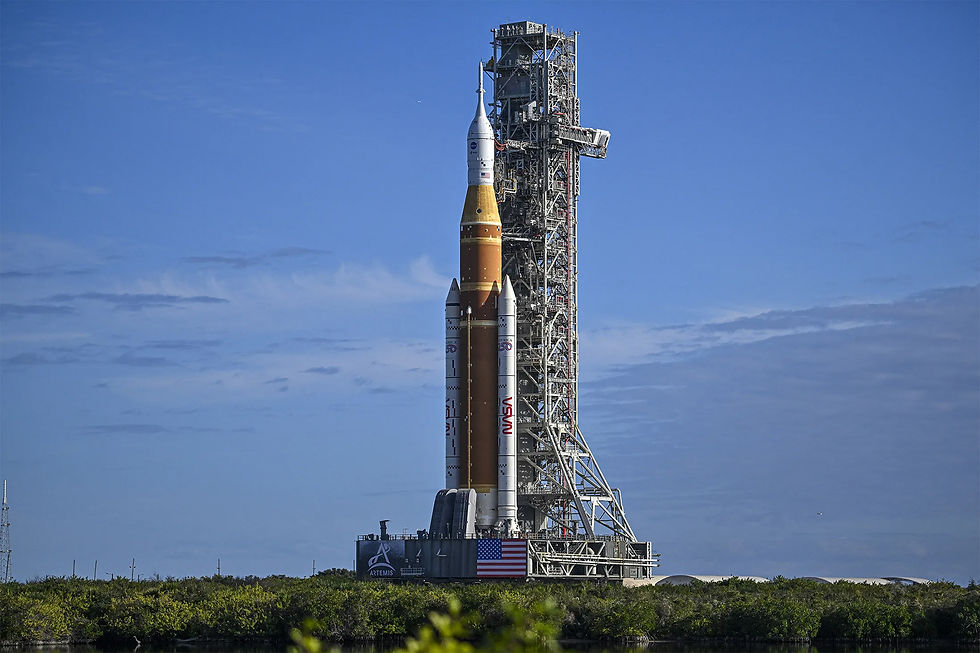
In parallel with the technical assessment, ground crews are making preparations to remove pad access platforms that were installed only a day earlier. These platforms, essential for crew and technician access, come with operational constraints driven by wind conditions. With high winds forecast, NASA is moving early to ensure that the platforms can be safely removed if a rollback decision is made. It is an unglamorous but critical detail: when the weather and the hardware both have opinions, the schedule usually listens to the loudest voice.

The helium system at the centre of the issue plays a vital role in the health of the ICPS. Helium is used to maintain proper environmental conditions for the stage’s engine and to pressurise the liquid hydrogen and liquid oxygen propellant tanks. During Artemis II’s wet dress rehearsals, which concluded on 19 February, the system performed as expected. However, problems emerged during subsequent normal operations and reconfigurations, when teams were unable to achieve proper helium flow through the system.

For now, operators are relying on a backup method to maintain environmental conditions for the upper stage engines and the rocket. NASA emphasises that the vehicle remains in a safe configuration, but backup modes are, by definition, not where engineers want to live for long. The objective is to restore nominal system performance before committing to a crewed mission that will travel hundreds of thousands of kilometres from home.

Engineers are casting a wide net in their investigation, reviewing several possible sources of the helium flow interruption. Suspects include the interface between ground support equipment and the rocket’s helium lines, a valve within the upper stage itself and a filter located between the ground and flight hardware. Each of these points represents a potential single point of failure, and none can be dismissed without detailed inspection and testing.

There is also a sense of déjà vu. During the uncrewed Artemis I mission, teams encountered helium-related pressurisation issues in the upper stage that required troubleshooting before launch. That experience provides valuable data and procedural memory, but it also underlines that some technical gremlins are persistent tenants in the SLS programme. Spaceflight history is rich with such recurring themes; rockets have long memories, even if engineers would prefer they did not.

If NASA ultimately decides to roll the Artemis II stack back to the VAB for repairs, the March launch window will almost certainly be lost. Rollbacks are time-consuming, resource-intensive operations that ripple through schedules like a dropped spanner in a clockwork mechanism. However, the early preparations now underway are designed to preserve the possibility of an April launch window, should the issue be quickly identified and resolved.

For NASA, Artemis II carries enormous symbolic and practical weight. It will be the first crewed mission of the Artemis era, sending astronauts on a lunar flyby and validating systems that will underpin future landings. The agency is keenly aware that public and political expectations are high, but history has taught NASA to favour patience over bravado when human lives are on the line.

If there is a silver lining, it is that the issue was detected on the ground, during preparations, rather than in flight. The Artemis programme is built around the principle of learning early and fixing thoroughly, even when that means accepting delays.





Comments