


Airline Fuel Levies: Necessary Lifeline or Convenient Revenue Tool?
By Garth Calitz
As fuel prices surge across global markets, airlines have once again turned to a familiar mechanism: the fuel levy. For passengers, the reappearance of these surcharges often feels like an unwelcome addition to already expensive tickets. But are these levies genuinely necessary, or are they a convenient way for airlines to quietly boost revenue?
The answer, as is often the case in aviation, lies somewhere in between.

Jet fuel remains one of the most volatile and significant cost drivers in aviation, typically accounting for between 20% and 40% of an airline’s operating expenses. When prices spike sharply, as they have in recent weeks due to geopolitical instability and supply disruptions, the impact on airline economics is immediate and severe.
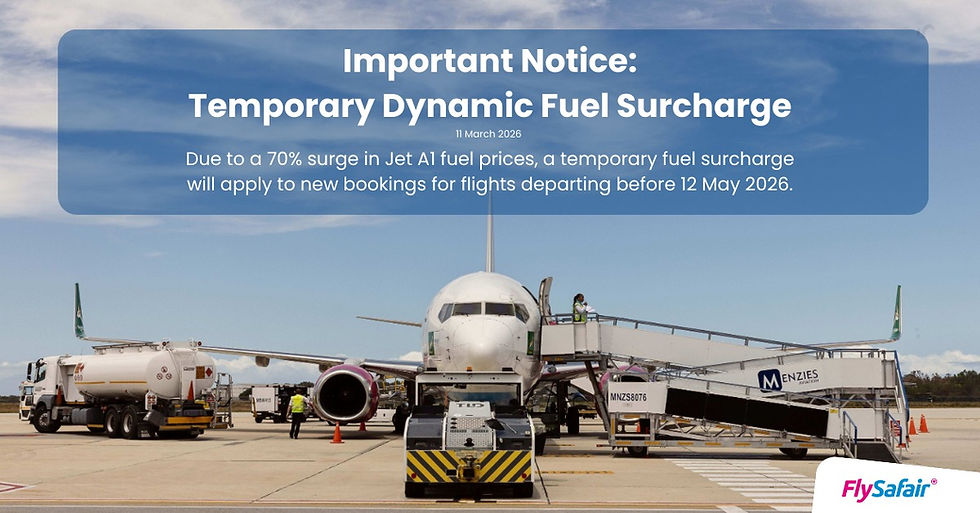
Unlike many other industries, airlines operate on notoriously thin margins. A sudden increase in fuel costs can erase profitability almost overnight, particularly for low-cost carriers that rely on tight cost control and high aircraft utilisation. In this context, introducing a temporary fuel levy is not only understandable but, in many cases, essential for financial survival.
South Africa’s market offers a clear example. The recent introduction of a temporary fuel surcharge by FlySafair reflects a direct response to a rapid escalation in jet fuel prices. Importantly, the airline has framed the measure as time-bound, signalling that the levy is intended as a short-term buffer rather than a permanent fixture.
South African Airways (SAA) has taken the alternative route by implementing fare increases across domestic, regional and international networks. Airlink have also opted for the latter and has begun adjusting fares upwards in response to high fuel costs.

If rising costs are the issue, why not simply increase ticket prices as SAA and Airlink did?
The answer lies in both operational flexibility and commercial strategy. Adjusting base fares across an entire network is a slower, more complex process that can distort demand patterns and competitive positioning. Fuel levies, by contrast, can be implemented quickly and adjusted frequently as market conditions change.
There is also a psychological component. A lower base fare, even when paired with additional charges, often appears more attractive to consumers during the booking process. By separating the fuel levy from the ticket price, airlines retain the ability to market competitive fares while still recovering increased operating expenses.
This dual function, cost recovery and pricing strategy, is where scepticism begins to emerge.

The Transparency Problem
One of the most persistent criticisms of fuel levies is the lack of transparency. Passengers are rarely given insight into how these surcharges are calculated, how closely they track actual fuel costs or when they will be removed.
This opacity creates a perception, sometimes justified, that levies can outlast the conditions that prompted them. Historically, there have been instances in which fuel surcharges remained in place even after oil prices stabilised or declined, effectively becoming a semi-permanent component of airline pricing structures.
Complicating matters further is the role of fuel hedging. Many airlines hedge their fuel purchases, locking in prices months in advance to mitigate volatility. This means that not all carriers are equally exposed to sudden price spikes. Yet passengers may still see similar surcharges applied across the board, raising questions about fairness and consistency.
The resurgence of fuel levies is not unique to South Africa. Airlines across Europe, Asia and the Middle East are implementing similar measures or increasing fares in response to the same underlying pressures. In some cases, carriers have gone further, reducing flight frequencies or cutting unprofitable routes altogether.
This global pattern suggests that the current wave of surcharges is rooted in genuine economic strain rather than isolated opportunism. Aviation remains deeply sensitive to external shocks, and fuel volatility continues to be one of its most destabilising forces.

Ultimately, the legitimacy of fuel levies depends on how they are applied.
When implemented transparently, linked clearly to market conditions and removed once those conditions improve, they serve a valid purpose. They allow airlines to navigate short-term cost shocks without fundamentally restructuring their pricing models or route networks.
However, when levies become opaque, persistent or disconnected from actual fuel trends, they risk eroding consumer trust. In an industry already grappling with perceptions of hidden fees and complex pricing, this is a risk airlines can ill afford.

Are Fuel Levies Taxed?
Despite the name, a fuel levy is not a government tax but an airline-imposed surcharge. However, it does not escape taxation entirely. In most cases, the levy is treated as part of the overall ticket price, meaning standard taxes, such as VAT on domestic flights in South Africa, are applied to the full amount, including the surcharge.
For international travel, where tickets are typically zero-rated for VAT, the fuel levy is not taxed in the same way. Importantly, airlines do not pay a specific “fuel levy tax.” Instead, the surcharge forms part of their normal revenue and is only taxed through standard mechanisms such as corporate income tax on profits.
The confusion arises because fuel levies appear alongside government-imposed taxes and charges on a ticket breakdown. In reality, they are a pricing tool used by airlines, taxed indirectly in some cases, but not a tax in themselves.

Fuel levies are neither purely justified nor purely opportunistic; they are a hybrid tool shaped by both necessity and strategy.
Airlines do face real and immediate cost pressures and in the current environment, some form of surcharge is arguably unavoidable. But the way these levies are communicated and managed will determine whether passengers view them as a fair response to market conditions or simply another line item designed to protect margins.
For now, travellers would be wise to accept that higher costs are part of the aviation landscape. But they are equally justified in expecting greater transparency about how and why those costs are passed on.





Helpful post, especially "As fuel prices surge across global markets". Related reference: Ascend to ZERO- trees game
I didn’t expect Retro Bowl College to make rebuilding from the bottom so addictive. Every small improvement felt like a major victory.