


AAD 2026: Motshekga Talks Sovereignty — Industry Wants Orders
By Garth Calitz

AAD 2026 day one is done and dusted and if the opening address by Defence and Military Veterans Minister Angie Motshekga is anything to go by, South Africa is about to become an aerospace and defence industrial powerhouse... Again.
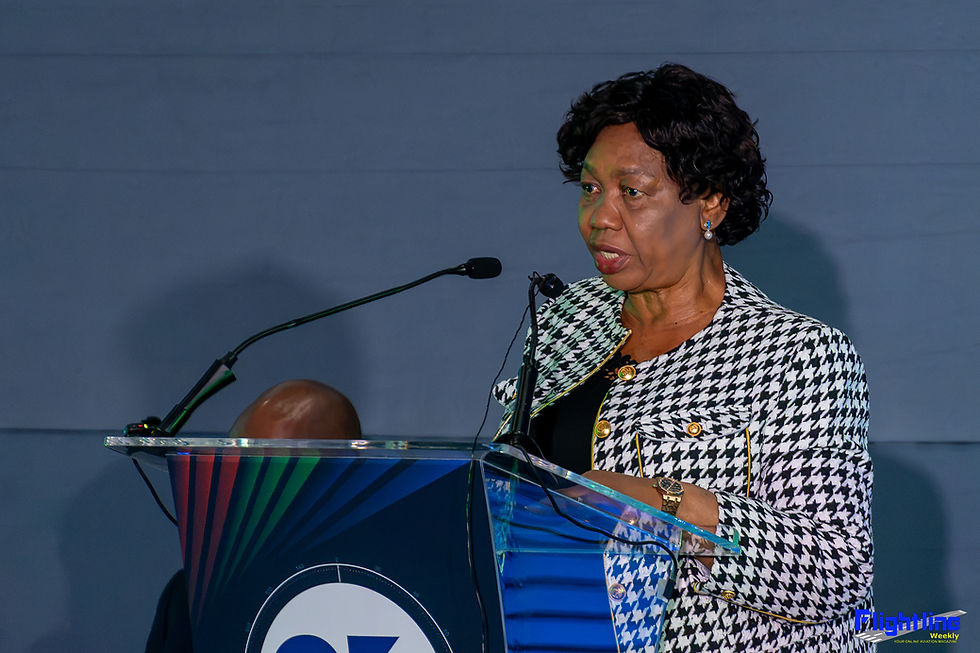
The 13th Africa Aerospace and Defence Exhibition opened at Air Force Base Waterkloof on 16 September with all the familiar ingredients: sovereignty, localisation, industrialisation, innovation, skills development, job creation, exports, international competitiveness and, naturally, a roadmap.
The Minister linked AAD 2026 directly to the outcomes of the Defence Industry Lekgotla held in July, presenting the exhibition as the "living embodiment" of those resolutions. It is an impressive description. Now all that remains is for the living embodiment to start producing. The July Defence Industry Lekgotla identified five broad priorities: building sovereign capability, making South Africa globally competitive, developing skills and creating jobs, making it easier to do business, and increasing exports. On paper, it is difficult to argue with any of them.

South Africa should undoubtedly aim to design, produce, and maintain essential defence technologies. The country should desire a competitive defence sector and seek to retain engineers, scientists, and artisans by engaging them in high-tech programs, rather than losing them to opportunities abroad. Additionally, it would be beneficial if exporting South African defence technology were simplified. However, these aspirations are not novel.
South Africa has been discussing localisation, sovereign capability, defence industrialisation and export growth for years. The industry has produced strategies, policies, frameworks, plans and roadmaps with impressive regularity. What it has produced rather less regularly is the one thing that ultimately matters in manufacturing: Orders.

The Minister also highlighted the President's recent visit to Denel, who was actually supposed to deliver the opening speech but delivered a sick note instead. She described the company as a cornerstone of South Africa's defence industrial base, pointing to its legacy of engineering excellence and innovation. Again, there is little argument about the legacy.
South Africa has demonstrated that it can develop sophisticated defence technology. The country's engineers have produced aircraft, helicopters, missiles, artillery, armoured vehicles, electronic warfare systems and unmanned platforms that have attracted international attention.
The Rooivalk remains perhaps the most obvious example. It was an extraordinarily capable machine, but its international customer list was somewhat shorter than the list of people who admired it. That illustrates the difference between building something impressive and building something commercially sustainable.

The former requires engineering. The latter requires engineering, money, production capacity, customers, political support, financing, supply chains and the ability to deliver the product before the customer loses interest. Preferably without requiring another roadmap.
There is an understandable attraction to the idea of sovereign defence capability. If a country can design, build, maintain and upgrade its own critical military equipment, it is less exposed to foreign supply restrictions and geopolitical shifts. But sovereign capability isn't achieved simply by declaring it a strategic priority. It requires sustained investment. It requires long-term procurement commitments. It requires a defence force that actually has the budget to buy what the domestic industry develops. And it requires industry to know that today's investment will still have a customer tomorrow.
You cannot maintain an aerospace manufacturing ecosystem by producing one prototype every decade and unveiling a new concept every AAD. At some point, somebody has to sign the purchase order.
The Minister also made the entirely reasonable argument that aerospace and defence technologies can have benefits far beyond the military. Drones can support agriculture and environmental monitoring. Satellite technology has civilian applications. Advanced manufacturing creates skills that can migrate into other industries. Cyber technologies have obvious commercial uses. This is all true. The aerospace and defence sector can absolutely contribute to industrial development.
There is a risk in viewing every defence exhibition as an industrialisation marvel just because a variety of intriguing machines are displayed in hangars and on the grass. A prototype does not equate to a production line, a production line does not guarantee a sustainable business, and a memorandum of understanding is not the same as an order. AAD has witnessed many instances of all three throughout the years.

Perhaps the most interesting commitment in the Minister's speech was the promise to modernise regulatory frameworks and reduce inefficiencies. The Industry has been asking for precisely that for years.
In the aerospace and defence industry, decisions made at the start of the week don't lead to product deliveries by the end of the week. Development programs can span several years, as can the certification process. Building production capabilities requires both time and significant capital investment. Consequently, investors most often value certainty.

If the regulatory landscape shifts midway through a program, procurement processes become erratic, or export approvals turn unnecessarily challenging, both companies and investors take note. To foster a globally competitive defence industry, minimising unnecessary bureaucracy could be far more effective than producing another polished industrial strategy document. It is not particularly exciting; no spectacular flying display will accompany it, but it might actually work.
The Minister's call for greater export competitiveness is particularly relevant. South Africa has the technical ability to develop products for the international market. What has historically been more difficult is converting that capability into sustained export programmes. International defence markets are brutally competitive.
Countries are not just purchasing hardware; they are acquiring logistics support, training, financing, political alliances, technology partnerships, industrial involvement, and long-term supply security. Consequently, a South African company isn't merely competing with another manufacturer; it might be up against an entire government. This situation highlights the significance of consistent government backing and a reliable domestic customer, areas where the South African government has not always excelled over the years.
If South Africa wants its defence industry to export, it needs to demonstrate that its own government is prepared to support the industry at home. Otherwise, foreign customers may reasonably wonder why they should buy a product that its country of origin isn't buying itself.

Another uncomfortable truth about defence exhibitions is that they excel at making everything appear prepared; there are aircraft, drones, radar systems, missiles, and armoured vehicles. There are companies displaying renderings of things that may eventually become aircraft, drones, radars, missiles or armoured vehicles. There are also businessmen wearing lanyards and carrying bags containing enough brochures to deforest a small country. And somewhere in the middle of it all are genuine technological breakthroughs. The trick is telling them apart.
AAD is ultimately a trade show. The question therefore isn't simply "What are you displaying?" It is: "Who is buying it?"
The Minister called on the partnerships formed at AAD to produce tangible outcomes for the defence force, industry and the public. That is perhaps the most important sentence of the entire speech. Because tangible outcomes are remarkably easy to measure.
Contracts.
Orders.
Production.
Exports.
Investment.
Jobs.
Deliveries.
Systems deployed.
Engineers employed.
Those numbers don't need a podium, a brass band or a ceremonial ribbon. They simply need to exist and that is where AAD 2026 becomes interesting. If the exhibition generates genuine commercial agreements and gives South African companies access to new markets, then the show has done its job. If local technologies move from prototype to production, even better. If young engineers and technicians find sustainable careers in the industry, better still.
But if we arrive at AAD 2028 with exactly the same prototypes, exactly the same promises and yet another roadmap explaining how sovereign capability is just around the corner, the industry might be forgiven for becoming slightly cynical.
There is no question that South Africa still possesses remarkable aerospace and defence expertise. There are companies here capable of developing genuinely sophisticated technology. There are engineers and technicians with world-class skills. There is a defence industrial heritage that many countries would like to have. What South Africa has to demonstrate is that it can turn that capability into sustainable businesses and operational military capability. The Minister's challenge was therefore entirely appropriate: make the partnerships forged at AAD deliver tangible results.
So let us measure them, not by the number of handshakes, not by the number of flags, not by how many times the words "sovereign capability" appear in a speech and certainly not by the thickness of the exhibition brochure. Measure them by what happens after everyone goes home.
Because at AAD, almost anything is possible.
The real test is whether it is still possible when the exhibition closes, the aircraft leave Waterkloof, and somebody finally asks the most dangerous question in the defence industry: "Where's the purchase order?"





Comments