


AAD 2026: Africa’s New Space Race - From Customer to Competitor
By Garth Calitz

Space is no longer simply the domain of superpowers and science-fiction enthusiasts. It is becoming a strategic military and commercial environment, and Africa is being forced to decide whether it will participate or simply pay the subscription fee.
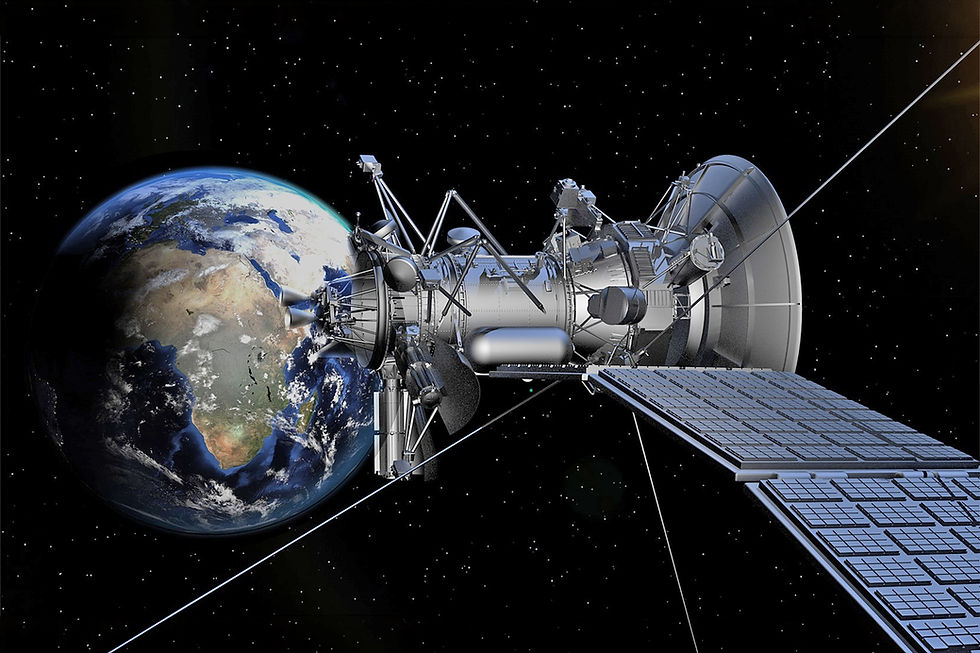
That was the focus of a panel discussion at the AAD 2026 Conference in Pretoria, titled “Space as a Strategic Domain: How Africa Can Secure, Commercialise and Compete in the New Space Race.” The session formed part of a conference programme examining the increasingly blurred boundaries between air, land, maritime, cyber and space operations.
The shift is significant. Satellites now underpin communications, navigation, intelligence, Earth observation, weather forecasting and disaster management. For defence forces, space-based capabilities are increasingly integral to command and control, surveillance and situational awareness.

In Africa, the issue extends beyond military capacity; it concerns economic independence. The continent has largely been a consumer of satellite services, but there is a rising awareness that Africa can develop its own capabilities and, crucially, commercialise them. Earth observation is perhaps the most immediate opportunity. Satellite data can support agriculture, mining, environmental monitoring, infrastructure development, disaster management and maritime security.

South Africa's SANSA already operates across these areas, providing Earth-observation data and services for resource management, food security, disaster response and national security.

SANSA's current strategic plan goes further, with plans to strengthen indigenous satellite engineering, develop Earth-observation and communications satellites and establish a South African constellation of up to 12 satellites during the 2025–2030 planning period. That represents a shift from simply buying access to space-derived information towards developing the capability to produce it.

The military implications are equally significant and can no longer be ignored. Modern forces increasingly depend on satellite communications, navigation, surveillance and intelligence. A conflict in which access to those services is disrupted could rapidly become a very different proposition.
AAD's conference programme consequently places space alongside cyber warfare, electronic warfare, autonomous systems and resilient communications as elements of the emerging multi-domain battlespace.
For African defence forces, the issue is therefore not necessarily about building enormous national space programmes.

It is about ensuring access to critical capabilities and developing enough indigenous expertise to avoid becoming completely dependent on somebody else's satellite constellation.
Africa does not necessarily need to build everything itself. The more realistic opportunity may be developing companies that turn space-derived data into commercially valuable products. Agricultural intelligence, mineral exploration, insurance, logistics, environmental monitoring, maritime surveillance and telecommunications can all generate customers for space-enabled services. The global space industry is already moving rapidly in this direction, with smaller satellites, commercial launch providers and private constellations lowering some of the barriers to entry.

Africa therefore has an opportunity to build businesses around the space economy, rather than attempting to reproduce the entire aerospace infrastructure of the United States, China or Europe.
South Africa has an established scientific and engineering base and a long history of involvement in space technology. SANSA's strategy explicitly identifies reducing dependence on foreign technology, developing local expertise and creating opportunities for domestic industry as objectives.
The challenge is turning capability into a sustainable industrial ecosystem. This is where the defence industry has faced a familiar problem: possessing impressive technology is one thing; producing it repeatedly, affordably and commercially is another.
A prototype is not an industry, a satellite launch is not a space economy and another conference presentation promising that everything will be operational “in the next few years” is not, technically speaking, infrastructure.
The emerging space race presents Africa and, in particular, South Africa with both a strategic challenge and an industrial opportunity. The continent does not have to beat America, China or Europe at their own game. It does, however, need to identify areas where African expertise, geography and market demand can create competitive advantages.

Earth observation, satellite communications, geospatial intelligence, space weather, data processing, satellite manufacturing and downstream applications are obvious areas. The objective should be to move from customer to partner — and eventually supplier.
AAD 2026's decision to put space alongside the other domains of modern warfare reflects just how quickly the strategic environment is changing.
The new space race is already underway.
The question is no longer whether Africa should join it.
The question is whether it will arrive with something to sell.





Comments